Bjordal Jan M, Johnson Mark I, Lopes-Martins Rodrigo A B, Bogen Bård, Chow Roberta, Ljunggren Anne E
Faculty of Health and Social Sciences, Institute of Physiotherapy, Bergen University College, Moellendalsvn, Bergen Norway.
BMC Musculoskelet Disord. 2007 Jun 22;8:51. doi: 10.1186/1471-2474-8-51.
Treatment efficacy of physical agents in osteoarthritis of the knee (OAK) pain has been largely unknown, and this systematic review was aimed at assessing their short-term efficacies for pain relief.
Systematic review with meta-analysis of efficacy within 1-4 weeks and at follow up at 1-12 weeks after the end of treatment.
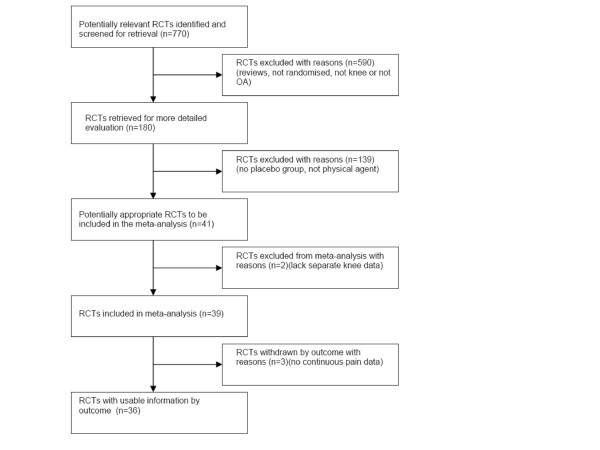
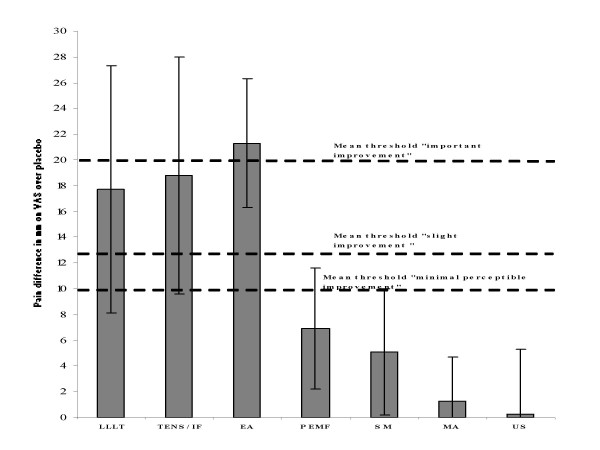
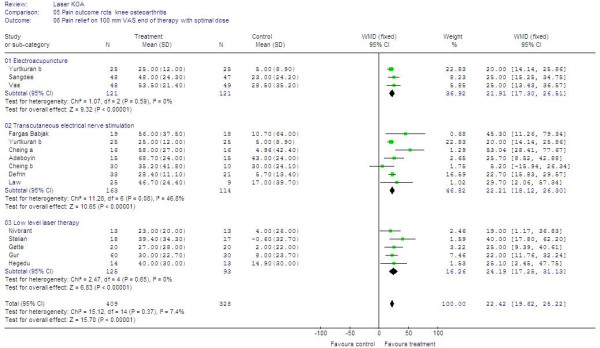
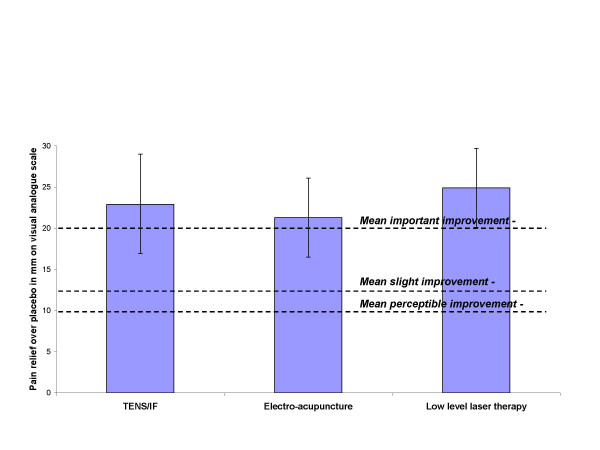
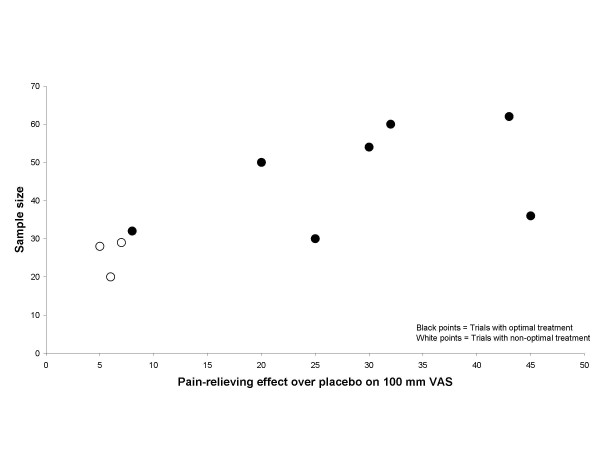
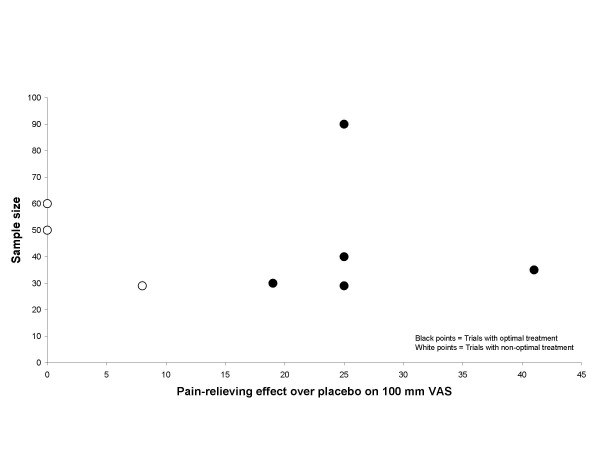
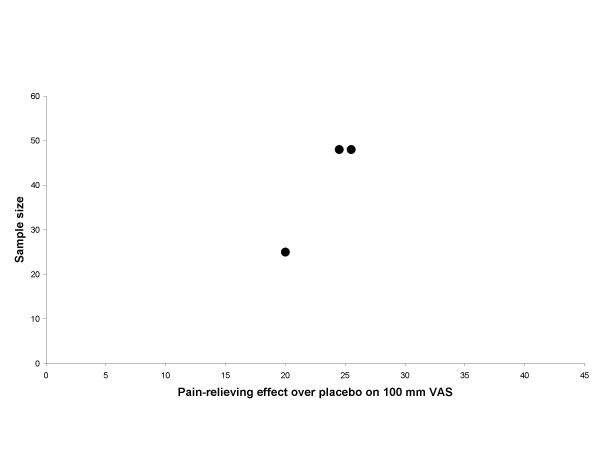
36 randomised placebo-controlled trials (RCTs) were identified with 2434 patients where 1391 patients received active treatment. 33 trials satisfied three or more out of five methodological criteria (Jadad scale). The patient sample had a mean age of 65.1 years and mean baseline pain of 62.9 mm on a 100 mm visual analogue scale (VAS). Within 4 weeks of the commencement of treatment manual acupuncture, static magnets and ultrasound therapies did not offer statistically significant short-term pain relief over placebo. Pulsed electromagnetic fields offered a small reduction in pain of 6.9 mm [95% CI: 2.2 to 11.6] (n = 487). Transcutaneous electrical nerve stimulation (TENS, including interferential currents), electro-acupuncture (EA) and low level laser therapy (LLLT) offered clinically relevant pain relieving effects of 18.8 mm [95% CI: 9.6 to 28.1] (n = 414), 21.9 mm [95% CI: 17.3 to 26.5] (n = 73) and 17.7 mm [95% CI: 8.1 to 27.3] (n = 343) on VAS respectively versus placebo control. In a subgroup analysis of trials with assumed optimal doses, short-term efficacy increased to 22.2 mm [95% CI: 18.1 to 26.3] for TENS, and 24.2 mm [95% CI: 17.3 to 31.3] for LLLT on VAS. Follow-up data up to 12 weeks were sparse, but positive effects seemed to persist for at least 4 weeks after the course of LLLT, EA and TENS treatment was stopped.
TENS, EA and LLLT administered with optimal doses in an intensive 2-4 week treatment regimen, seem to offer clinically relevant short-term pain relief for OAK.
物理治疗手段对膝关节骨关节炎(OAK)疼痛的治疗效果在很大程度上尚不明确,本系统评价旨在评估其缓解疼痛的短期疗效。
对治疗后1 - 4周及治疗结束后1 - 12周随访时的疗效进行系统评价和荟萃分析。
共纳入36项随机安慰剂对照试验(RCT),涉及2434例患者,其中1391例接受了积极治疗。33项试验满足五项方法学标准(Jadad量表)中的三项或更多。患者样本的平均年龄为65.1岁,在100毫米视觉模拟量表(VAS)上的平均基线疼痛为62.9毫米。在治疗开始后的4周内,手法针刺、静磁疗法和超声疗法与安慰剂相比,在短期疼痛缓解方面没有统计学意义。脉冲电磁场使疼痛小幅减轻6.9毫米[95%可信区间:2.2至11.6](n = 487)。经皮电刺激神经疗法(TENS,包括干扰电流)、电针(EA)和低强度激光疗法(LLLT)与安慰剂对照相比,在VAS上分别产生了具有临床意义的疼痛缓解效果,分别为18.8毫米[95%可信区间:9.6至28.1](n = 414)、21.9毫米[95%可信区间:17.3至26.5](n = 73)和17.7毫米[95%可信区间:8.1至27.3](n = 343)。在假定为最佳剂量的试验亚组分析中,TENS的短期疗效在VAS上增加到22.2毫米[95%可信区间:18.1至26.3],LLLT增加到24.2毫米[95%可信区间:17.3至31.3]。长达12周的随访数据较少,但在LLLT、EA和TENS治疗疗程停止后,积极效果似乎至少持续4周。
在2 - 4周的强化治疗方案中,以最佳剂量给予TENS、EA和LLLT,似乎能为OAK提供具有临床意义的短期疼痛缓解。