Herman Patricia M, Pitcher Mark H, Langevin Helene M
Health Care Division, RAND, Santa Monica, CA, USA.
National Center for Complementary and Integrative Health, National Institutes of Health, Bethesda, MD, USA.
Glob Adv Integr Med Health. 2024 Oct 18;13:27536130241293642. doi: 10.1177/27536130241293642. eCollection 2024 Jan-Dec.
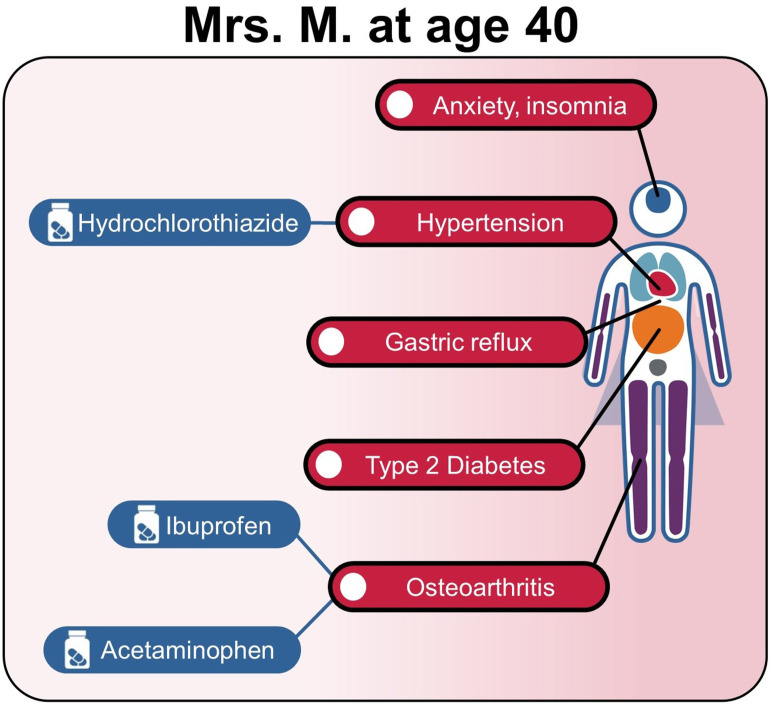
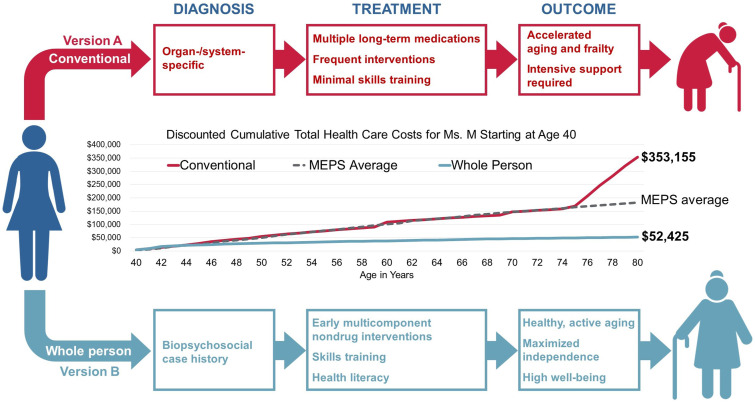
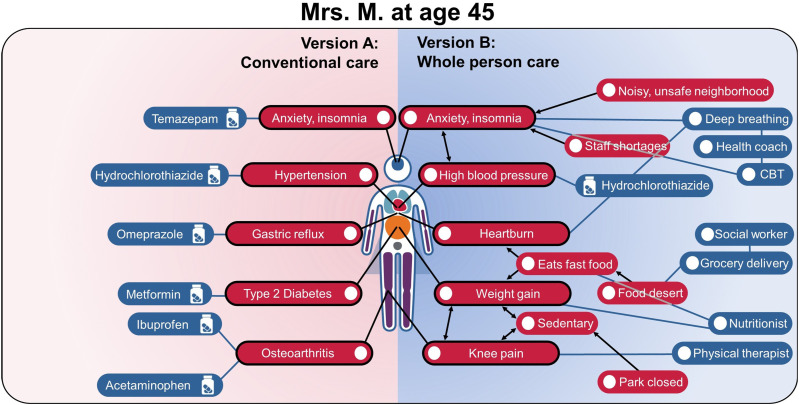
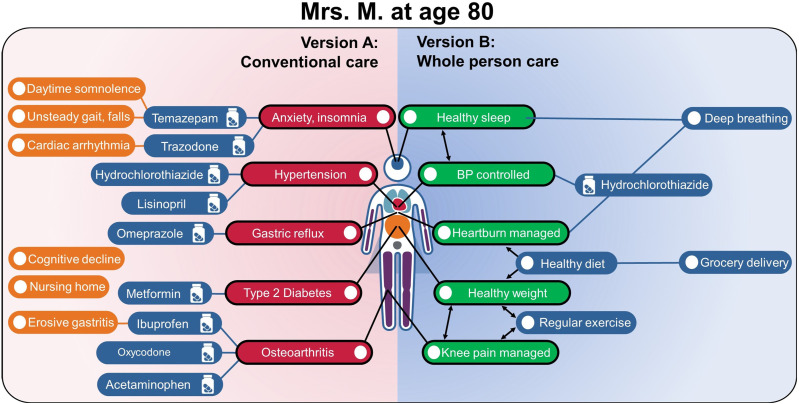
Our conventional approach to health care tends to separate patients' health by body system, treating each independently and "efficiently"-e.g., minimal time with a provider, reliance on medications, and little investment to support behavioral and lifestyle improvements. Meanwhile, the United States has the most expensive health care in the world, with some of the worse outcomes. Purpose In this paper, we make the case for transforming health care from a disease-centric approach to a "whole person" model. We provide detailed health and health care utilization assumptions for a hypothetical patient, Mrs. M, over her life from age 40 to 80 years under 2 care scenarios: the continuation of conventional care (Version A) and a whole person care approach (Version B). Analysis We developed a set of health care utilization assumptions for each scenario, applied 2023 U.S. dollar (USD) resource prices, and estimated cumulative total health care costs. The price and the health care utilization assumptions for the conventional care scenario were validated using Medical Expenditures Panel Survey (MEPS) data. At age 80, with conventional care, we find Mrs. M increasingly frail and living in a skilled nursing facility, with total cumulative health care costs of $353,155. With whole person care, we find her active and generally healthy at age 80, with total cumulative health care costs of $52,425. Although based on an "imagined" case, the 2 versions of Mrs. M's history illustrate how an investment beginning in early middle age to support a healthy diet, physical activity, and stress management can plausibly lead to improved health and well-being, as well as reduced health care spending.
我们传统的医疗保健方式倾向于按身体系统划分患者的健康状况,对每个系统进行独立且“高效”的治疗——例如,与医疗服务提供者接触的时间最短,依赖药物治疗,且很少投入资源来支持行为和生活方式的改善。与此同时,美国拥有世界上最昂贵的医疗保健体系,但其一些医疗结果却较差。目的 在本文中,我们主张将医疗保健从以疾病为中心的方法转变为“全人”模式。我们针对一位假设的患者M夫人,在她40岁至80岁的一生中,在两种护理方案下提供了详细的健康和医疗保健利用假设:传统护理的延续(版本A)和全人护理方法(版本B)。分析 我们为每种方案制定了一套医疗保健利用假设,应用2023年美元(USD)资源价格,并估计了累计总医疗保健成本。传统护理方案的价格和医疗保健利用假设使用医疗支出面板调查(MEPS)数据进行了验证。在80岁时,采用传统护理,我们发现M夫人日益虚弱,住在专业护理机构,累计总医疗保健成本为353,155美元。采用全人护理,我们发现她在80岁时活跃且总体健康,累计总医疗保健成本为52,425美元。尽管基于一个“虚构”的案例,但M夫人病史的两个版本说明了从中年早期开始投资以支持健康饮食、体育活动和压力管理如何合理地导致健康状况改善和幸福感提升,以及医疗保健支出的减少。