Vidakovic Sandra, Jans Hans S, Alexander Abe, Sloboda Ron S
Cross Cancer Institute, Department of Medical Physics, Edmonton, Alberta, Canada.
J Appl Clin Med Phys. 2006 Jul 5;8(1):21-32. doi: 10.1120/jacmp.v8i1.2351.
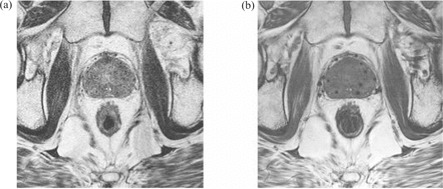
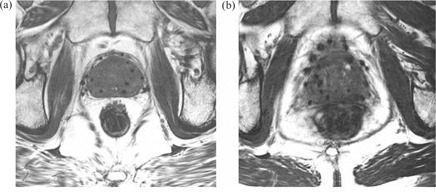
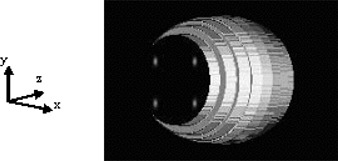
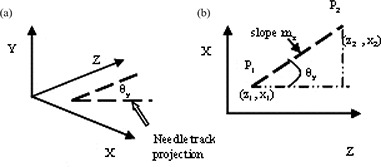
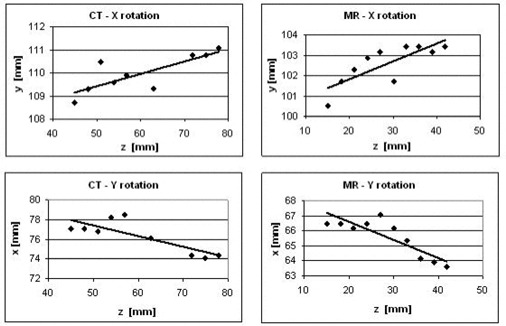
Post-implant dosimetry for permanent prostate brachytherapy is typically performed using computed tomography (CT) images, for which the clear visualization of soft tissue structures is problematic. Registration of CT and magnetic resonance (MR) image volumes can improve the definition of all structures of interest (soft tissues, bones, and seeds) in the joint image set. In the present paper, we describe a novel two-stage rigid-body registration algorithm that consists of (1) parallelization of straight lines fit to image features running primarily in the superior-inferior (Z) direction, followed by (2) normalized mutual information registration. The first stage serves to fix rotation angles about the anterior-posterior (Y) and left-right (X) directions, and the second stage determines the remaining Z-axis rotation angle and the X, Y, Z translation values. The new algorithm was applied to CT and 1.5T MR (T2-weighted and balanced fast-field echo sequences) axial image sets for three patients acquired four weeks after prostate brachytherapy using 125I seeds. Image features used for the stage 1 parallelization were seed trains in CT and needle tracks and seed voids in MR. Simulated datasets were also created to further investigate algorithm performance. Clinical image volumes were successfully registered using the two-stage approach to within a root-mean-squares (RMS) distance of <1.5 mm, provided that some pubic bone and anterior rectum were included in the registration volume of interest and that no motion artifact was apparent. This level of accuracy is comparable to that obtained for the same clinical datasets using the Procrustes algorithm. Unlike Procrustes, the new algorithm can be almost fully automated, and hence we conclude that its further development for application in post-implant dosimetry is warranted.
永久性前列腺近距离放射治疗植入后的剂量测定通常使用计算机断层扫描(CT)图像进行,而在这些图像中软组织结构的清晰可视化存在问题。CT图像体积与磁共振(MR)图像体积的配准可以改善联合图像集中所有感兴趣结构(软组织、骨骼和籽源)的清晰度。在本文中,我们描述了一种新颖的两阶段刚体配准算法,该算法包括:(1)对主要沿上下(Z)方向运行的图像特征拟合直线进行并行化处理,随后进行(2)归一化互信息配准。第一阶段用于确定围绕前后(Y)和左右(X)方向的旋转角度,第二阶段确定剩余的Z轴旋转角度以及X、Y、Z平移值。该新算法应用于三位患者在前列腺近距离放射治疗使用¹²⁵I籽源四周后获取的CT和1.5T MR(T2加权和平衡快速场回波序列)轴向图像集。用于第一阶段并行化处理的图像特征在CT中为籽源链,在MR中为针道和籽源空洞。还创建了模拟数据集以进一步研究算法性能。使用两阶段方法成功地将临床图像体积配准到均方根(RMS)距离<1.5毫米以内,前提是感兴趣的配准体积中包含一些耻骨和直肠前部且无明显运动伪影。这种精度水平与使用普罗克汝斯算法对相同临床数据集所获得的精度相当。与普罗克汝斯算法不同,新算法几乎可以完全自动化,因此我们得出结论,有必要对其进行进一步开发以应用于植入后剂量测定。