Aalborg University.
J Appl Clin Med Phys. 2016 May 8;17(3):294-303. doi: 10.1120/jacmp.v17i3.6088.
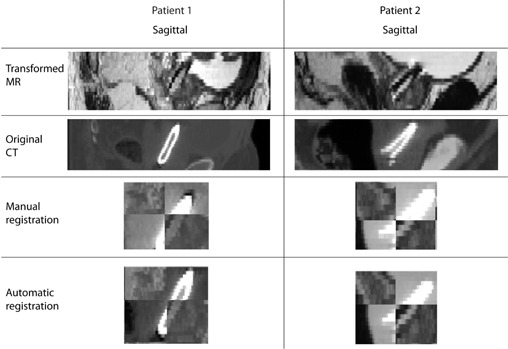
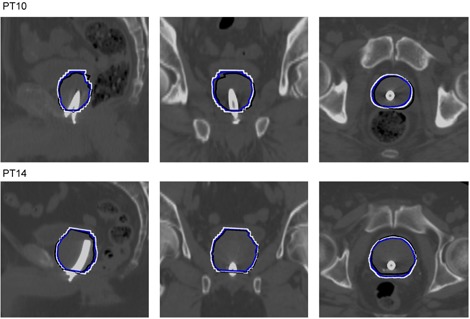
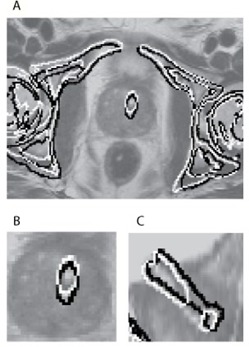
In image-guided radiotherapy (IGRT) of prostate cancer, delineation of the clini-cal target volume (CTV) often relies on magnetic resonance (MR) because of its good soft-tissue visualization. Registration of MR and computed tomography (CT) is required in order to add this accurate delineation to the dose planning CT. An automatic approach for local MR-CT registration of the prostate has previously been developed using a voxel property-based registration as an alternative to a manual landmark-based registration. The aim of this study is to compare the two registration approaches and to investigate the clinical potential for replacing the manual registration with the automatic registration. Registrations and analysis were performed for 30 prostate cancer patients treated with IGRT using a Ni-Ti prostate stent as a fiducial marker. The comparison included computing translational and rotational differences between the approaches, visual inspection, and computing the overlap of the CTV. The computed mean translational difference was 1.65, 1.60, and 1.80mm and the computed mean rotational difference was 1.51°, 3.93°, and 2.09° in the superior/inferior, anterior/posterior, and medial/lateral direction, respectively. The sensitivity of overlap was 87%. The results demonstrate that the automatic registration approach performs registrations comparable to the manual registration.
在前列腺癌的图像引导放疗(IGRT)中,由于磁共振(MR)具有良好的软组织可视化效果,因此临床靶区(CTV)的勾画通常依赖于磁共振。为了将这种精确的勾画添加到剂量规划 CT 中,需要对 MR 和计算机断层扫描(CT)进行配准。先前已经开发了一种基于体素属性的自动方法,用于对前列腺进行局部 MR-CT 配准,作为手动基于标志点的配准的替代方法。本研究的目的是比较这两种配准方法,并研究用自动配准代替手动配准的临床潜力。使用 Ni-Ti 前列腺支架作为基准标记,对 30 名接受 IGRT 治疗的前列腺癌患者进行了配准和分析。比较包括计算两种方法之间的平移和旋转差异、视觉检查和 CTV 重叠计算。在上下、前后和内外方向上,计算的平均平移差异分别为 1.65、1.60 和 1.80mm,计算的平均旋转差异分别为 1.51°、3.93°和 2.09°。重叠的灵敏度为 87%。结果表明,自动配准方法可以进行与手动配准相当的配准。