Psychiatry Department, University of Texas Southwestern Medical Center, Dallas, Texas, United States of America.
PLoS One. 2007 Jun 27;2(6):e573. doi: 10.1371/journal.pone.0000573.
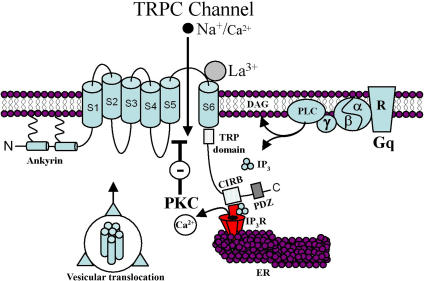
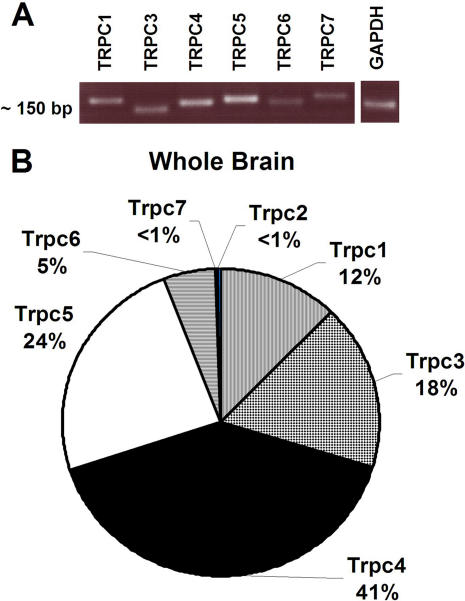
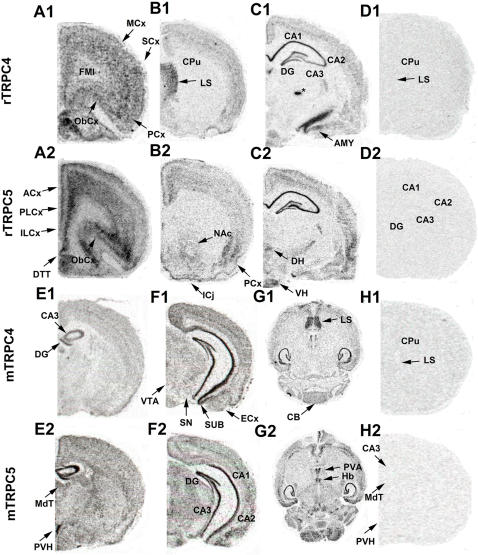
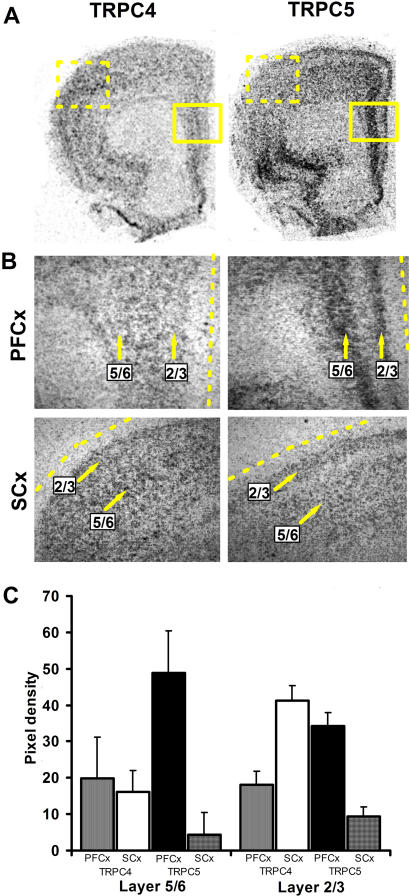
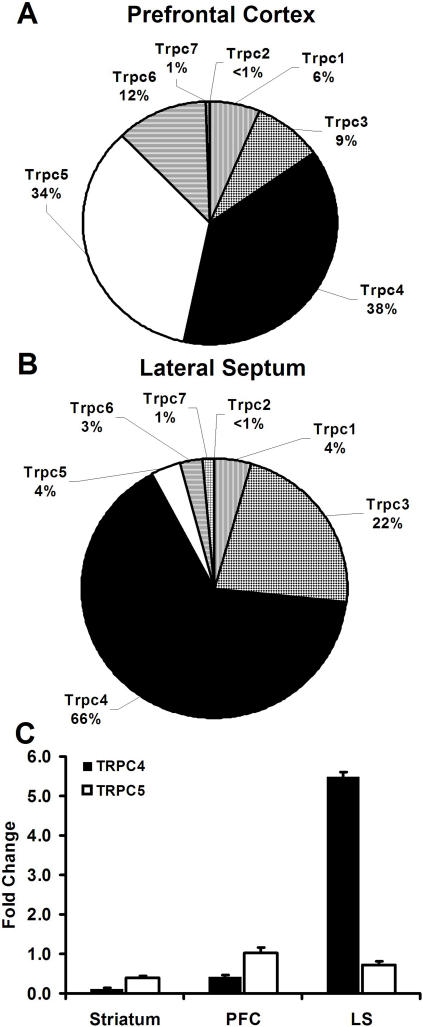
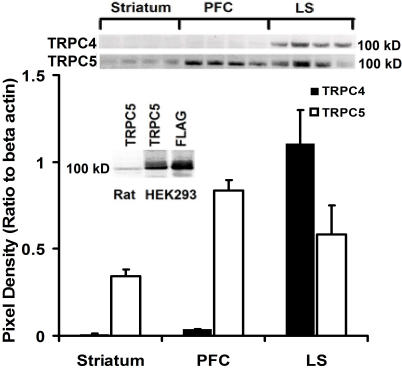
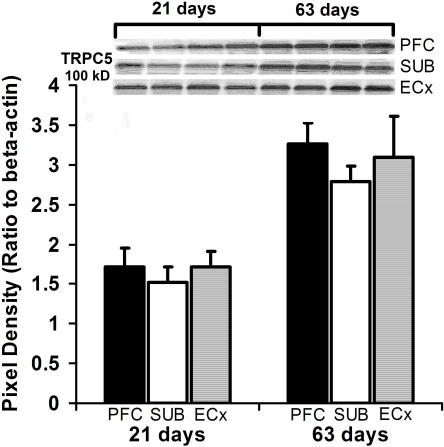
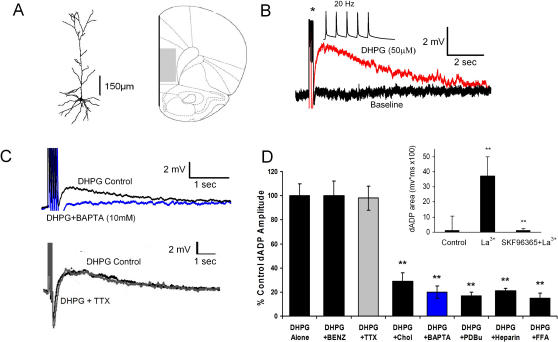
The canonical transient receptor potential (TRPC) channels are a family of non-selective cation channels that are activated by increases in intracellular Ca(2+) and G(q)/phospholipase C-coupled receptors. We used quantitative real-time PCR, in situ hybridization, immunoblots and patch-clamp recording from several brain regions to examine the expression of the predominant TRPC channels in the rodent brain. Quantitative real-time PCR of the seven TRPC channels in the rodent brain revealed that TRPC4 and TRPC5 channels were the predominant TRPC subtypes in the adult rat brain. In situ hybridization histochemistry and immunoblotting further resolved a dense corticolimbic expression of the TRPC4 and TRPC5 channels. Total protein expression of HIP TRPC4 and 5 proteins increased throughout development and peaked late in adulthood (6-9 weeks). In adults, TRPC4 expression was high throughout the frontal cortex, lateral septum (LS), pyramidal cell layer of the hippocampus (HIP), dentate gyrus (DG), and ventral subiculum (vSUB). TRPC5 was highly expressed in the frontal cortex, pyramidal cell layer of the HIP, DG, and hypothalamus. Detailed examination of frontal cortical layer mRNA expression indicated TRPC4 mRNA is distributed throughout layers 2-6 of the prefrontal cortex (PFC), motor cortex (MCx), and somatosensory cortex (SCx). TRPC5 mRNA expression was concentrated specifically in the deep layers 5/6 and superficial layers 2/3 of the PFC and anterior cingulate. Patch-clamp recording indicated a strong metabotropic glutamate-activated cation current-mediated depolarization that was dependent on intracellular Ca(2+)and inhibited by protein kinase C in brain regions associated with dense TRPC4 or 5 expression and absent in regions lacking TRPC4 and 5 expression. Overall, the dense corticolimbic expression pattern suggests that these Gq/PLC coupled nonselective cation channels may be involved in learning, memory, and goal-directed behaviors.
经典的瞬时受体电位 (TRPC) 通道是一组非选择性阳离子通道,其被细胞内 Ca(2+) 和 G(q)/磷脂酶 C 偶联受体的增加激活。我们使用定量实时 PCR、原位杂交、免疫印迹和来自几个脑区的膜片钳记录来检查啮齿动物脑中主要 TRPC 通道的表达。定量实时 PCR 显示,TRPC4 和 TRPC5 通道是成年大鼠脑中主要的 TRPC 亚型。原位杂交组织化学和免疫印迹进一步解析了 TRPC4 和 TRPC5 通道在皮质边缘的密集表达。HIP TRPC4 和 5 蛋白的总蛋白表达在整个发育过程中增加,并在成年后期(6-9 周)达到高峰。在成年期,TRPC4 表达在整个前额皮质、外侧隔核 (LS)、海马锥体细胞层 (HIP)、齿状回 (DG) 和腹侧下丘 (vSUB) 中均较高。TRPC5 在前额皮质、HIP 的锥体细胞层、DG 和下丘脑中有较高表达。对前额皮质层 mRNA 表达的详细检查表明,TRPC4 mRNA 分布在额皮质前皮质 (PFC)、运动皮质 (MCx) 和躯体感觉皮质 (SCx) 的 2-6 层。TRPC5 mRNA 表达特异性集中在 PFC 的深层 5/6 和浅层 2/3 以及前扣带。膜片钳记录表明,一种强烈的代谢型谷氨酸能激活的阳离子电流介导的去极化,依赖于细胞内 Ca(2+),并被蛋白激酶 C 抑制,这在与密集的 TRPC4 或 5 表达相关的脑区存在,而在缺乏 TRPC4 和 5 表达的脑区不存在。总的来说,密集的皮质边缘表达模式表明这些 Gq/PLC 偶联的非选择性阳离子通道可能参与学习、记忆和目标导向行为。