Wilson Shona, Booth Mark, Jones Frances M, Mwatha Joseph K, Kimani Gachuhi, Kariuki H Curtis, Vennervald Birgitte J, Ouma John H, Muchiri Eric, Dunne David W
Department of Pathology, University of Cambridge, Cambridge, UK.
BMC Infect Dis. 2007 Jun 29;7:67. doi: 10.1186/1471-2334-7-67.
Amongst school-aged children living in malaria endemic areas, chronic morbidity and exacerbation of morbidity associated with other infections are often not coincident with the presence or levels of Plasmodium parasitaemia, but may result from long-term exposure to the parasite. Studies of hepatosplenomegaly associated with Schistosoma mansoni infection and exposure to Plasmodium infection indicate that differences that occur over 1-2 km in levels of Plasmodium transmission are related to the degree of exacerbation of hepatosplenomegaly and that Plasmodium falciparum schizont antigen (Pfs)-IgG3 levels may be a marker for the differing levels of exposure.
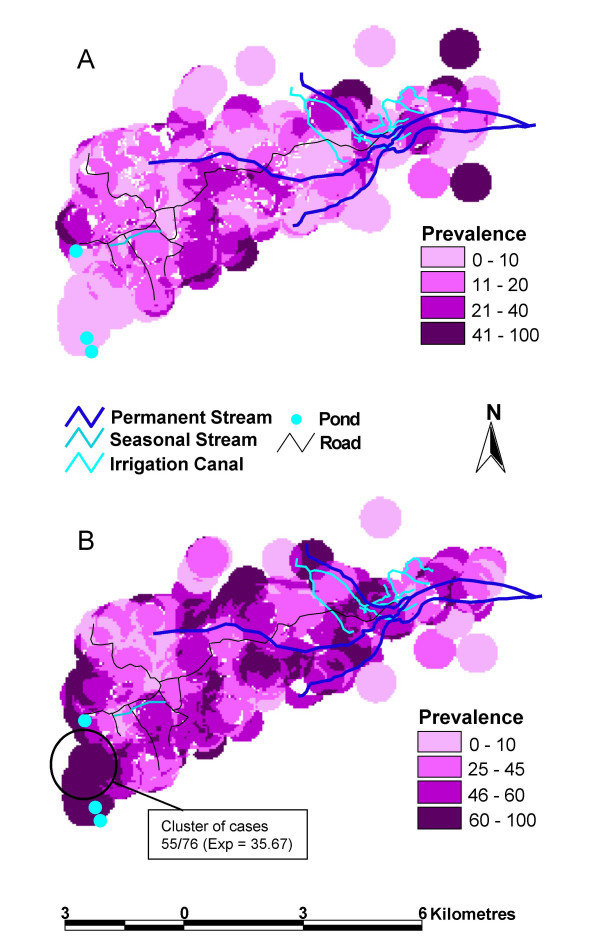
To investigate the validity of Pfs-IgG3 measurements as a tool to assess these comparative exposure levels on a microgeographical scale, cross-sectional community surveys were conducted over a 10 x 6 km study site in Makueni District, Kenya, during low and high malaria transmission seasons. During both high and low malaria transmission seasons, thick blood smears were examined microscopically and circulating Pfs-IgG3 levels measured from dried blood spot elute. GIS techniques were used to map prevalence of parasitaemia and Pfs-IgG3 levels.
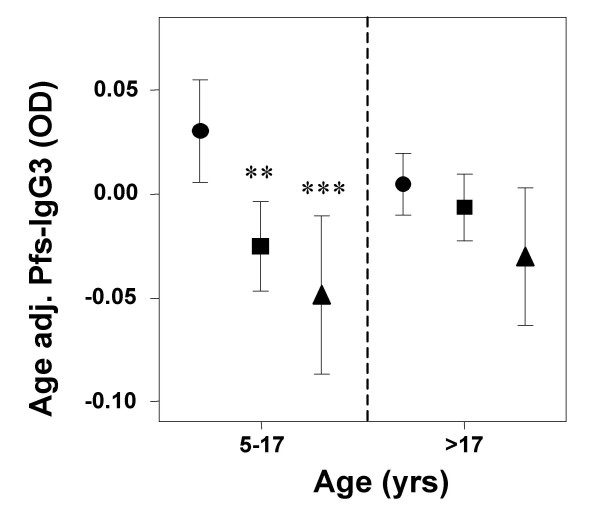
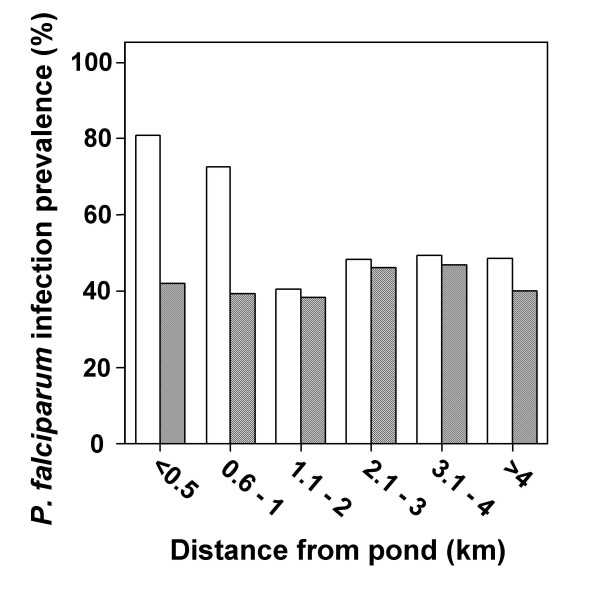
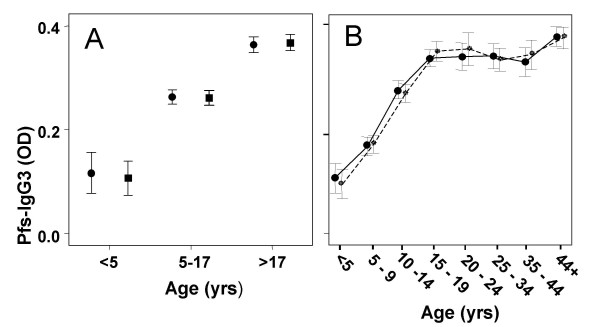
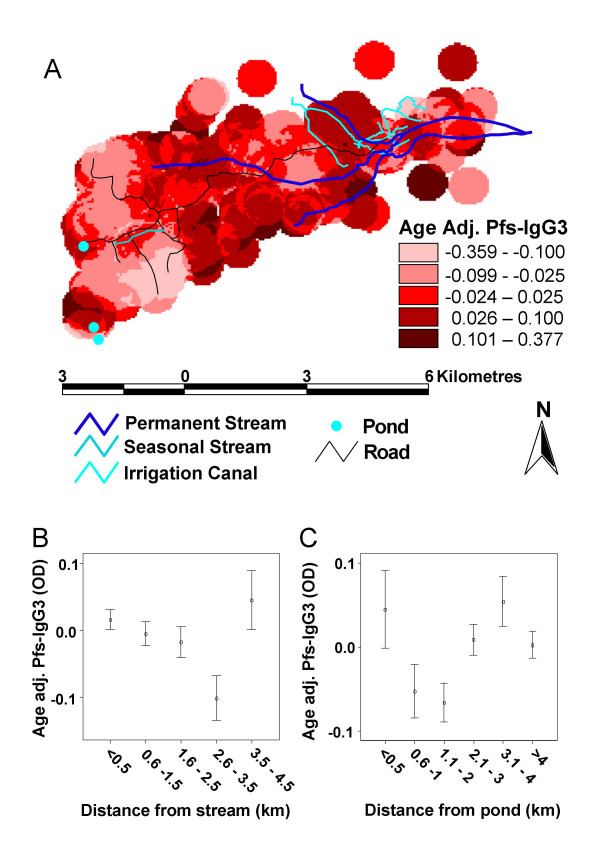
Microgeographical variations in prevalence of parasitaemia were observed during the high but not the low transmission season. Pfs-IgG3 levels were stable between high and low transmission seasons, but increased with age throughout childhood before reaching a plateau in adults. Adjusting Pfs-IgG3 levels of school-aged children for age prior to mapping resulted in spatial patterns that reflected the microgeographical variations observed for high season prevalence of parasitaemia, however, Pfs-IgG3 levels of adults did not. The distances over which age-adjusted Pfs-IgG3 of school-aged children fluctuated were comparable with those distances over which chronic morbidity has previous been shown to vary.
Age-adjusted Pfs-IgG3 levels of school-aged children are stable and when mapped can provide a tool sensitive enough to detect microgeographical variations in malaria exposure, that would be useful for studying the aetiology of morbidities associated with long-term exposure and co-infections.
在生活于疟疾流行地区的学龄儿童中,慢性发病率以及与其他感染相关的发病率加剧情况,往往与疟原虫血症的存在或水平并不一致,而是可能源于长期接触该寄生虫。对与曼氏血吸虫感染及疟原虫感染接触相关的肝脾肿大的研究表明,在1 - 2公里范围内疟原虫传播水平的差异与肝脾肿大加剧程度有关,并且恶性疟原虫裂殖体抗原(Pfs)-IgG3水平可能是不同接触水平的一个标志物。
为了调查Pfs-IgG3测量作为一种在微观地理尺度上评估这些比较接触水平的工具的有效性,在肯尼亚马库埃尼区一个10×6公里的研究地点,于疟疾传播的低季和高季进行了横断面社区调查。在疟疾传播的高季和低季期间,对厚血涂片进行显微镜检查,并从干血斑洗脱液中测量循环Pfs-IgG3水平。利用地理信息系统(GIS)技术绘制疟原虫血症患病率和Pfs-IgG3水平图。
在疟疾传播高季观察到了疟原虫血症患病率的微观地理差异,但在低季未观察到。Pfs-IgG3水平在高季和低季之间保持稳定,但在整个儿童期随年龄增长而升高,在成年人中达到平稳状态。在绘制地图之前对学龄儿童的Pfs-IgG3水平进行年龄校正,得到的空间模式反映了在高季疟原虫血症患病率中观察到的微观地理差异,然而,成年人的Pfs-IgG3水平则不然。学龄儿童经年龄校正后的Pfs-IgG3波动的距离与之前显示慢性发病率有所不同的距离相当。
学龄儿童经年龄校正后的Pfs-IgG3水平是稳定的,绘制地图时可提供一种足够敏感的工具,以检测疟疾接触的微观地理差异,这将有助于研究与长期接触和合并感染相关的发病病因。