Selby C P, Witkin E M, Sancar A
Department of Biochemistry and Biophysics, University of North Carolina School of Medicine, Chapel Hill 27599.
Proc Natl Acad Sci U S A. 1991 Dec 15;88(24):11574-8. doi: 10.1073/pnas.88.24.11574.
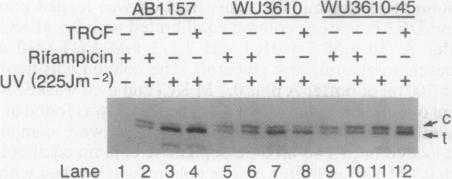
Mutation frequency decline (MFD) is the rapid decrease in the frequency of certain induced nonsense suppressor mutations occurring when protein synthesis is transiently inhibited immediately after irradiation. MFD is abolished by mutations in the uvrA, -B, or -C genes, which prevent excision repair, or by a mfd mutation, which reduces the rate of excision but does not affect survival. Using an in vitro repair synthesis assay we found that although wild-type cells repair the transcribed (template) strand preferentially, mfd- cells are incapable of strand-specific repair. The deficiency in strand-selective repair of mfd- cell extract was corrected by adding highly purified "transcription-repair coupling factor" to the reaction mixture. We conclude that mfd is, most likely, the gene encoding the transcription-repair coupling factor.
突变频率下降(MFD)是指在辐射后立即短暂抑制蛋白质合成时,某些诱导性无义抑制突变的频率迅速降低。uvrA、-B或-C基因发生突变会消除MFD,这些突变会阻止切除修复;而mfd突变也会消除MFD,该突变会降低切除速率但不影响存活率。使用体外修复合成试验,我们发现尽管野生型细胞优先修复转录(模板)链,但mfd-细胞无法进行链特异性修复。通过向反应混合物中添加高度纯化的“转录-修复偶联因子”,纠正了mfd-细胞提取物在链选择性修复方面的缺陷。我们得出结论,mfd很可能是编码转录-修复偶联因子的基因。