Wiehe Juliane M, Ponsaerts Peter, Rojewski Markus T, Homann Joerg M, Greiner Jochen, Kronawitter Desiree, Schrezenmeier Hubert, Hombach Vinzenz, Wiesneth Markus, Zimmermann Oliver, Torzewski Jan
Department of Internal Medicine II, University of Ulm, Ulm, Germany.
J Cell Mol Med. 2007 May-Jun;11(3):521-30. doi: 10.1111/j.1582-4934.2007.00038.x.
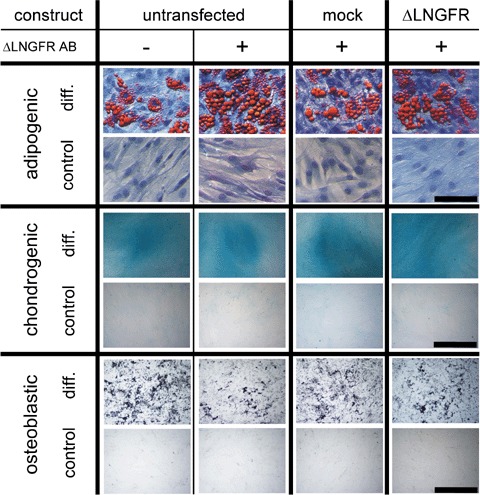
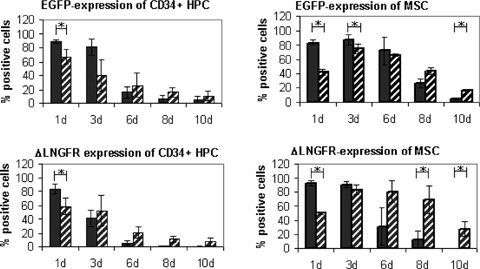
Gene transfer into human CD34+ haematopoietic progenitor cells (HPC) and multi-potent mesenchymal stromal cells (MSC) is an essential tool for numerous in vitro and in vivo applications including therapeutic strategies, such as tissue engineering and gene therapy. Virus based methods may be efficient, but bear risks like tumorigenesis and activation of immune responses. A safer alternative is non-viral gene transfer, which is considered to be less efficient and accomplished with high cell toxicity. The truncated low affinity nerve growth factor receptor (ALNGFR) is a marker gene approved for human in vivo application. Human CD34+ HPC and human MSC were transfected with in vitro-transcribed mRNA for DeltaLNGFR using the method of nucleofection. Transfection efficiency and cell viability were compared to plasmid-based nucleofection. Protein expression was assessed using flow cytometry over a time period of 10 days. Nucleofection of CD34+ HPC and MSC with mRNA resulted in significantly higher transfection efficiencies compared to plasmid transfection. Cell differentiation assays were performed after selecting DeltaLNGFR positive cells using a fluorescent activating cell sorter. Neither cell differentiation of MSC into chondrocytes, adipocytes and osteoblasts, nor differentiation of HPC into burst forming unit erythroid (BFU-E) colony forming unit-granulocyte, erythrocyte, macrophage and megakaryocyte (CFU-GEMM), and CFU-granulocyte-macrophage (GM) was reduced. mRNA based nucleofection is a powerful, highly efficient and non-toxic approach for transient labelling of human progenitor cells or, via transfection of selective proteins, for transient manipulation of stem cell function. It may be useful to transiently manipulate stem cell characteristics and thus combine principles of gene therapy and tissue engineering.
将基因导入人CD34+造血祖细胞(HPC)和多能间充质基质细胞(MSC)是众多体外和体内应用的重要工具,包括组织工程和基因治疗等治疗策略。基于病毒的方法可能有效,但存在致瘤和激活免疫反应等风险。一种更安全的替代方法是非病毒基因转移,但其效率较低且细胞毒性较高。截短的低亲和力神经生长因子受体(ΔLNGFR)是一种被批准用于人体体内应用的标记基因。使用核转染方法将体外转录的DeltaLNGFR mRNA转染到人CD34+HPC和人MSC中。将转染效率和细胞活力与基于质粒的核转染进行比较。在10天的时间段内使用流式细胞术评估蛋白质表达。与质粒转染相比,用mRNA对CD34+HPC和MSC进行核转染可显著提高转染效率。使用荧光激活细胞分选仪选择DeltaLNGFR阳性细胞后进行细胞分化测定。MSC向软骨细胞、脂肪细胞和成骨细胞的分化,以及HPC向红系爆式集落形成单位(BFU-E)、粒-红-巨噬-巨核细胞集落形成单位(CFU-GEMM)和粒-巨噬细胞集落形成单位(CFU-GM)的分化均未降低。基于mRNA的核转染是一种强大、高效且无毒的方法,可用于对人祖细胞进行瞬时标记,或通过转染选择性蛋白质对干细胞功能进行瞬时操作。它可能有助于瞬时操纵干细胞特性,从而将基因治疗和组织工程的原理结合起来。