Ouwens D M, Diamant M, Fodor M, Habets D D J, Pelsers M M A L, El Hasnaoui M, Dang Z C, van den Brom C E, Vlasblom R, Rietdijk A, Boer C, Coort S L M, Glatz J F C, Luiken J J F P
Department of Molecular Cell Biology, Section of Signal Transduction and Ageing, Leiden University Medical Centre, Postzone S1-P, P.O. Box 9600, NL-2300, RC Leiden, The Netherlands.
Department of Endocrinology, Diabetes Centre, VU University Medical Centre, Amsterdam, the Netherlands.
Diabetologia. 2007 Sep;50(9):1938-1948. doi: 10.1007/s00125-007-0735-8. Epub 2007 Jul 18.
AIMS/HYPOTHESIS: Changes in cardiac substrate utilisation leading to altered energy metabolism may underlie the development of diabetic cardiomyopathy. We studied cardiomyocyte substrate uptake and utilisation and the role of the fatty acid translocase CD36 in relation to in vivo cardiac function in rats fed a high-fat diet (HFD).
Rats were exposed to an HFD or a low-fat diet (LFD). In vivo cardiac function was monitored by echocardiography. Substrate uptake and utilisation were determined in isolated cardiomyocytes.
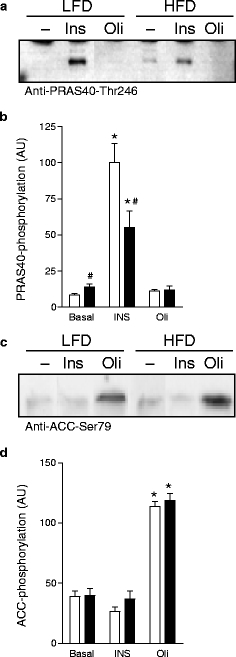
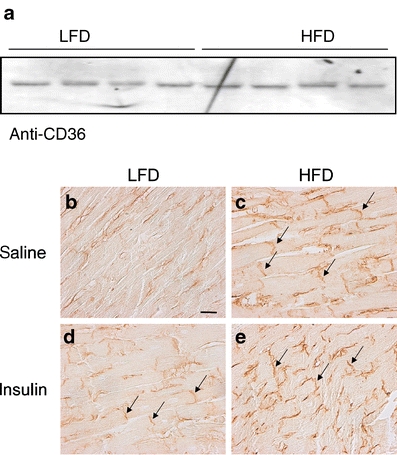
Feeding an HFD for 8 weeks induced left ventricular dilation in the systolic phase and decreased fractional shortening and the ejection fraction. Insulin-stimulated glucose uptake and proline-rich Akt substrate 40 phosphorylation were 41% (p < 0.001) and 45% (p < 0.05) lower, respectively, in cardiomyocytes from rats on the HFD. However, long-chain fatty acid (LCFA) uptake was 1.4-fold increased (p < 0.001) and LCFA esterification into triacylglycerols and phospholipids was increased 1.4- and 1.5-fold, respectively (both p < 0.05), in cardiomyocytes from HFD compared with LFD hearts. In the presence of the CD36 inhibitor sulfo-N-succinimidyloleate, LCFA uptake and esterification were similar in LFD and HFD cardiomyocytes. In HFD hearts CD36 was relocated to the sarcolemma, and basal phosphorylation of a mediator of CD36-trafficking, i.e. protein kinase B (PKB/Akt), was increased.
CONCLUSIONS/INTERPRETATION: Feeding rats an HFD induced cardiac contractile dysfunction, which was accompanied by the relocation of CD36 to the sarcolemma, and elevated basal levels of phosphorylated PKB/Akt. The permanent presence of CD36 at the sarcolemma resulted in enhanced rates of LCFA uptake and myocardial triacylglycerol accumulation, and may contribute to the development of insulin resistance and diabetic cardiomyopathy.
目的/假设:导致能量代谢改变的心脏底物利用变化可能是糖尿病性心肌病发生的基础。我们研究了高脂饮食(HFD)喂养大鼠的心肌细胞底物摄取和利用情况,以及脂肪酸转运蛋白CD36在体内心脏功能方面的作用。
将大鼠分为高脂饮食组或低脂饮食(LFD)组。通过超声心动图监测体内心脏功能。在分离的心肌细胞中测定底物摄取和利用情况。
高脂饮食喂养8周导致大鼠左心室在收缩期扩张,缩短分数和射血分数降低。高脂饮食组大鼠心肌细胞中,胰岛素刺激的葡萄糖摄取和富含脯氨酸的Akt底物40磷酸化分别降低了41%(p<0.001)和45%(p<0.05)。然而,与低脂饮食组心脏相比,高脂饮食组大鼠心肌细胞中长链脂肪酸(LCFA)摄取增加了1.4倍(p<0.001),LCFA酯化生成三酰甘油和磷脂分别增加了1.4倍和1.5倍(均p<0.05)。在存在CD36抑制剂磺基-N-琥珀酰亚胺油酸酯的情况下,低脂饮食组和高脂饮食组心肌细胞中LCFA摄取和酯化情况相似。在高脂饮食组心脏中,CD36重新定位于肌膜,并且CD36转运介质即蛋白激酶B(PKB/Akt)的基础磷酸化增加。
结论/解读:给大鼠喂食高脂饮食可诱导心脏收缩功能障碍,同时伴有CD36重新定位于肌膜以及磷酸化PKB/Akt基础水平升高。CD36在肌膜的持续存在导致LCFA摄取率增加和心肌三酰甘油积累,并可能有助于胰岛素抵抗和糖尿病性心肌病的发展。