Xie Mian, Li Xiang, Han Jing, Vogt Daniel L, Wittemann Silke, Mark Melanie D, Herlitze Stefan
Department of Neurosciences, Case Western Reserve University, Cleveland, OH 44106, USA.
J Cell Biol. 2007 Jul 30;178(3):489-502. doi: 10.1083/jcb.200702072.
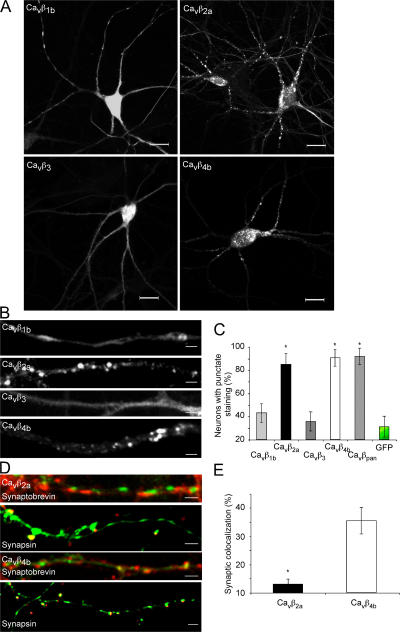
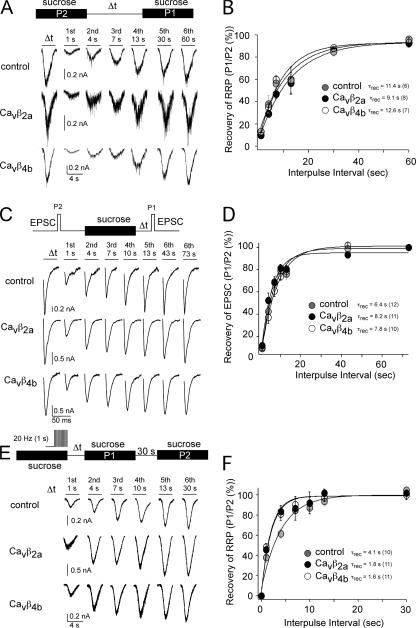
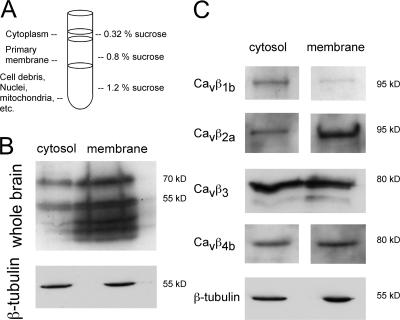
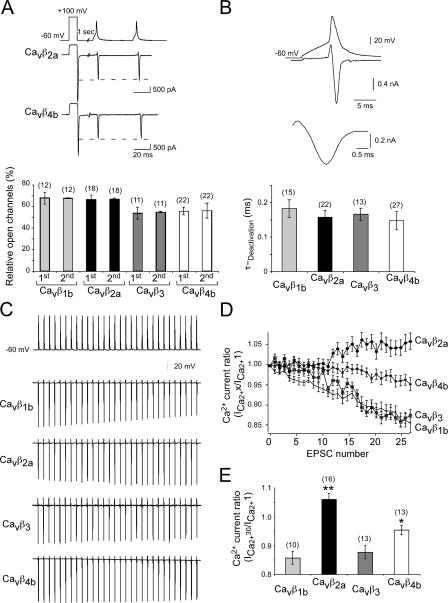
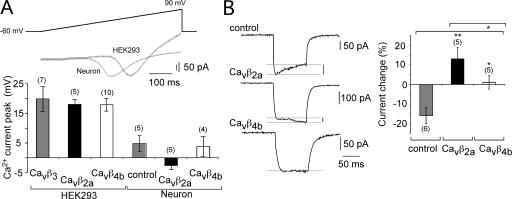
Ca(2+) channel beta subunits determine the transport and physiological properties of high voltage-activated Ca(2+) channel complexes. Our analysis of the distribution of the Ca(v)beta subunit family members in hippocampal neurons correlates their synaptic distribution with their involvement in transmitter release. We find that exogenously expressed Ca(v)beta(4b) and Ca(v)beta(2a) subunits distribute in clusters and localize to synapses, whereas Ca(v)beta(1b) and Ca(v)beta(3) are homogenously distributed. According to their localization, Ca(v)beta(2a) and Ca(v)beta(4b) subunits modulate the synaptic plasticity of autaptic hippocampal neurons (i.e., Ca(v)beta(2a) induces depression, whereas Ca(v)beta(4b) induces paired-pulse facilitation [PPF] followed by synaptic depression during longer stimuli trains). The induction of PPF by Ca(v)beta(4b) correlates with a reduction in the release probability and cooperativity of the transmitter release. These results suggest that Ca(v)beta subunits determine the gating properties of the presynaptic Ca(2+) channels within the presynaptic terminal in a subunit-specific manner and may be involved in organization of the Ca(2+) channel relative to the release machinery.
钙离子通道β亚基决定了高电压激活的钙离子通道复合物的转运和生理特性。我们对海马神经元中Ca(v)β亚基家族成员分布的分析,将它们的突触分布与其在递质释放中的作用联系起来。我们发现,外源表达的Ca(v)β(4b)和Ca(v)β(2a)亚基聚集成簇并定位于突触,而Ca(v)β(1b)和Ca(v)β(3)则均匀分布。根据它们的定位,Ca(v)β(2a)和Ca(v)β(4b)亚基调节自突触海马神经元的突触可塑性(即Ca(v)β(2a)诱导抑制,而Ca(v)β(4b)诱导双脉冲易化[PPF],随后在较长刺激串期间诱导突触抑制)。Ca(v)β(4b)诱导的PPF与递质释放概率和协同性的降低相关。这些结果表明,Ca(v)β亚基以亚基特异性方式决定突触前终末内突触前钙离子通道的门控特性,并且可能参与钙离子通道相对于释放机制的组织。