Meyer Matthias, Stenzel Udo, Myles Sean, Prüfer Kay, Hofreiter Michael
Max Planck Institute for Evolutionary Anthropology, Deutscher Platz 6, D-04103 Leipzig, Germany.
Nucleic Acids Res. 2007;35(15):e97. doi: 10.1093/nar/gkm566. Epub 2007 Aug 1.
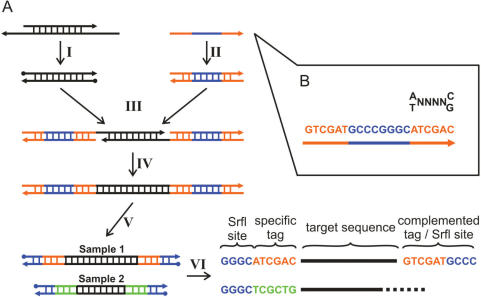
High-throughput 454 DNA sequencing technology allows much faster and more cost-effective sequencing than traditional Sanger sequencing. However, the technology imposes inherent limitations on the number of samples that can be processed in parallel. Here we introduce parallel tagged sequencing (PTS), a simple, inexpensive and flexible barcoding technique that can be used for parallel sequencing any number and type of double-stranded nucleic acid samples. We demonstrate that PTS is particularly powerful for sequencing contiguous DNA fragments such as mtDNA genomes: in theory as many as 250 mammalian mtDNA genomes can be sequenced in a single GS FLX run. PTS dramatically increases the sequencing throughput of samples in parallel and thus fully mobilizes the resources of the 454 technology for targeted sequencing.
高通量454 DNA测序技术比传统的桑格测序法能实现更快且更具成本效益的测序。然而,该技术对可并行处理的样本数量存在固有限制。在此,我们介绍并行标记测序(PTS),这是一种简单、廉价且灵活的条形码技术,可用于对任何数量和类型的双链核酸样本进行并行测序。我们证明,PTS对于诸如线粒体DNA基因组等连续DNA片段的测序尤为强大:理论上,在一次GS FLX运行中可对多达250个哺乳动物线粒体DNA基因组进行测序。PTS显著提高了并行样本的测序通量,从而充分调动了454技术用于靶向测序的资源。