Kovess-Masféty Viviane, Saragoussi Delphine, Sevilla-Dedieu Christine, Gilbert Fabien, Suchocka Agnieszka, Arveiller Nathalie, Gasquet Isabelle, Younes Nadia, Hardy-Bayle Marie-Christine
MGEN Foundation for Public Health, EA 4069 University of Paris 5, 3 square Max Hymans, 75748 Paris Cedex 15, France.
BMC Public Health. 2007 Jul 31;7:188. doi: 10.1186/1471-2458-7-188.
The unequal use of mental health care is a great issue, even in countries with universal health coverage. Better knowledge of the factors that have an impact on the pathway to mental health care may be a great help for designing education campaigns and for best organizing health care delivery. The objective of this study is to explore the determinants of help-seeking intentions for mental health problems and which factors influence treatment opinions and the reliance on and compliance with health professionals' advice.
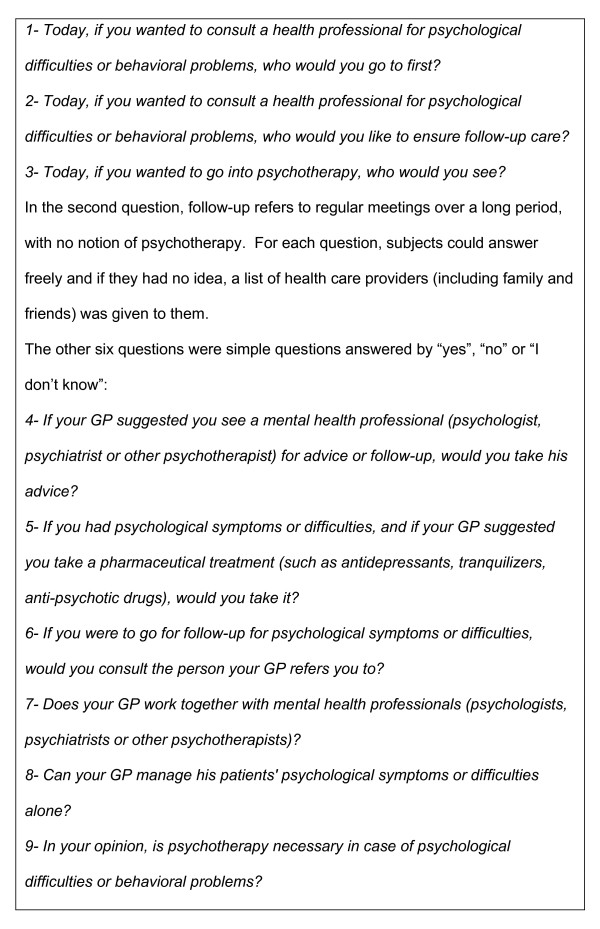
441 adults aged 18 to 70 were randomly selected from the general population of two suburban districts near Paris and agreed to participate in the study (response rate = 60.4%). The 412 respondents with no mental health problems based on the CIDI-SF and the CAGE, who had not consulted for a mental health problem in the previous year, were asked in detail about their intentions to seek help in case of a psychological disorder and about their opinion of mental health treatments. The links between the respondents' characteristics and intentions and opinions were explored.
More than half of the sample (57.8%) would see their general practitioner (GP) first and 46.6% would continue with their GP for follow-up. Mental health professionals were mentioned far less than GPs. People who would choose their GP first were older and less educated, whereas those who would favor mental health specialists had lower social support. For psychotherapy, respondents were split equally between seeing a GP, a psychiatrist or a psychologist. People were reluctant to take psychotropic drugs, but looked favorably on psychotherapy.
GPs are often the point of entry into the mental health care system and need to be supported. Public information campaigns about mental health care options and treatments are needed to educate the public, eliminate the stigma of mental illness and eliminate prejudices.
即使在拥有全民医保的国家,心理健康护理的使用不平等也是一个重大问题。更好地了解影响心理健康护理途径的因素,可能对设计教育活动以及优化医疗服务提供有很大帮助。本研究的目的是探讨心理健康问题求助意愿的决定因素,以及哪些因素会影响治疗意见和对健康专业人员建议的依赖与遵从。
从巴黎附近两个郊区的普通人群中随机抽取441名18至70岁的成年人,他们同意参与研究(回复率 = 60.4%)。根据复合性国际诊断交谈表简版(CIDI - SF)和CAGE问卷,412名在前一年未因心理健康问题咨询过且无心理健康问题的受访者,被详细询问了他们在出现心理障碍时寻求帮助的意愿以及对心理健康治疗的看法。探讨了受访者特征与意愿及看法之间的联系。
超过一半的样本(57.8%)会首先去看全科医生(GP),46.6%会继续找全科医生进行后续治疗。提及心理健康专业人员的比例远低于全科医生。首先选择全科医生的人年龄较大且受教育程度较低,而倾向于心理健康专家的人社会支持较低。对于心理治疗,选择看全科医生、精神科医生或心理学家的受访者比例相当。人们不愿服用精神药物,但对心理治疗持积极态度。
全科医生通常是进入心理健康护理系统的切入点,需要得到支持。需要开展关于心理健康护理选择和治疗的公共宣传活动,以教育公众、消除精神疾病的污名化并消除偏见。