Zhang Xulong, Zhang Jian, Wang Lihua, Wei Haiming, Tian Zhigang
Institute of Immunopharmacology & Immunotherapy, School of Pharmaceutical Sciences, Shandong University, Jinan 250012, China.
BMC Cancer. 2007 Aug 4;7:149. doi: 10.1186/1471-2407-7-149.
Signal transducer and activator of transcription 3 (STAT3) is usually constitutively activated in a variety of malignancies. Therefore, STAT3 may be a promising target for treatment of tumor cells. To explore the possibility of a double-stranded decoy oligodeoxynucleotide (ODN) targeted blocking STAT3 over-activated tumor cells, we, here, evaluate the efficacy of STAT3 decoy ODN on human lung cancer cells in vitro and in vivo.
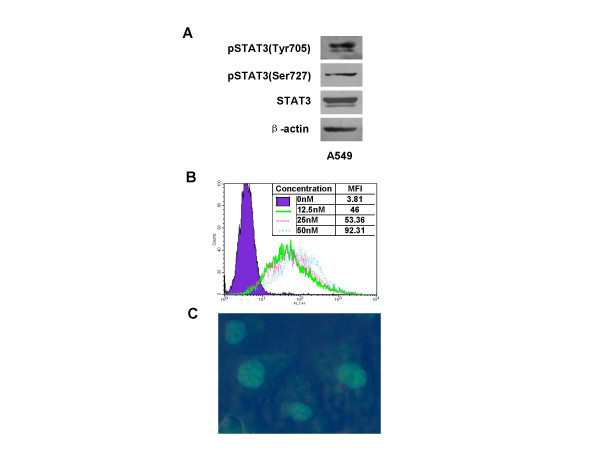
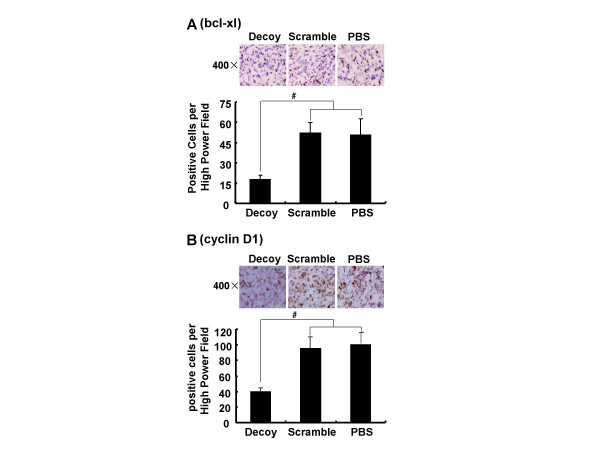
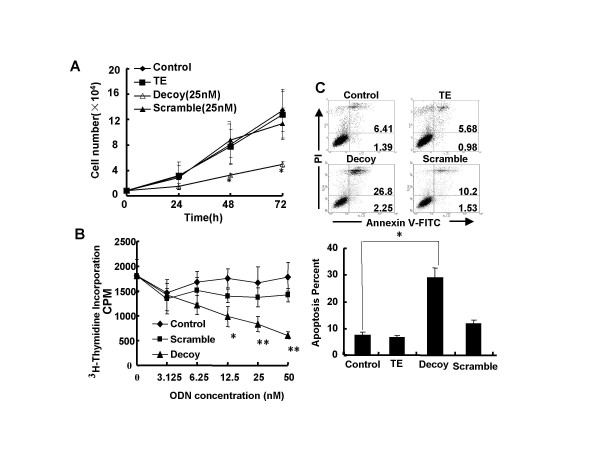
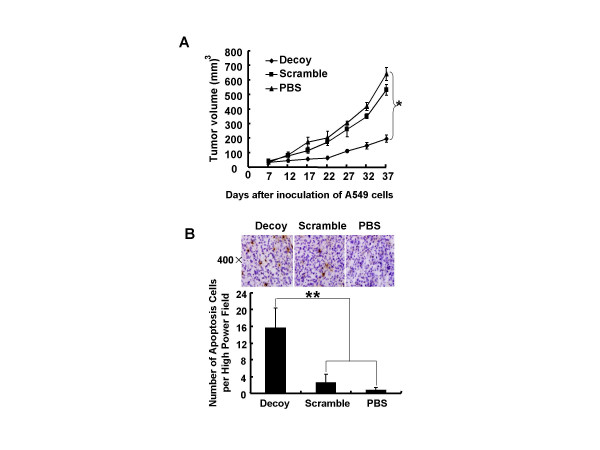
A STAT3 decoy ODN was transfected into A549 lung cancer cell line in vitro by using lipofectamine. The flow cytometry and fluorescent microscopy were used to detect the transfection efficiency and the sub-cellular localization of STAT3 decoy ODN in A549 cells. Cell proliferation was determined by counting cell numbers and [3H]-thymidine uptake. Cell apoptosis was examined with Annexin V and propidum iodide by flow cytometry. The expression levels of STAT3 target genes were identified by RT-PCR and immunoblot. For in vivo experiment, A549 lung carcinoma-nude mice xenograft was used as a model to examine the effect of the STAT3 decoy by intratumoral injection. At the end of treatment, TUNEL and immunohistochemistry were used to examine the apoptosis and the expression levels of bcl-xl and cyclin D1 in tumor tissues.
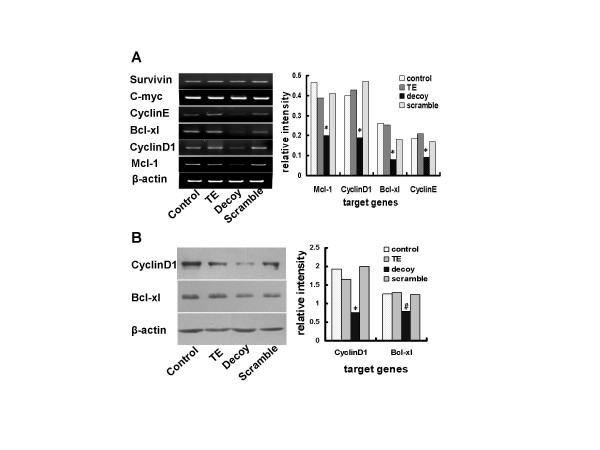
STAT3 decoy ODN was effectively transfected into A549 lung cancer cells and mainly located in nucleus. STAT3-decoy ODN significantly induced apoptosis and reduced [3H]-thymidine incorporation of A549 cells as well as down-regulated STAT3-target genes in vitro. STAT3 decoy ODN also dramatically inhibited the lung tumor growth in xenografted nude mice and decreased gene expression of bcl-xl and cyclin D1.
STAT3 decoy ODN significantly suppressed lung cancer cells in vitro and in vivo, indicating that STAT3 decoy ODN may be a potential therapeutic approach for treatment of lung cancer.
信号转导与转录激活因子3(STAT3)在多种恶性肿瘤中通常呈组成性激活。因此,STAT3可能是治疗肿瘤细胞的一个有前景的靶点。为探索双链诱饵寡脱氧核苷酸(ODN)靶向阻断STAT3过度激活的肿瘤细胞的可能性,我们在此评估STAT3诱饵ODN对人肺癌细胞的体内外疗效。
利用脂质体将STAT3诱饵ODN体外转染至A549肺癌细胞系。采用流式细胞术和荧光显微镜检测转染效率以及STAT3诱饵ODN在A549细胞中的亚细胞定位。通过细胞计数和[3H] - 胸腺嘧啶核苷摄取来测定细胞增殖。采用流式细胞术用膜联蛋白V和碘化丙啶检测细胞凋亡。通过逆转录 - 聚合酶链反应(RT - PCR)和免疫印迹鉴定STAT3靶基因的表达水平。对于体内实验,以A549肺癌 - 裸鼠异种移植瘤作为模型,通过瘤内注射来检测STAT3诱饵的作用。治疗结束时,采用末端脱氧核苷酸转移酶介导的缺口末端标记法(TUNEL)和免疫组织化学检测肿瘤组织中的细胞凋亡以及bcl - xl和细胞周期蛋白D1的表达水平。
STAT3诱饵ODN有效转染至A549肺癌细胞且主要定位于细胞核。STAT3诱饵ODN在体外显著诱导A549细胞凋亡并减少[3H] - 胸腺嘧啶核苷掺入,同时下调STAT3靶基因。STAT3诱饵ODN还显著抑制异种移植裸鼠的肺肿瘤生长,并降低bcl - xl和细胞周期蛋白D1的基因表达。
STAT3诱饵ODN在体外和体内均显著抑制肺癌细胞,表明STAT3诱饵ODN可能是治疗肺癌的一种潜在治疗方法。