Tighe Anthony, Ray-Sinha Arpita, Staples Oliver D, Taylor Stephen S
Faculty of Life Sciences, Michael Smith Building, Oxford Road, University of Manchester, Manchester M13 9PT, UK.
BMC Cell Biol. 2007 Aug 14;8:34. doi: 10.1186/1471-2121-8-34.
Several mechanisms operate during mitosis to ensure accurate chromosome segregation. However, during tumour evolution these mechanisms go awry resulting in chromosome instability. While several lines of evidence suggest that mutations in adenomatous polyposis coli (APC) may promote chromosome instability, at least in colon cancer, the underlying mechanisms remain unclear. Here, we turn our attention to GSK-3 - a protein kinase, which in concert with APC, targets beta-catenin for proteolysis - and ask whether GSK-3 is required for accurate chromosome segregation.
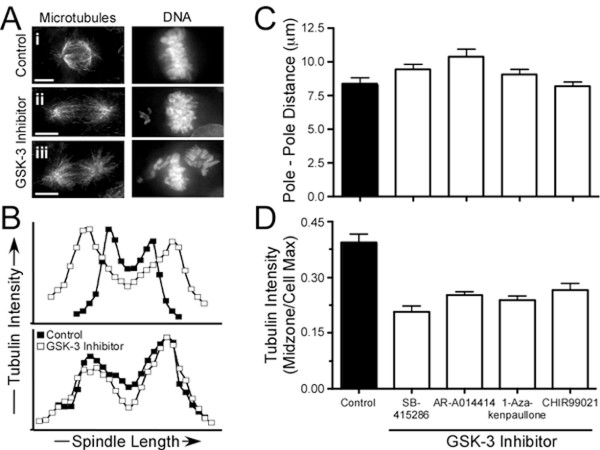
To probe the role of GSK-3 in mitosis, we inhibited GSK-3 kinase activity in cells using a panel of small molecule inhibitors, including SB-415286, AR-A014418, 1-Azakenpaullone and CHIR99021. Analysis of synchronised HeLa cells shows that GSK-3 inhibitors do not prevent G1/S progression or cell division. They do, however, significantly delay mitotic exit, largely because inhibitor-treated cells have difficulty aligning all their chromosomes. Although bipolar spindles form and the majority of chromosomes biorient, one or more chromosomes often remain mono-oriented near the spindle poles. Despite a prolonged mitotic delay, anaphase frequently initiates without the last chromosome aligning, resulting in chromosome non-disjunction. To rule out the possibility of "off-target" effects, we also used RNA interference to selectively repress GSK-3beta. Cells deficient for GSK-3beta exhibit a similar chromosome alignment defect, with chromosomes clustered near the spindle poles. GSK-3beta repression also results in cells accumulating micronuclei, a hallmark of chromosome missegregation.
Thus, not only do our observations indicate a role for GSK-3 in accurate chromosome segregation, but they also raise the possibility that, if used as therapeutic agents, GSK-3 inhibitors may induce unwanted side effects by inducing chromosome instability.
有几种机制在有丝分裂过程中发挥作用,以确保染色体精确分离。然而,在肿瘤进化过程中,这些机制出现紊乱,导致染色体不稳定。虽然有几条证据表明,腺瘤性息肉病大肠杆菌(APC)中的突变可能促进染色体不稳定,至少在结肠癌中如此,但其潜在机制仍不清楚。在这里,我们将注意力转向糖原合成酶激酶-3(GSK-3)——一种蛋白激酶,它与APC协同作用,靶向β-连环蛋白进行蛋白水解——并探讨GSK-3对于精确的染色体分离是否是必需的。
为了探究GSK-3在有丝分裂中的作用,我们使用一组小分子抑制剂,包括SB-415286、AR-A014418、1-氮杂肯帕罗酮和CHIR99021,在细胞中抑制GSK-3激酶活性。对同步化的HeLa细胞的分析表明,GSK-3抑制剂不会阻止G1/S期进程或细胞分裂。然而,它们确实会显著延迟有丝分裂退出,这主要是因为用抑制剂处理的细胞难以使所有染色体排列整齐。尽管形成了双极纺锤体,并且大多数染色体双定向,但一条或多条染色体常常在纺锤体极附近保持单定向。尽管有丝分裂延迟延长,但后期常常在最后一条染色体未排列整齐的情况下启动,导致染色体不分离。为了排除“脱靶”效应的可能性,我们还使用RNA干扰选择性地抑制GSK-3β。缺乏GSK-3β的细胞表现出类似的染色体排列缺陷,染色体聚集在纺锤体极附近。抑制GSK-3β还导致细胞积累微核,这是染色体错分离的一个标志。
因此,我们的观察结果不仅表明GSK-3在精确的染色体分离中发挥作用,而且还提出了一种可能性,即如果将GSK-3抑制剂用作治疗药物,它们可能会通过诱导染色体不稳定而产生不良副作用。