Côté Hélène C F, Day Andrew G, Heyland Daren K
Department of Pathology and Laboratory Medicine, University of British Columbia, Vancouver, Canada V6T 2B5.
Crit Care. 2007;11(4):R88. doi: 10.1186/cc6096.
Mitochondrial dysfunction may be causally related to the pathogenesis of organ failure in critically ill patients. Decreased mitochondrial DNA (mtDNA) levels have been associated with mitochondrial dysfunction and were investigated here in relation to short-term (31-day) survival.
This was a prospective longitudinal cohort study of 28 mechanically ventilated critically ill adults admitted to a single center tertiary care intensive care unit (ICU) with hypotension secondary to cardiogenic (N = 13), septic (N = 14) or hypovolemic (N = 1) disease processes. Clinical data and blood were collected at baseline and patients were followed until they expired or left the ICU. Blood was collected every Monday, Wednesday and Friday, and the buffycoat relative mtDNA/nuclear DNA (nDNA) ratio was determined. An archived pool of healthy controls was also studied.
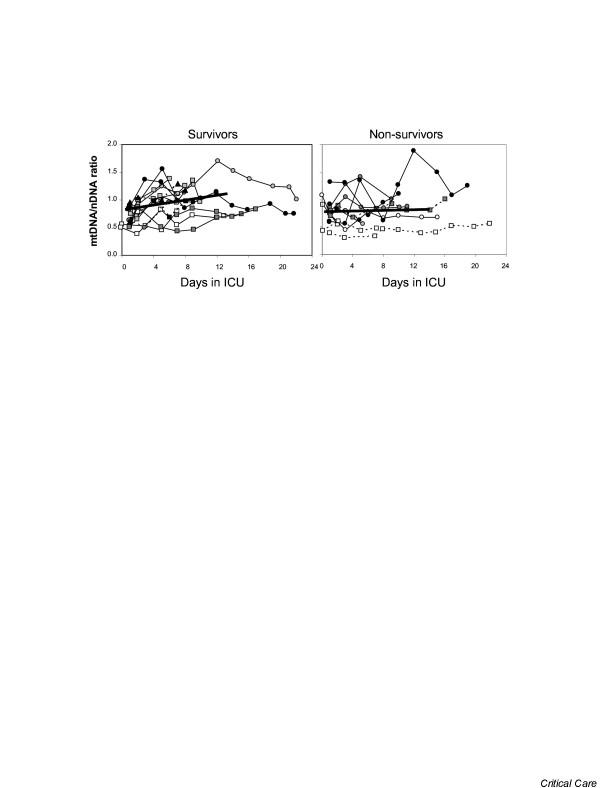
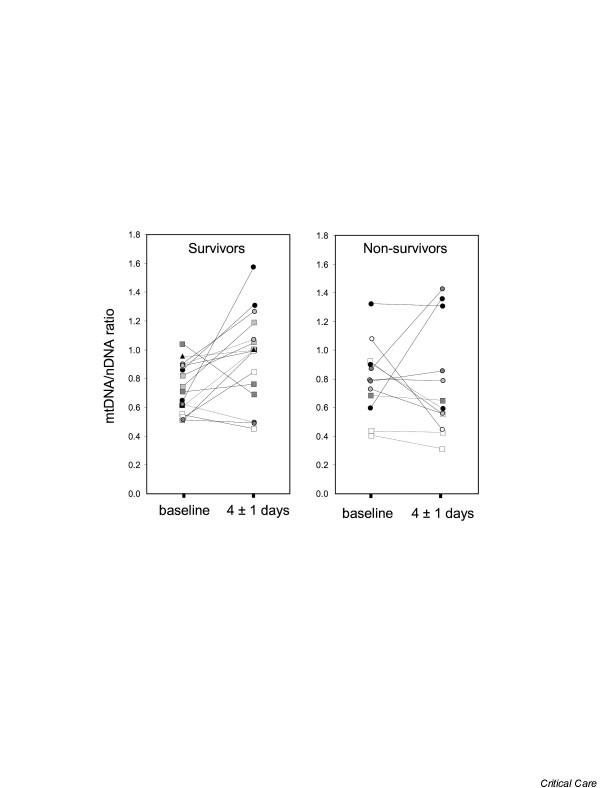
At baseline, the patients' mtDNA/nDNA ratio was 30% lower than a pool of 24 healthy controls (0.76 versus 1.09) and was not different between short-term survivors and non-survivors (0.74 +/- 0.05 (N = 16) versus 0.79 +/- 0.06 (N = 12), p = 0.49). By day 4, the percent mtDNA/nDNA change from baseline in survivors was significantly different from that in non-survivors (+29.5% versus -5.7%, p = 0.03). It also tended to be higher in survivors at last measurement (+38.4% versus +7.1%, p = 0.06). There was a weak correlation between within patient mtDNA/nDNA and platelet count (r = 0.20, p = 0.03) but not with Sequential Organ Failure Assessment (SOFA) scores (r = 0.12, p = 0.23). The mtDNA associations remained after adjustment for platelet.
Blood mtDNA levels appeared initially low, increased over time in patients who ultimately survived, and remained low in those who did not. This is consistent with mitochondrial recovery being associated with survival and warrants further investigation as a marker of mitochondrial alterations and outcome in critical illness.
线粒体功能障碍可能与危重症患者器官衰竭的发病机制存在因果关系。线粒体DNA(mtDNA)水平降低与线粒体功能障碍有关,本研究对其与短期(31天)生存率的关系进行了调查。
这是一项前瞻性纵向队列研究,纳入了28例入住单中心三级医疗重症监护病房(ICU)的接受机械通气的成年危重症患者,这些患者因心源性(N = 13)、感染性(N = 14)或低血容量性(N = 1)疾病过程继发低血压。在基线时收集临床数据和血液样本,并对患者进行随访,直至其死亡或离开ICU。每周一、周三和周五采集血液样本,测定血沉棕黄层中相对mtDNA/核DNA(nDNA)比值。同时还研究了一组存档的健康对照。
在基线时,患者的mtDNA/nDNA比值比24名健康对照者低30%(0.76对1.09),短期幸存者和非幸存者之间无差异(0.74±0.05(N = 16)对0.79±0.06(N = 12),p = 0.49)。到第4天,幸存者mtDNA/nDNA相对于基线的变化百分比与非幸存者有显著差异(+29.5%对 -5.7%,p = 0.03)。在最后一次测量时,幸存者的该比值也往往更高(+38.4%对 +7.1%,p = 0.06)。患者体内mtDNA/nDNA与血小板计数之间存在弱相关性(r = 0.20,p = 0.03),但与序贯器官衰竭评估(SOFA)评分无关(r = 0.12,p = 0.23)。在对血小板进行校正后,mtDNA的相关性依然存在。
血液mtDNA水平最初似乎较低,最终存活的患者随时间升高,而未存活者则保持较低水平。这与线粒体恢复与生存相关一致,作为危重症中线粒体改变和预后的标志物值得进一步研究。