Tong Xiaodong, Xiong Ying, Zborowski Maciej, Farag Sherif S, Chalmers Jeffrey J
Department of Chemical and Biomolecular Engineering, The Ohio State University, Columbus Ohio, USA.
Exp Hematol. 2007 Oct;35(10):1613-22. doi: 10.1016/j.exphem.2007.06.015. Epub 2007 Aug 13.
To develop an immunomagnetic cell separation system for allogeneic hematopoietic stem cell (HSC) transplantations, which can achieve a high level of T-cell depletion (at least 4.0 log(10)), high level of recovery of hematopoietic stem cells (>90%), with a high throughput (>10(6) cells/second).
Peripheral blood leukocytes (PBLs) from buffy coats were spiked with CD34-expressing cells (KG1a) to mimic a leukaphoresis product containing stimulated HSCs. T cells were labeled with anti-CD3(+) Dynabeads and separated in a quadrupole magnetic cell sorter (QMS). The performance of the system with respect to T-cell depletion and recovery of non-T cells and spiked KG1a was determined using four-color, flow cytometry analysis, with the aid of Trucount cell-concentration calibration beads. Limiting dilution assays were also performed to quantify the log(10) depletion of clonable T cells.
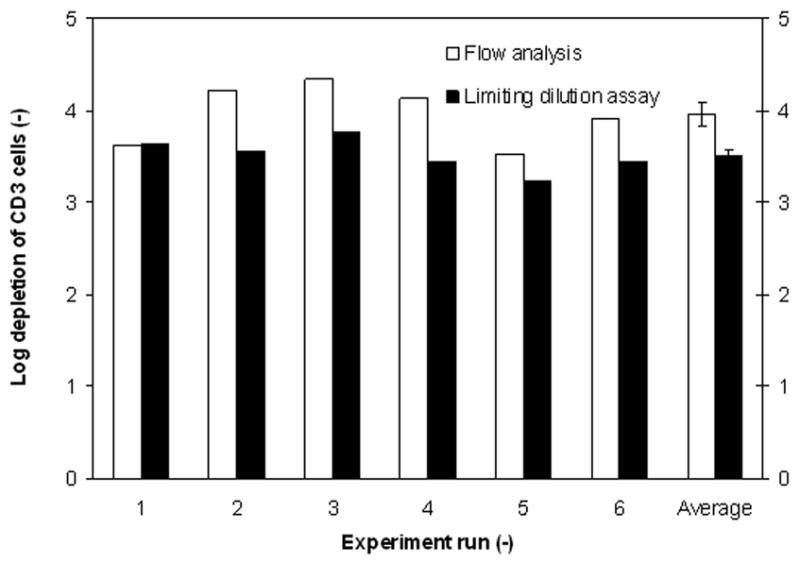
While the general performance of the QMS system is governed by proven theoretical principles, significant system variability exist, not all of which can be explained by our current understanding. Consequently, a factorial design was employed, guided by JMP software, to optimize the labeling conditions and operation of the QMS focused on maximizing the depletion of T cell, and recovery of unlabeled cells including KG1a cells. From these studies, an optimized, no wash, immunomagnetic labeling protocol and optimized QMS operating conditions were developed. For an average initial cell concentration of 1.7 x 10(8) total cells, an average 3.96 +/- 0.33 log(10) depletion (range, 3.53-4.34) of CD3(+)CD45(+) cells with a mean 99.43% +/- 4.23% recovery of CD34(+)CD45(+) cells (range, 94.38-104.90%) was achieved at a sorting speed of 10(6) cells/s (n = 6). Limiting dilution assays on the T-cell depleted fractions, which gave a log(10) depletion of 3.51 for the clonable T cells.
We suggest that this system will provide superior performance with respect to T-cell depletion and CD34(+) recovery for clinical allogeneic bone marrow transplants. Ongoing studies, on a clinical scale, are being conducted to demonstrate this claim.
开发一种用于异基因造血干细胞(HSC)移植的免疫磁细胞分离系统,该系统能够实现高水平的T细胞清除(至少4.0 log₁₀)、造血干细胞的高回收率(>90%)以及高通量(>10⁶个细胞/秒)。
将来自血沉棕黄层的外周血白细胞(PBLs)与表达CD34的细胞(KG1a)混合,以模拟含有受刺激造血干细胞的白细胞分离产物。用抗CD3⁺ Dynabeads标记T细胞,并在四极磁细胞分选仪(QMS)中进行分离。借助Trucount细胞浓度校准微球,通过四色流式细胞术分析来确定该系统在T细胞清除以及非T细胞和添加的KG1a细胞回收率方面的性能。还进行了有限稀释分析以量化可克隆T细胞的log₁₀清除率。
虽然QMS系统的总体性能受已证实的理论原理支配,但存在显著的系统变异性,并非所有变异性都能由我们目前的理解来解释。因此,在JMP软件的指导下采用析因设计,以优化标记条件和QMS的操作,重点是最大化T细胞的清除以及未标记细胞(包括KG1a细胞)的回收率。通过这些研究,开发出了一种优化的、无需洗涤的免疫磁标记方案和优化的QMS操作条件。对于平均初始细胞浓度为1.7×10⁸个总细胞,在分选速度为10⁶个细胞/秒时(n = 6),CD3⁺CD45⁺细胞平均清除3.96±0.33 log₁₀(范围为3.53 - 4.34),CD34⁺CD45⁺细胞平均回收率为99.43%±4.23%(范围为94.38 - 104.90%)。对T细胞清除后的组分进行有限稀释分析,可克隆T细胞的log₁₀清除率为3.51。
我们认为该系统在临床异基因骨髓移植的T细胞清除和CD34⁺回收率方面将具有卓越性能。正在进行临床规模的研究以证实这一说法。