Institut für Medizinische Immunologie der Charité, Charité Universitätsmedizin Berlin, Berlin, Germany.
PLoS One. 2007 Aug 15;2(8):e735. doi: 10.1371/journal.pone.0000735.
Tuberculin-specific T-cell responses have low diagnostic specificity in BCG vaccinated populations. While subunit-antigen (e.g. ESAT-6, CFP-10) based tests are useful for diagnosing latent tuberculosis infection, there is no reliable immunological test for active pulmonary tuberculosis. Notably, all existing immunological tuberculosis-tests are based on T-cell response size, whereas the diagnostic potential of T-cell response quality has never been explored. This includes surface marker expression and functionality of mycobacterial antigen specific T-cells.
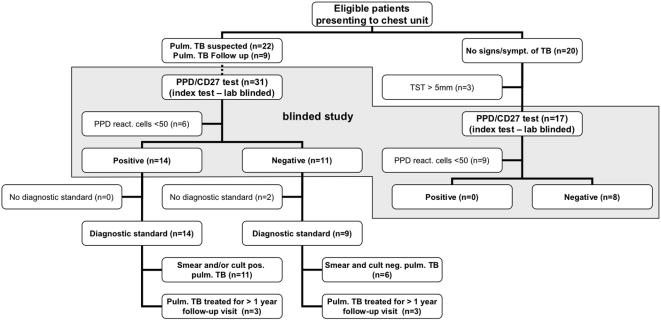
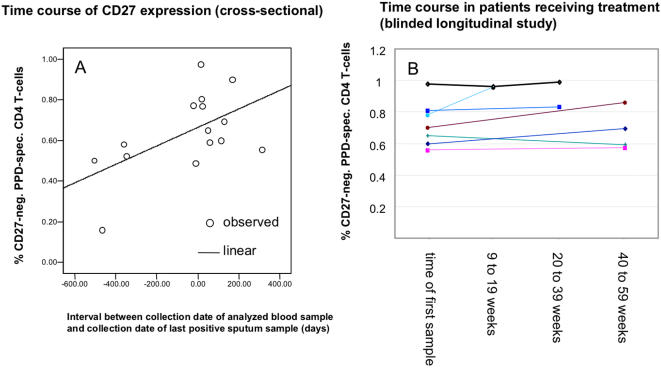
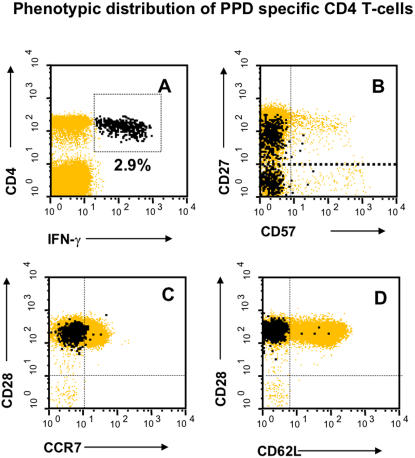
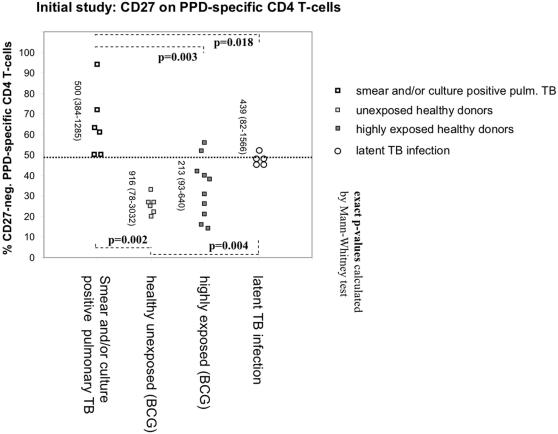
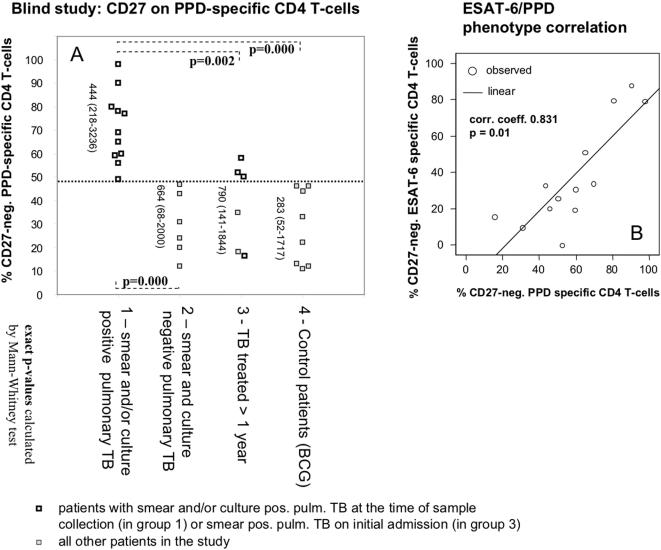
METHODOLOGY/PRINCIPAL FINDINGS: Flow-cytometry was used to examine over-night antigen-stimulated T-cells from tuberculosis patients and controls. Tuberculin and/or the relatively M. tuberculosis specific ESAT-6 protein were used as stimulants. A set of classic surface markers of T-cell naïve/memory differentiation was selected and IFN-gamma production was used to identify T-cells recognizing these antigens. The percentage of tuberculin-specific T-helper-cells lacking the surface receptor CD27, a state associated with advanced differentiation, varied considerably between individuals (from less than 5% to more than 95%). Healthy BCG vaccinated individuals had significantly fewer CD27-negative tuberculin-reactive CD4 T-cells than patients with smear and/or culture positive pulmonary tuberculosis, discriminating these groups with high sensitivity and specificity, whereas individuals with latent tuberculosis infection exhibited levels in between.
CONCLUSIONS/SIGNIFICANCE: Smear and/or culture positive pulmonary tuberculosis can be diagnosed by a rapid and reliable immunological test based on the distribution of CD27 expression on peripheral blood tuberculin specific T-cells. This test works very well even in a BCG vaccinated population. It is simple and will be of great utility in situations where sputum specimens are difficult to obtain or sputum-smear is negative. It will also help avoid unnecessary hospitalization and patient isolation.
在卡介苗接种人群中,结核菌素特异性 T 细胞反应的诊断特异性较低。虽然基于亚单位抗原(例如 ESAT-6、CFP-10)的检测可用于诊断潜伏性结核感染,但目前尚无可靠的免疫性肺结核检测方法。值得注意的是,所有现有的免疫性肺结核检测方法均基于 T 细胞反应大小,而 T 细胞反应质量的诊断潜力从未被探索过。这包括分枝杆菌抗原特异性 T 细胞的表面标志物表达和功能。
方法/主要发现:使用流式细胞术检测肺结核患者和对照者经 overnight 抗原刺激后的 T 细胞。结核菌素和/或相对更具结核特异性的 ESAT-6 蛋白被用作刺激物。选择了一组经典的 T 细胞初始/记忆分化表面标志物,并使用 IFN-γ产生来鉴定识别这些抗原的 T 细胞。缺乏表面受体 CD27 的结核菌素特异性 T 辅助细胞(与高度分化相关的状态)的百分比在个体之间差异很大(从小于 5%到大于 95%)。与涂片和/或培养阳性肺结核患者相比,健康的卡介苗接种个体中的结核菌素反应性 CD4 T 细胞中 CD27 阴性细胞的比例明显更少,这种差异具有较高的敏感性和特异性,可以区分这些组,而潜伏性结核感染患者的水平则处于两者之间。
结论/意义:基于外周血结核菌素特异性 T 细胞 CD27 表达分布,可以通过一种快速、可靠的免疫学检测方法诊断涂片和/或培养阳性肺结核。即使在卡介苗接种人群中,该检测方法也非常有效。它简单易用,在获取痰标本困难或痰涂片阴性的情况下非常有用。它还有助于避免不必要的住院和患者隔离。