Cox David G, Penney Kathryn, Guo Qun, Hankinson Susan E, Hunter David J
Program in Molecular and Genetic Epidemiology, Epidemiology Department, Harvard School of Public Health, USA.
BMC Cancer. 2007 Sep 11;7:175. doi: 10.1186/1471-2407-7-175.
Transforming growth factor beta 1 (TGFB1) forms a signaling complex with transforming growth factor beta receptors 1 and 2 and has been described as both a tumor suppressor and tumor promoter. Single nucleotide polymorphisms in TGFB1 and a microsatellite in TGFBR1 have been investigated for association with risk of breast cancer, with conflicting results.
We examined polymorphisms in the promoter region of the TGFB1 gene as well as the TGFBR1*6A microsatellite in the Nurses' Health Study cohort.
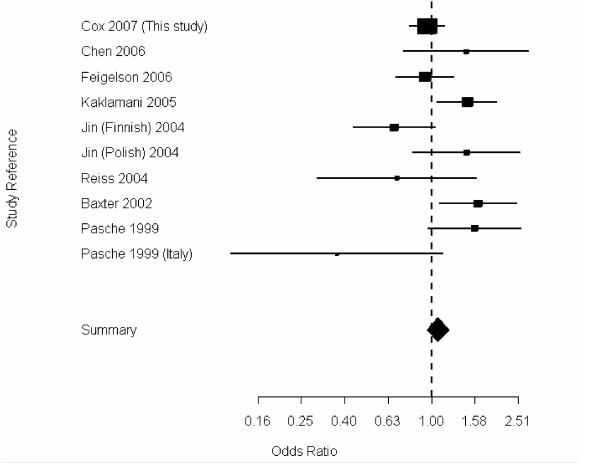
No overall associations between the L10P polymorphism of TGFB1 or the TGFBR1 microsatellite were detected. However, we observed an inverse association between the -509 C/T polymorphism of TGFB1 (p-trend = 0.04), which was stronger and more significant among women with estrogen receptor positive breast cancer.
Polymorphisms in the promoter region of TGFB1 are not likely to be associated with large increases in breast cancer risk overall among Caucasian women.
转化生长因子β1(TGFB1)与转化生长因子β受体1和2形成信号复合物,其作用既有肿瘤抑制因子的一面,也有肿瘤促进因子的一面。TGFB1中的单核苷酸多态性以及TGFBR1中的一个微卫星已被研究与乳腺癌风险的相关性,但结果相互矛盾。
我们在护士健康研究队列中检测了TGFB1基因启动子区域的多态性以及TGFBR1*6A微卫星。
未检测到TGFB1的L10P多态性或TGFBR1微卫星之间的总体关联。然而,我们观察到TGFB1的-509 C/T多态性之间存在负相关(p趋势=0.04),在雌激素受体阳性乳腺癌女性中这种相关性更强且更显著。
TGFB1启动子区域的多态性不太可能与白种女性总体乳腺癌风险的大幅增加相关。