Vaccine Research Center, Emory University, Atlanta, Georgia, United States of America.
PLoS One. 2007 Sep 12;2(9):e863. doi: 10.1371/journal.pone.0000863.
Toll-like receptors (TLRs) are pattern recognition receptors that recognize pathogen associated molecular patterns and trigger innate immunity leading to initiation of adaptive immunity. TLR-mediated activation of dendritic cells (DCs) is known to be a critical event in the initiation of cellular and humoral immune responses. Recent work however suggests that B cells also express TLRs, and that they can be activated via TLR ligands. However, whether such B cell activation occurs only on memory B cells, or whether it can also occur on truly naïve B cells remains controversial. Furthermore, the expression and functional relevance of TLRs on distinct subsets of B cells, which are known to play differential roles in humoral responses is not known.
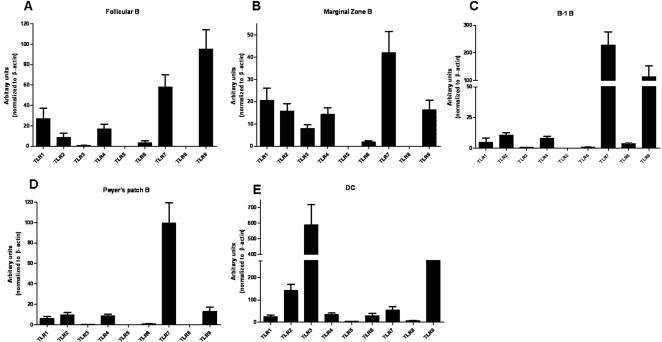
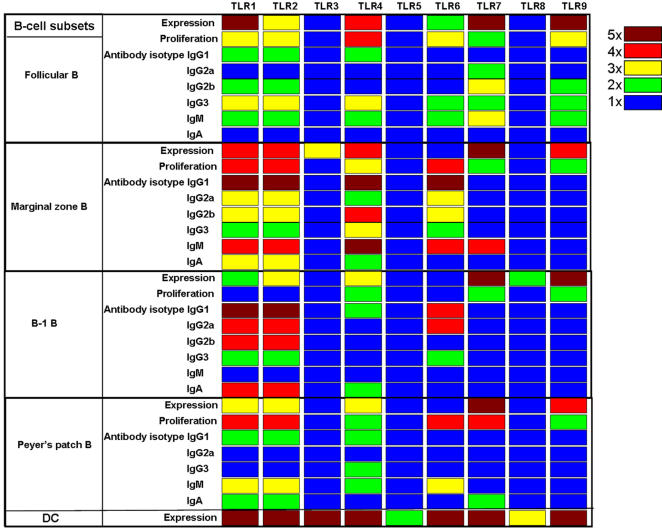
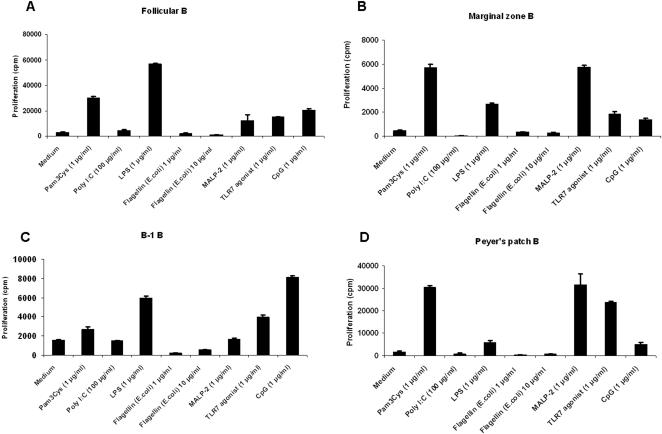
METHODOLOGY/PRINCIPAL FINDINGS: In this study, we investigated the expression pattern of different TLRs in distinct subsets of murine B cells (naïve, memory, follicular, marginal zone, B-1 and peyer's patch). In contrast to the reported restricted expression pattern of TLRs in human peripheral blood naïve B cells, murine splenic naïve B cells express a variety of TLRs with the exception of TLR5 and 8. Consistent with this relatively broad expression pattern, murine naive B cells proliferate and secrete antibody to a variety of TLR agonists in vitro, in the absence of B-cell receptor cross-linking. In addition, we observed subtle differences in the antibody secretion pattern of follicular, marginal zone, B-1 and peyer's patch B-cell subsets.
CONCLUSIONS/SIGNIFICANCE: Thus various B cell subsets, including truly naïve B cells, express multiple TLRs, and signaling via such TLRs results in their robust proliferation and antibody secretion, even in the absence of dendritic cell activation, or T-cell help.
Toll 样受体(TLRs)是一种模式识别受体,可识别病原体相关的分子模式,触发先天免疫,从而启动适应性免疫。已知 TLR 介导的树突状细胞(DC)的激活是细胞和体液免疫反应启动的关键事件。然而,最近的研究表明 B 细胞也表达 TLR,并且它们可以通过 TLR 配体被激活。然而,这种 B 细胞的激活是否仅发生在记忆 B 细胞上,或者它是否也可以发生在真正的初始 B 细胞上,仍然存在争议。此外,TLRs 在已知在体液反应中发挥不同作用的不同 B 细胞亚群中的表达和功能相关性尚不清楚。
方法/主要发现:在这项研究中,我们研究了不同 TLR 在小鼠 B 细胞(初始、记忆、滤泡、边缘区、B-1 和派尔氏斑)亚群中的表达模式。与报道的人外周血初始 B 细胞中 TLR 表达受限的模式相反,鼠脾初始 B 细胞表达多种 TLR,TLR5 和 8 除外。与这种相对广泛的表达模式一致,鼠初始 B 细胞在体外增殖并分泌针对各种 TLR 激动剂的抗体,而无需 B 细胞受体交联。此外,我们观察到滤泡、边缘区、B-1 和派尔氏斑 B 细胞亚群的抗体分泌模式存在细微差异。
结论/意义:因此,各种 B 细胞亚群,包括真正的初始 B 细胞,表达多种 TLR,通过这些 TLR 信号转导导致其强烈增殖和抗体分泌,即使在没有树突状细胞激活或 T 细胞辅助的情况下也是如此。