Department of Biology, University of Ottawa, Ontario, Canada.
PLoS One. 2007 Sep 12;2(9):e879. doi: 10.1371/journal.pone.0000879.
Because rates of evolution and species divergence times cannot be estimated directly from molecular data, all current dating methods require that specific assumptions be made before inferring any divergence time. These assumptions typically bear either on rates of molecular evolution (molecular clock hypothesis, local clocks models) or on both rates and times (penalized likelihood, Bayesian methods). However, most of these assumptions can affect estimated dates, oftentimes because they underestimate large amounts of rate change.
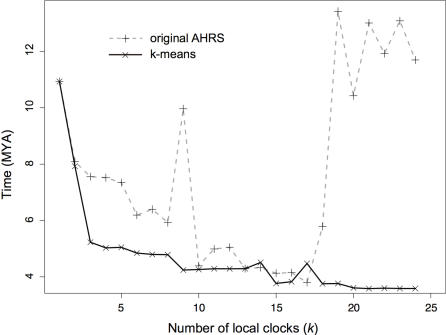
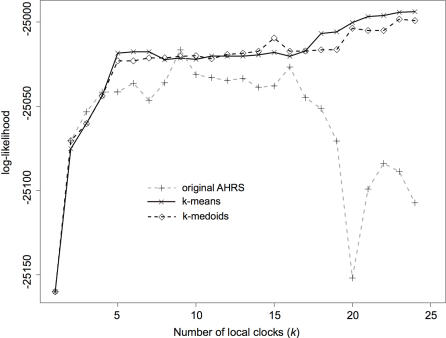
A significant modification to a recently proposed ad hoc rate-smoothing algorithm is described, in which local molecular clocks are automatically placed on a phylogeny. This modification makes use of hybrid approaches that borrow from recent theoretical developments in microarray data analysis. An ad hoc integration of phylogenetic uncertainty under these local clock models is also described. The performance and accuracy of the new methods are evaluated by reanalyzing three published data sets.
It is shown that the new maximum likelihood hybrid methods can perform better than penalized likelihood and almost as well as uncorrelated Bayesian models. However, the new methods still tend to underestimate the actual amount of rate change. This work demonstrates the difficulty of estimating divergence times using local molecular clocks.
由于无法直接从分子数据中估计进化率和物种分歧时间,因此所有当前的约会方法都需要在推断任何分歧时间之前做出特定的假设。这些假设通常要么涉及分子进化的速度(分子钟假设、局部时钟模型),要么同时涉及速度和时间(罚分似然法、贝叶斯方法)。然而,这些假设中的大多数都会影响估计的日期,通常是因为它们低估了大量的速度变化。
本文描述了一种最近提出的特殊速率平滑算法的重大修改,该算法可自动将局部分子钟放置在系统发育树上。这种修改利用了混合方法,借鉴了微阵列数据分析中的最新理论发展。还描述了在这些局部时钟模型下对系统发育不确定性的特殊集成。通过重新分析三个已发表的数据集来评估新方法的性能和准确性。
结果表明,新的最大似然混合方法的性能可以优于罚分似然法,并且几乎与不相关的贝叶斯模型一样好。然而,新方法仍然倾向于低估实际的速率变化量。这项工作表明,使用局部分子钟估计分歧时间具有一定的难度。