Departamento Fisiología General, Facultad de Medicina, Universidad de Málaga, Málaga, Spain.
PLoS One. 2007 Sep 12;2(9):e888. doi: 10.1371/journal.pone.0000888.
The neuronal cortical network generates slow (<1 Hz) spontaneous rhythmic activity that emerges from the recurrent connectivity. This activity occurs during slow wave sleep or anesthesia and also in cortical slices, consisting of alternating up (active, depolarized) and down (silent, hyperpolarized) states. The search for the underlying mechanisms and the possibility of analyzing network dynamics in vitro has been subject of numerous studies. This exposes the need for a detailed quantitative analysis of the membrane fluctuating behavior and computerized tools to automatically characterize the occurrence of up and down states.
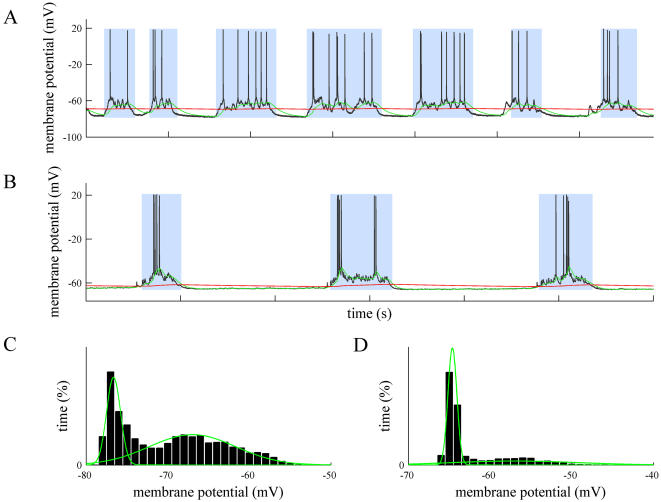
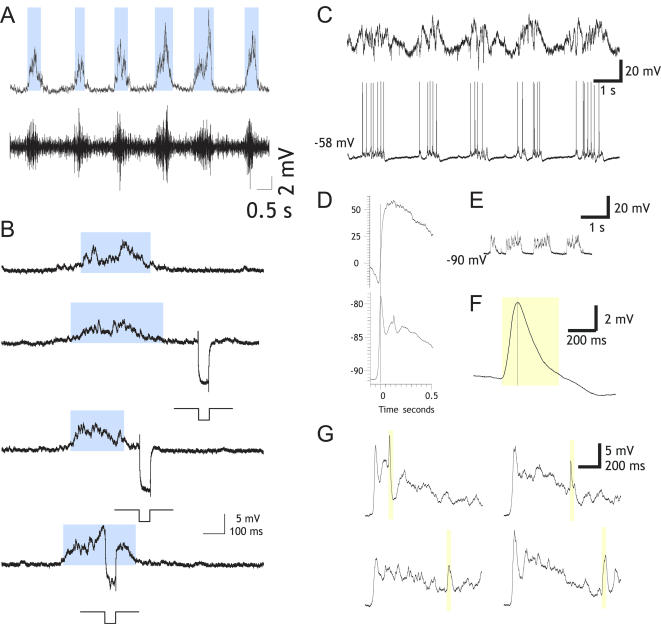
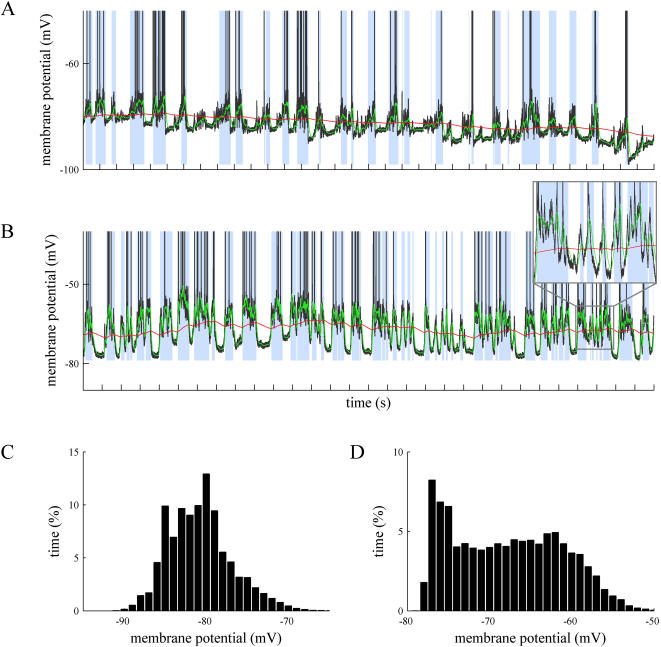
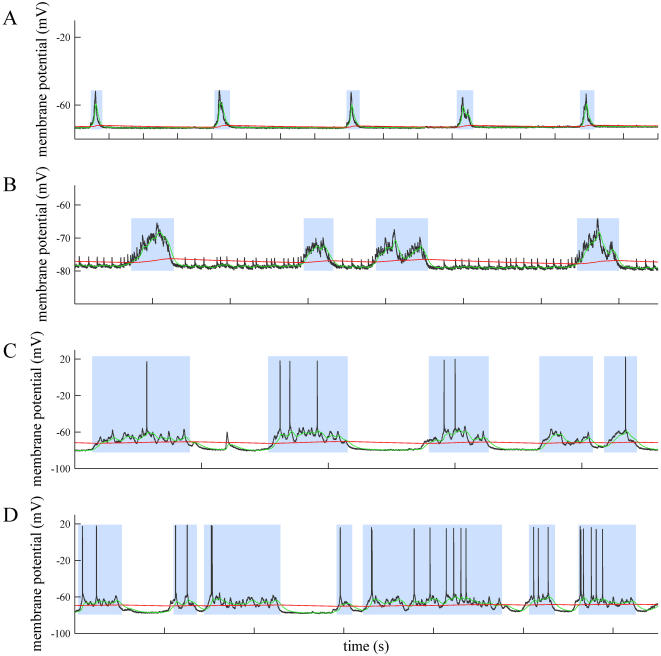
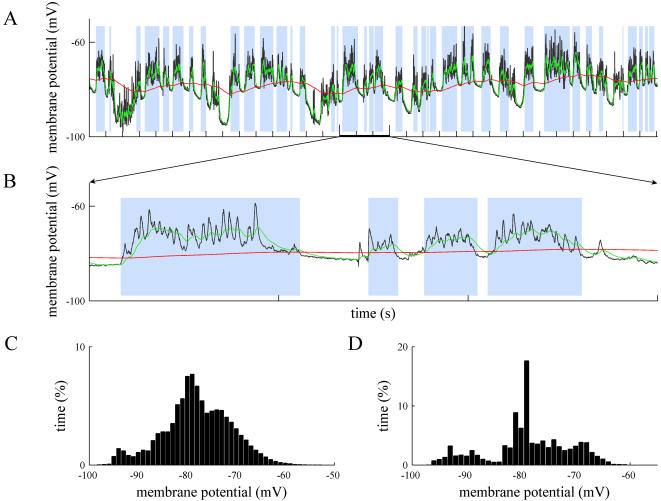
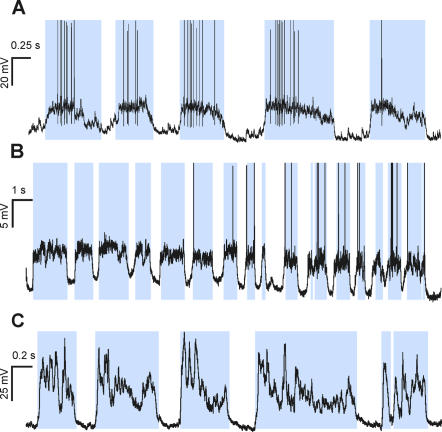
METHODOLOGY/PRINCIPAL FINDINGS: Intracellular recordings from different areas of the cerebral cortex were obtained from both in vitro and in vivo preparations during slow oscillations. A method that separates up and down states recorded intracellularly is defined and analyzed here. The method exploits the crossover of moving averages, such that transitions between up and down membrane regimes can be anticipated based on recent and past voltage dynamics. We demonstrate experimentally the utility and performance of this method both offline and online, the online use allowing to trigger stimulation or other events in the desired period of the rhythm. This technique is compared with a histogram-based approach that separates the states by establishing one or two discriminating membrane potential levels. The robustness of the method presented here is tested on data that departs from highly regular alternating up and down states.
CONCLUSIONS/SIGNIFICANCE: We define a simple method to detect cortical states that can be applied in real time for offline processing of large amounts of recorded data on conventional computers. Also, the online detection of up and down states will facilitate the study of cortical dynamics. An open-source MATLAB toolbox, and Spike 2-compatible version are made freely available.
神经元皮质网络产生慢波(<1 Hz)自发节律性活动,这种活动源自于递归连接。这种活动发生在慢波睡眠或麻醉期间,也发生在皮质切片中,由交替的上升(活跃、去极化)和下降(沉默、超极化)状态组成。对潜在机制的研究以及在体外分析网络动力学的可能性一直是许多研究的主题。这就需要对膜波动行为进行详细的定量分析,并开发计算机化工具来自动描述上升和下降状态的发生。
方法/主要发现:在慢波振荡期间,从体外和体内准备的大脑皮质的不同区域获得了细胞内记录。这里定义并分析了一种分离细胞内记录的上升和下降状态的方法。该方法利用移动平均值的交叉,使得可以根据最近和过去的电压动态来预测上升和下降膜状态之间的转换。我们在线下和在线实验中演示了这种方法的实用性和性能,在线使用允许在节律的期望时间段内触发刺激或其他事件。与通过建立一个或两个判别膜电位水平来分离状态的基于直方图的方法相比,该技术测试了这里提出的方法的稳健性。
结论/意义:我们定义了一种简单的方法来检测皮质状态,可以实时应用于常规计算机上大量记录数据的离线处理。此外,上升和下降状态的在线检测将有助于皮质动力学的研究。我们提供了一个免费的开源 MATLAB 工具箱和 Spike 2 兼容版本。