Nanbo Asuka, Sugden Arthur, Sugden Bill
McArdle Laboratory for Cancer Research, University of Wisconsin, Madison, WI 53706, USA.
EMBO J. 2007 Oct 3;26(19):4252-62. doi: 10.1038/sj.emboj.7601853. Epub 2007 Sep 13.
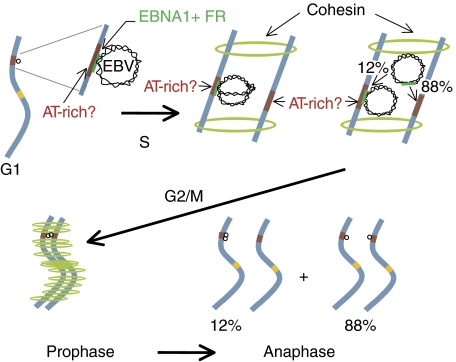
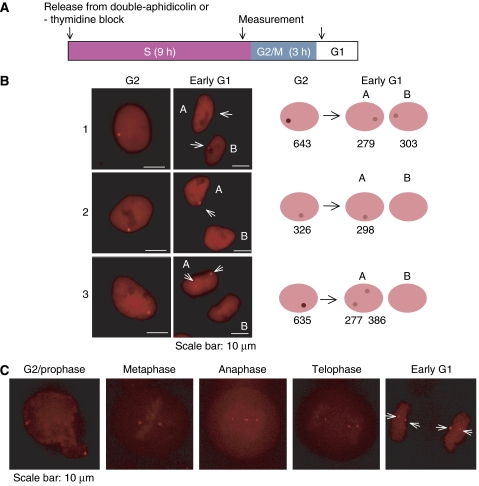
Epstein-Barr virus (EBV) is an exceptionally successful human viral pathogen maintained as a licensed, plasmid replicon in proliferating cells. We have measured the distributions of EBV-derived plasmids in single live cells throughout the cell cycle in the absence of selection and confirmed the measured rates of duplication and partitioning computationally and experimentally. These analyses have uncovered a striking, non-random partitioning for this minimalist plasmid replicon and revealed additional properties of it and its host cells: (1) 84% of the plasmids duplicate during each S phase; (2) all duplicated plasmids are spatially colocalized as pairs, a positioning that is coupled to their non-random partitioning; (3) each clone of cells requires a certain threshold number of plasmids per cell for its optimal growth under selection; (4) defects in plasmid synthesis and partitioning are balanced to yield wide distributions of plasmids in clonal populations of cells for which the plasmids provide a selective advantage. These properties of its plasmid replicon underlie EBV's success as a human pathogen.
爱泼斯坦-巴尔病毒(EBV)是一种极其成功的人类病毒病原体,在增殖细胞中作为一种许可的质粒复制子存在。我们在无选择条件下测量了整个细胞周期中单个活细胞内EBV衍生质粒的分布,并通过计算和实验证实了所测得的复制和分配速率。这些分析揭示了这种极简质粒复制子惊人的非随机分配,并揭示了其及其宿主细胞的其他特性:(1)84%的质粒在每个S期复制;(2)所有复制的质粒在空间上成对共定位,这种定位与其非随机分配相关联;(3)在选择条件下,每个细胞克隆需要每个细胞有一定阈值数量的质粒才能实现最佳生长;(4)质粒合成和分配中的缺陷相互平衡,从而在质粒赋予选择性优势的细胞克隆群体中产生广泛的质粒分布。其质粒复制子的这些特性是EBV作为人类病原体成功的基础。