Hutchison Clyde A
J. Craig Venter Institute, 9704 Medical Center Drive, Rockville, MD 20850, USA.
Nucleic Acids Res. 2007;35(18):6227-37. doi: 10.1093/nar/gkm688. Epub 2007 Sep 12.
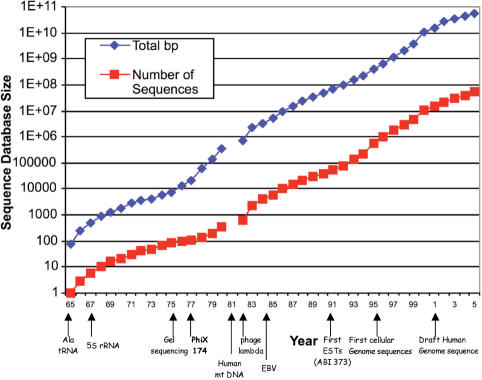
Fifteen years elapsed between the discovery of the double helix (1953) and the first DNA sequencing (1968). Modern DNA sequencing began in 1977, with development of the chemical method of Maxam and Gilbert and the dideoxy method of Sanger, Nicklen and Coulson, and with the first complete DNA sequence (phage X174), which demonstrated that sequence could give profound insights into genetic organization. Incremental improvements allowed sequencing of molecules >200 kb (human cytomegalovirus) leading to an avalanche of data that demanded computational analysis and spawned the field of bioinformatics. The US Human Genome Project spurred sequencing activity. By 1992 the first 'sequencing factory' was established, and others soon followed. The first complete cellular genome sequences, from bacteria, appeared in 1995 and other eubacterial, archaebacterial and eukaryotic genomes were soon sequenced. Competition between the public Human Genome Project and Celera Genomics produced working drafts of the human genome sequence, published in 2001, but refinement and analysis of the human genome sequence will continue for the foreseeable future. New 'massively parallel' sequencing methods are greatly increasing sequencing capacity, but further innovations are needed to achieve the 'thousand dollar genome' that many feel is prerequisite to personalized genomic medicine. These advances will also allow new approaches to a variety of problems in biology, evolution and the environment.
从双螺旋结构的发现(1953年)到首次DNA测序(1968年),过去了15年。现代DNA测序始于1977年,当时Maxam和Gilbert的化学方法以及Sanger、Nicklen和Coulson的双脱氧方法得以发展,同时还得到了首个完整的DNA序列(噬菌体X174),这表明序列能够为遗传组织提供深刻见解。不断的改进使得对大于200 kb的分子(人类巨细胞病毒)进行测序成为可能,从而产生了大量需要进行计算分析的数据,并催生了生物信息学领域。美国人类基因组计划推动了测序活动。到1992年,首个“测序工厂”成立,随后其他工厂也纷纷涌现。1995年,细菌的首个完整细胞基因组序列问世,其他真细菌、古细菌和真核生物基因组也很快被测序。公共人类基因组计划与赛雷拉基因组公司之间的竞争产生了人类基因组序列的工作草图,并于2001年发表,但在可预见的未来,对人类基因组序列的完善和分析仍将继续。新的“大规模平行”测序方法正在大幅提高测序能力,但仍需要进一步创新,以实现许多人认为是个性化基因组医学先决条件的“一千美元基因组”。这些进展还将为解决生物学、进化和环境方面的各种问题带来新方法。