Kumanyika Shiriki K, Whitt-Glover Melicia C, Gary Tiffany L, Prewitt T Elaine, Odoms-Young Angela M, Banks-Wallace Joanne, Beech Bettina M, Halbert Chanita Hughes, Karanja Njeri, Lancaster Kristie J, Samuel-Hodge Carmen D
University of Pennsylvania School of Medicine, CCEB, 8th Floor Blockley Hall, 423 Guardian Dr, Philadelphia PA 19104-6021, USA.
Prev Chronic Dis. 2007 Oct;4(4):A112. Epub 2007 Sep 15.
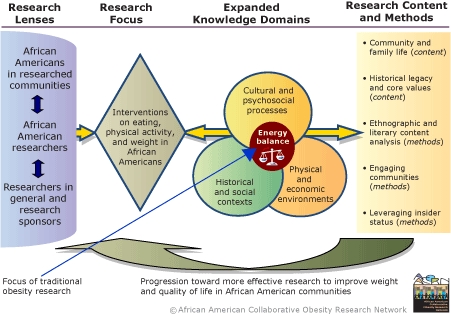
Obesity is more prevalent among African Americans and other racial and ethnic minority populations than among whites. The behaviors that determine weight status are embedded in the core social and cultural processes and environments of day-to-day life in these populations. Therefore, identifying effective, sustainable solutions to obesity requires an ecological model that is inclusive of relevant contextual variables. Race and ethnicity are potent stratification variables in U.S. society and strongly influence life contexts, including many aspects that relate to eating and physical activity behaviors. This article describes a synthesis initiated by the African American Collaborative Obesity Research Network (AACORN) to build and broaden the obesity research paradigm. The focus is on African Americans, but the expanded paradigm has broader implications and may apply to other populations of color. The synthesis involves both community and researcher perspectives, drawing on and integrating insights from an expanded set of knowledge domains to promote a deeper understanding of relevant contexts. To augment the traditional, biomedical focus on energy balance, the expanded paradigm includes insights from family sociology, literature, philosophy, transcultural psychology, marketing, economics, and studies of the built environment. We also emphasize the need for more attention to tensions that may affect African American or other researchers who identify or are identified as members of the communities they study. This expanded paradigm, for which development is ongoing, poses new challenges for researchers who focus on obesity and obesity-related health disparities but also promises discovery of new directions that can lead to new solutions.
肥胖在非裔美国人以及其他种族和少数族裔人群中比在白人中更为普遍。决定体重状况的行为根植于这些人群日常生活的核心社会和文化进程及环境之中。因此,要找到解决肥胖问题的有效且可持续的办法,就需要一个包含相关背景变量的生态模型。种族和族裔是美国社会中强有力的分层变量,对生活环境有着重大影响,包括与饮食及身体活动行为相关的诸多方面。本文介绍了由非裔美国人肥胖协作研究网络(AACORN)发起的一项综合研究,旨在构建并拓展肥胖研究范式。重点是针对非裔美国人,但扩展后的范式具有更广泛的意义,可能适用于其他有色人种群体。该综合研究涉及社区和研究人员的观点,借鉴并整合了一系列扩展知识领域的见解,以促进对相关背景的更深入理解。为了超越传统生物医学对能量平衡的关注,扩展后的范式纳入了家庭社会学、文学、哲学、跨文化心理学、市场营销、经济学以及建筑环境研究等方面的见解。我们还强调需要更多地关注可能影响那些认同自己或被视为所研究社区成员的非裔美国研究人员或其他研究人员的紧张关系。这个仍在不断发展的扩展范式,给专注于肥胖及与肥胖相关的健康差异的研究人员带来了新的挑战,但也有望发现能带来新解决方案的新方向。