School of Life Science, East China Normal University, Shanghai, China.
PLoS One. 2007 Sep 19;2(9):e900. doi: 10.1371/journal.pone.0000900.
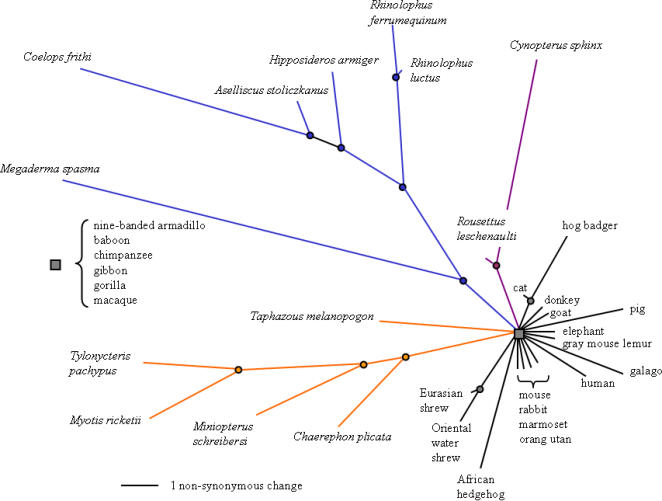
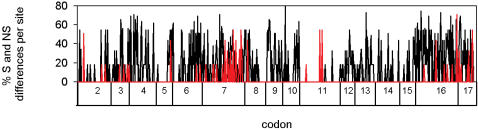
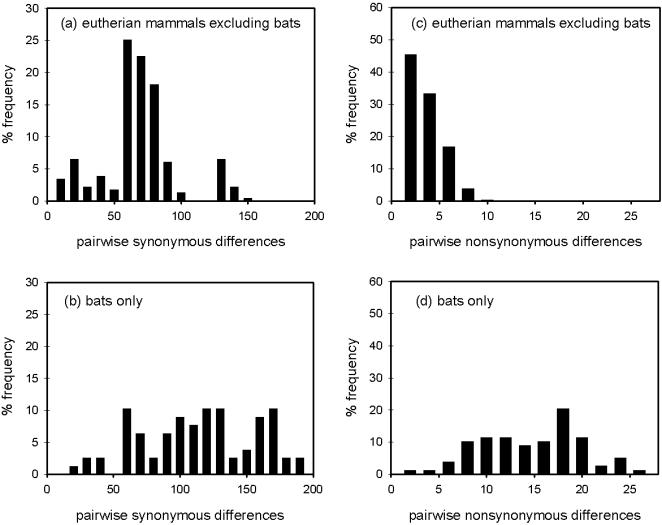
FOXP2 is a transcription factor implicated in the development and neural control of orofacial coordination, particularly with respect to vocalisation. Observations that orthologues show almost no variation across vertebrates yet differ by two amino acids between humans and chimpanzees have led to speculation that recent evolutionary changes might relate to the emergence of language. Echolocating bats face especially challenging sensorimotor demands, using vocal signals for orientation and often for prey capture. To determine whether mutations in the FoxP2 gene could be associated with echolocation, we sequenced FoxP2 from echolocating and non-echolocating bats as well as a range of other mammal species. We found that contrary to previous reports, FoxP2 is not highly conserved across all nonhuman mammals but is extremely diverse in echolocating bats. We detected divergent selection (a change in selective pressure) at FoxP2 between bats with contrasting sonar systems, suggesting the intriguing possibility of a role for FoxP2 in the evolution and development of echolocation. We speculate that observed accelerated evolution of FoxP2 in bats supports a previously proposed function in sensorimotor coordination.
FOXP2 是一种转录因子,与口面部协调的发育和神经控制有关,特别是与发声有关。观察到直系同源物在脊椎动物中几乎没有变化,但人类和黑猩猩之间有两个氨基酸的差异,这导致了这样一种推测,即最近的进化变化可能与语言的出现有关。回声定位蝙蝠面临着特别具有挑战性的感觉运动需求,它们使用声音信号进行定向,并且经常用于捕捉猎物。为了确定 FoxP2 基因中的突变是否与回声定位有关,我们对回声定位和非回声定位蝙蝠以及一系列其他哺乳动物物种的 FoxP2 进行了测序。我们发现,与之前的报道相反,FoxP2 在所有非人类哺乳动物中并不是高度保守的,而是在回声定位蝙蝠中非常多样化。我们在具有不同声纳系统的蝙蝠之间检测到 FoxP2 的分歧选择(选择压力的变化),这表明 FoxP2 在回声定位的进化和发展中可能具有作用。我们推测,在蝙蝠中观察到的 FoxP2 加速进化支持了以前提出的在感觉运动协调中的作用。