Woo Sukyung, Krzyzanski Wojciech, Jusko William J
Department of Pharmaceutical Sciences, School of Pharmacy and Pharmaceutical Sciences, State University of New York at Buffalo, 565 Hochstetter Hall, Buffalo, NY 14260, USA.
Cancer Chemother Pharmacol. 2008 Jun;62(1):123-33. doi: 10.1007/s00280-007-0582-9. Epub 2007 Sep 22.
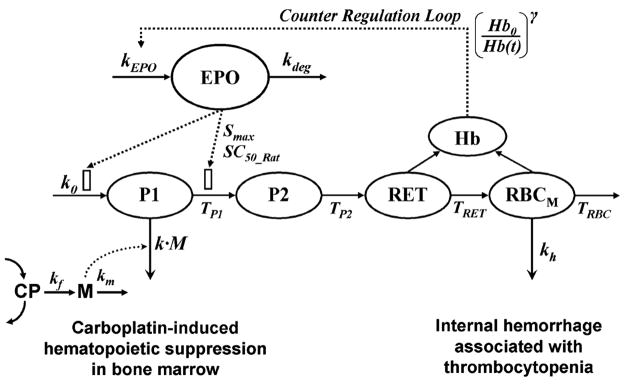
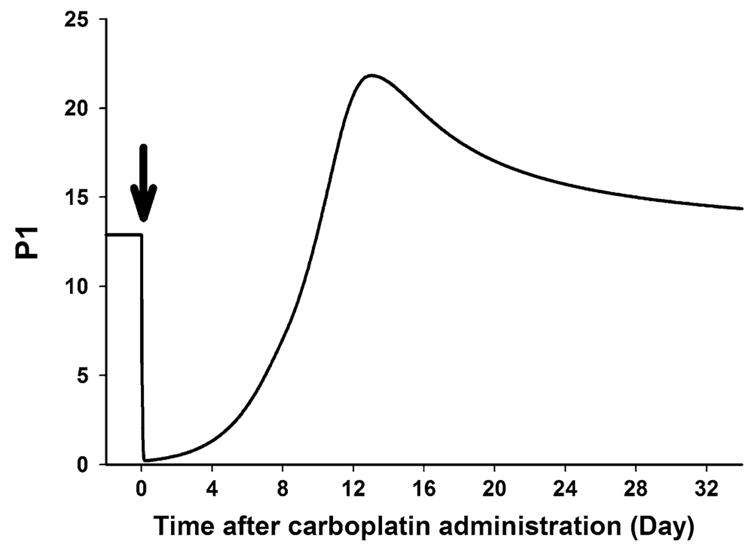
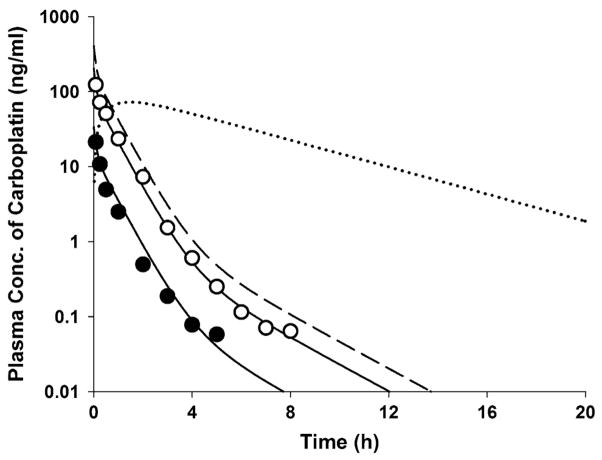
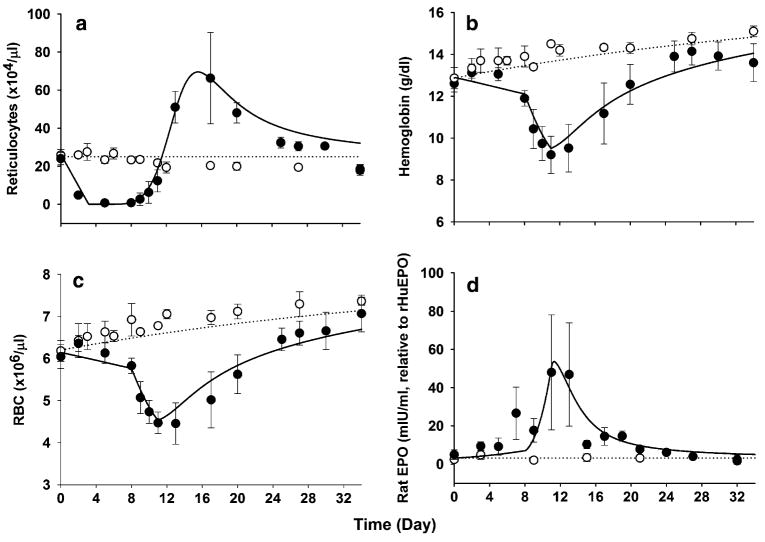
Anticancer agents often cause bone marrow toxicity resulting in progressive anemia which may influence the therapeutic effects of erythropoietic-stimulating agents. The objective of this study was to develop a pharmacodynamic (PD) model to describe chemotherapy-induced anemia in rats. Anemia was induced in male Wistar rats with a single intravenous (i.v.) injection of 60 mg/kg carboplatin. Hematological responses including reticulocytes, red blood cells (RBC), hemoglobin, and endogenous rat erythropoietin (EPO) were measured for up to 4 weeks. A catenary, lifespan-based, indirect response model served as a basic PD model to represent erythroid cellular populations in the bone marrow and blood involved in erythropoiesis. The model assumed that actively proliferating progenitor cells in the bone marrow are sensitive to anti-cancer agents and subject to an irreversible removal process. The removal rate of the target cells is proportional to drug activity concentrations and the cell numbers. An additional RBC loss from the circulation resulting from thrombocytopenia was described by a first-order process. The turnover process of rat EPO and EPO-mediated feedback inhibition mechanism regulated by hemoglobin changes were incorporated. Reticulocyte counts decreased rapidly and reached a nadir by day 3 after administration of carboplatin and returned to the baseline by day 13. This was followed by a gradual increase and the rebound peak occurred at about day 15. The hemoglobin nadir was approximately 9 g/dl observed at about 11-13 days compared to its normal value of 13 g/dl and hemoglobin returned to the baseline by day 30. The increase in endogenous rat EPO mirrored inversely hemoglobin changes and the maximum increase was observed soon after the hemoglobin nadir. The carboplatin-treated rats exhibited progressive anemia. The proposed model adequately described the time course of hematological changes after carboplatin in rats and can be a useful tool to explore potential strategies for the management of anemia caused by chemotherapy.
抗癌药物常导致骨髓毒性,进而引发进行性贫血,这可能会影响促红细胞生成剂的治疗效果。本研究的目的是建立一个药效学(PD)模型,以描述大鼠化疗诱导的贫血。通过单次静脉注射60mg/kg卡铂,诱导雄性Wistar大鼠发生贫血。在长达4周的时间内,测量包括网织红细胞、红细胞(RBC)、血红蛋白和内源性大鼠促红细胞生成素(EPO)在内的血液学反应。一个基于寿命的链状间接反应模型作为基本的PD模型,用于表示参与红细胞生成的骨髓和血液中的红系细胞群体。该模型假设骨髓中活跃增殖的祖细胞对抗癌药物敏感,并经历不可逆的清除过程。靶细胞的清除率与药物活性浓度和细胞数量成正比。由血小板减少导致的循环中额外的红细胞损失通过一级过程来描述。纳入了大鼠EPO的周转过程以及由血红蛋白变化调节的EPO介导的反馈抑制机制。卡铂给药后第3天,网织红细胞计数迅速下降并达到最低点,第13天恢复到基线水平。随后逐渐上升,约在第15天出现反弹峰值。与正常水平13g/dl相比,血红蛋白最低点约在11 - 13天出现,约为9g/dl,第30天血红蛋白恢复到基线水平。内源性大鼠EPO的增加与血红蛋白变化呈相反关系,在血红蛋白最低点后不久观察到最大增幅。卡铂治疗的大鼠表现出进行性贫血。所提出的模型充分描述了卡铂给药后大鼠血液学变化的时间进程,可作为探索化疗所致贫血管理潜在策略的有用工具。