Gyurak Anett, Ayduk Ozlem
University of California, Berkeley, CA 94720, USA.
Psychol Sci. 2007 Oct;18(10):886-92. doi: 10.1111/j.1467-9280.2007.01996.x.
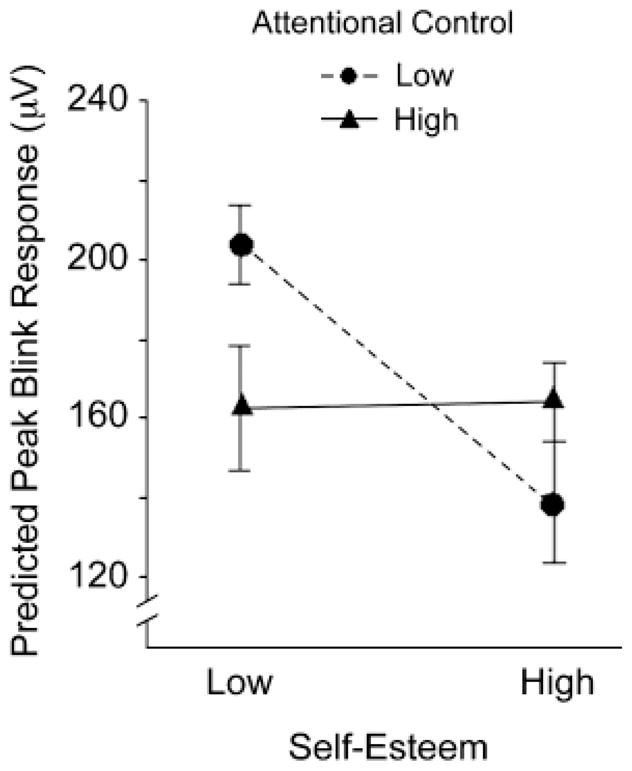
We examined the hypothesis that rejection automatically elicits defensive physiological reactions in people with low self-esteem (SE) but that attentional control moderates this effect. Undergraduates (N= 67) completed questionnaire measures of SE and attentional control. Their eye-blink responses to startle probes were measured while they viewed paintings related to rejection and acceptance themes. The stimuli also included positive-, negative-, and neutral-valence control paintings unrelated to rejection. As predicted, compared with people high in SE, those low in SE showed stronger startle eye-blink responses to paintings related to rejection, but not to negative paintings. Paintings related to acceptance did not attenuate their physiological reactivity. Furthermore, attentional control moderated their sensitivity to rejection, such that low SE was related to greater eye-blink responses to rejection only among individuals who were low in attentional control. Implications of the role of attentional control as a top-down process regulating emotional reactivity in people with low SE are discussed.
拒绝会自动引发低自尊人群的防御性生理反应,但注意控制会调节这种效应。本科生(N = 67)完成了自尊和注意控制的问卷调查。在他们观看与拒绝和接受主题相关的画作时,测量他们对惊吓探测的眨眼反应。刺激物还包括与拒绝无关的正价、负价和中性价控制画作。正如预测的那样,与高自尊者相比,低自尊者对与拒绝相关的画作表现出更强的惊吓眨眼反应,但对负价画作则不然。与接受相关的画作并未减弱他们的生理反应性。此外,注意控制调节了他们对拒绝的敏感性,以至于只有在注意控制能力低的个体中,低自尊才与对拒绝的更大眨眼反应相关。本文讨论了注意控制作为一种自上而下的过程对低自尊者情绪反应性的调节作用的意义。