Lim H W Gerald, Huber Greg, Torii Yoshihiro, Hirata Aiko, Miller Jonathan, Sazer Shelley
Department of Biochemistry and Molecular Biology, Baylor College of Medicine, Houston, Texas, USA.
PLoS One. 2007 Sep 26;2(9):e948. doi: 10.1371/journal.pone.0000948.
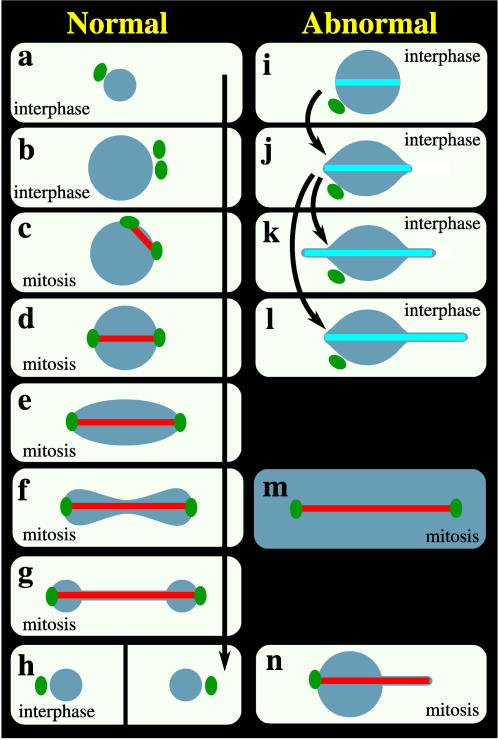
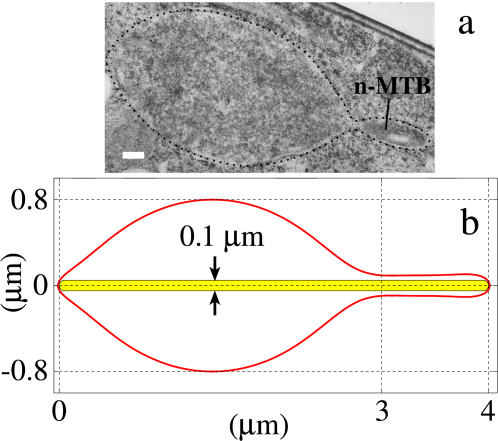
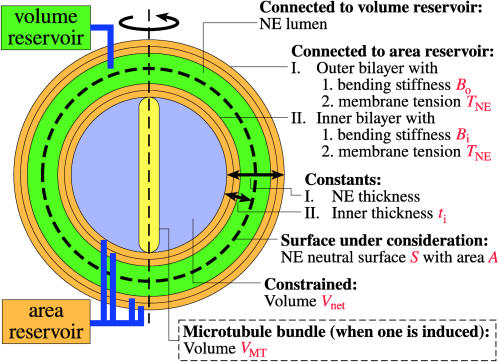
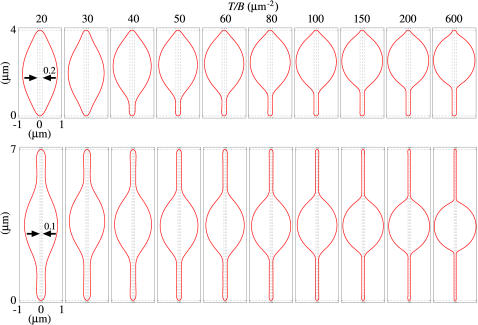
It has long been known that during the closed mitosis of many unicellular eukaryotes, including the fission yeast (Schizosaccharomyces pombe), the nuclear envelope remains intact while the nucleus undergoes a remarkable sequence of shape transformations driven by elongation of an intranuclear mitotic spindle whose ends are capped by spindle pole bodies embedded in the nuclear envelope. However, the mechanical basis of these normal cell cycle transformations, and abnormal nuclear shapes caused by intranuclear elongation of microtubules lacking spindle pole bodies, remain unknown. Although there are models describing the shapes of lipid vesicles deformed by elongation of microtubule bundles, there are no models describing normal or abnormal shape changes in the nucleus. We describe here a novel biophysical model of interphase nuclear geometry in fission yeast that accounts for critical aspects of the mechanics of the fission yeast nucleus, including the biophysical properties of lipid bilayers, forces exerted on the nuclear envelope by elongating microtubules, and access to a lipid reservoir, essential for the large increase in nuclear surface area during the cell cycle. We present experimental confirmation of the novel and non-trivial geometries predicted by our model, which has no free parameters. We also use the model to provide insight into the mechanical basis of previously described defects in nuclear division, including abnormal nuclear shapes and loss of nuclear envelope integrity. The model predicts that (i) despite differences in structure and composition, fission yeast nuclei and vesicles with fluid lipid bilayers have common mechanical properties; (ii) the S. pombe nucleus is not lined with any structure with shear resistance, comparable to the nuclear lamina of higher eukaryotes. We validate the model and its predictions by analyzing wild type cells in which ned1 gene overexpression causes elongation of an intranuclear microtubule bundle that deforms the nucleus of interphase cells.
长期以来,人们一直知道,在包括裂殖酵母(Schizosaccharomyces pombe)在内的许多单细胞真核生物的封闭有丝分裂过程中,核膜保持完整,而细胞核经历一系列显著的形状转变,这是由核内有丝分裂纺锤体的伸长驱动的,纺锤体的两端由嵌入核膜的纺锤极体覆盖。然而,这些正常细胞周期转变的力学基础,以及由缺乏纺锤极体的微管在核内伸长导致的异常核形状,仍然未知。尽管有模型描述了由微管束伸长而变形的脂质囊泡的形状,但没有描述细胞核正常或异常形状变化的模型。我们在此描述了一种裂殖酵母间期核几何结构的新型生物物理模型,该模型解释了裂殖酵母细胞核力学的关键方面,包括脂质双层的生物物理特性、伸长的微管对核膜施加的力,以及对脂质库的获取,这对于细胞周期中核表面积的大幅增加至关重要。我们提供了对我们模型预测的新颖且非平凡几何形状的实验验证,该模型没有自由参数。我们还使用该模型深入了解先前描述的核分裂缺陷的力学基础,包括异常核形状和核膜完整性丧失。该模型预测:(i)尽管结构和组成存在差异,但裂殖酵母细胞核和具有流体脂质双层的囊泡具有共同的力学特性;(ii)粟酒裂殖酵母细胞核没有内衬任何具有抗剪切性的结构,这与高等真核生物的核纤层相当。我们通过分析野生型细胞来验证该模型及其预测,在这些细胞中,ned1基因的过表达会导致核内微管束伸长,从而使间期细胞的细胞核变形。