Kaper Thijs, Looger Loren L, Takanaga Hitomi, Platten Michael, Steinman Lawrence, Frommer Wolf B
Department of Plant Biology, Carnegie Institution, Stanford, California, United States of America.
PLoS Biol. 2007 Oct;5(10):e257. doi: 10.1371/journal.pbio.0050257.
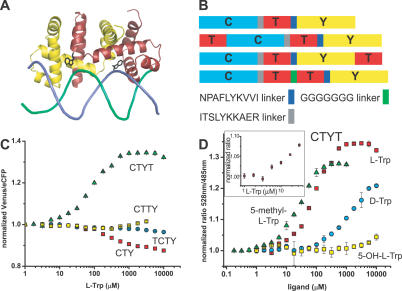
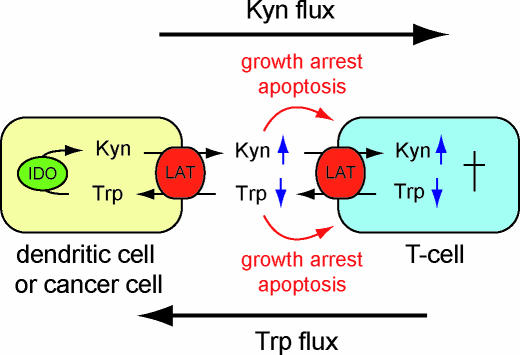
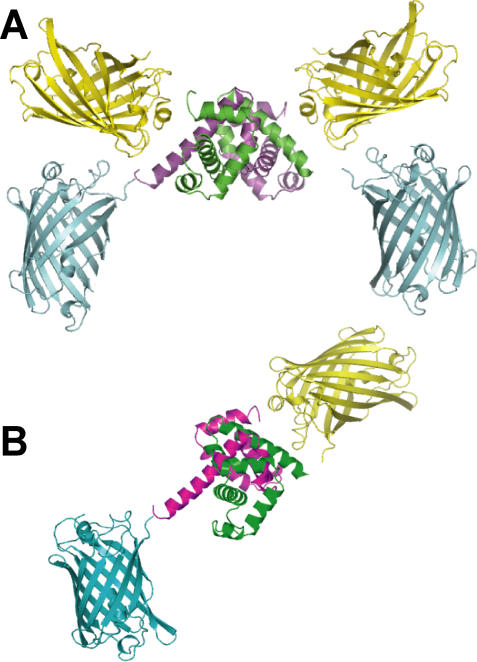
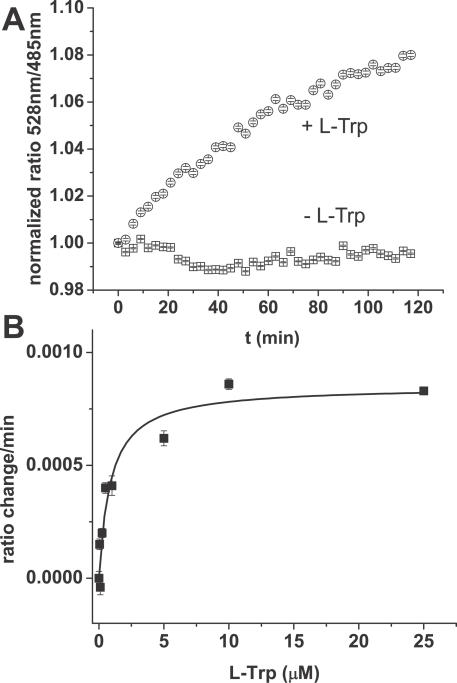
Mammalian cells rely on cellular uptake of the essential amino acid tryptophan. Tryptophan sequestration by up-regulation of the key enzyme for tryptophan degradation, indoleamine 2,3-dioxygenase (IDO), e.g., in cancer and inflammation, is thought to suppress the immune response via T cell starvation. Additionally, the excreted tryptophan catabolites (kynurenines) induce apoptosis of lymphocytes. Whereas tryptophan transport systems have been identified, the molecular nature of kynurenine export remains unknown. To measure cytosolic tryptophan steady-state levels and flux in real time, we developed genetically encoded fluorescence resonance energy transfer nanosensors (FLIPW). The transport properties detected by FLIPW in KB cells, a human oral cancer cell line, and COS-7 cells implicate LAT1, a transporter that is present in proliferative tissues like cancer, in tryptophan uptake. Importantly, we found that this transport system mediates tryptophan/kynurenine exchange. The tryptophan influx/kynurenine efflux cycle couples tryptophan starvation to elevation of kynurenine serum levels, providing a two-pronged induction of apoptosis in neighboring cells. The strict coupling protects cells that overproduce IDO from kynurenine accumulation. Consequently, this mechanism may contribute to immunosuppression involved in autoimmunity and tumor immune escape.
哺乳动物细胞依赖于对必需氨基酸色氨酸的细胞摄取。例如,在癌症和炎症中,通过上调色氨酸降解的关键酶吲哚胺2,3-双加氧酶(IDO)来隔离色氨酸,被认为是通过T细胞饥饿来抑制免疫反应。此外,排泄的色氨酸分解代谢产物(犬尿氨酸)可诱导淋巴细胞凋亡。虽然已经确定了色氨酸转运系统,但犬尿氨酸输出的分子本质仍然未知。为了实时测量胞质色氨酸的稳态水平和通量,我们开发了基因编码的荧光共振能量转移纳米传感器(FLIPW)。FLIPW在人口腔癌细胞系KB细胞和COS-7细胞中检测到的转运特性表明,一种存在于癌症等增殖组织中的转运蛋白LAT1参与了色氨酸的摄取。重要的是,我们发现这种转运系统介导色氨酸/犬尿氨酸交换。色氨酸流入/犬尿氨酸流出循环将色氨酸饥饿与犬尿氨酸血清水平升高联系起来,从而在相邻细胞中提供双重诱导凋亡的作用。这种严格的偶联保护过度产生IDO的细胞免受犬尿氨酸积累的影响。因此,这种机制可能有助于自身免疫和肿瘤免疫逃逸中的免疫抑制。