Coley Andrew M, Gupta Aditi, Murphy Vince J, Bai Tao, Kim Hanna, Foley Michael, Anders Robin F, Batchelor Adrian H
Cooperative Research Center for Diagnostics, Department of Biochemistry, La Trobe University, Victoria, Australia.
PLoS Pathog. 2007 Sep 7;3(9):1308-19. doi: 10.1371/journal.ppat.0030138.
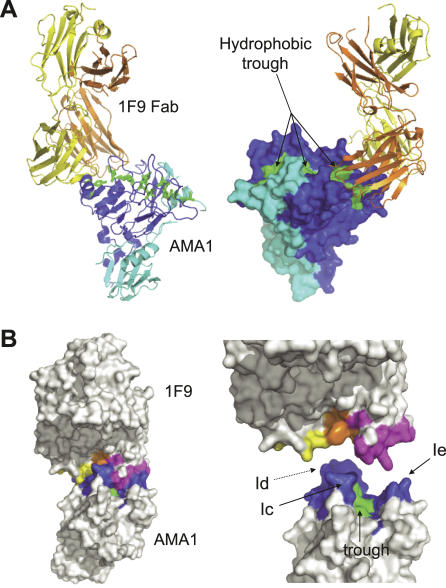
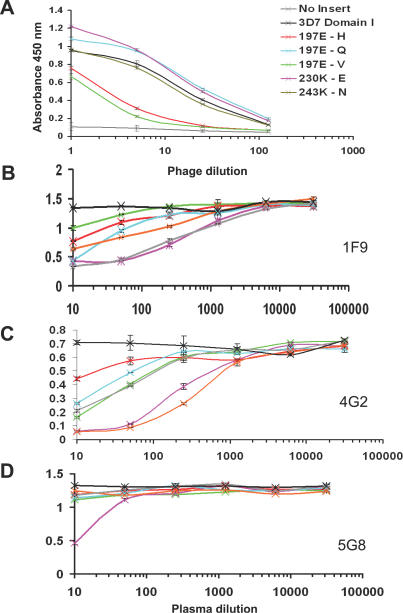
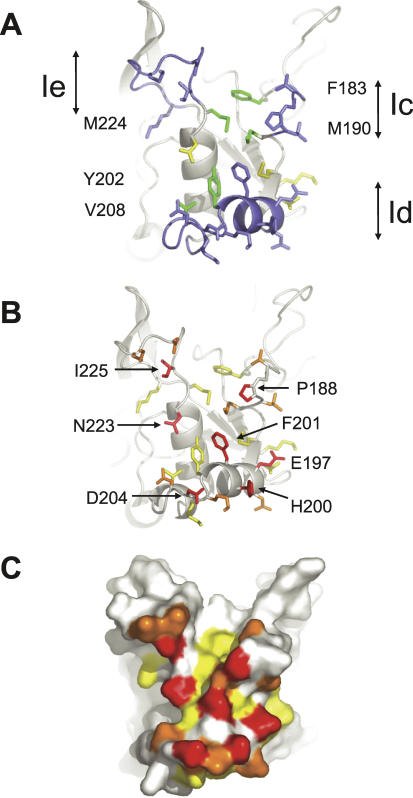
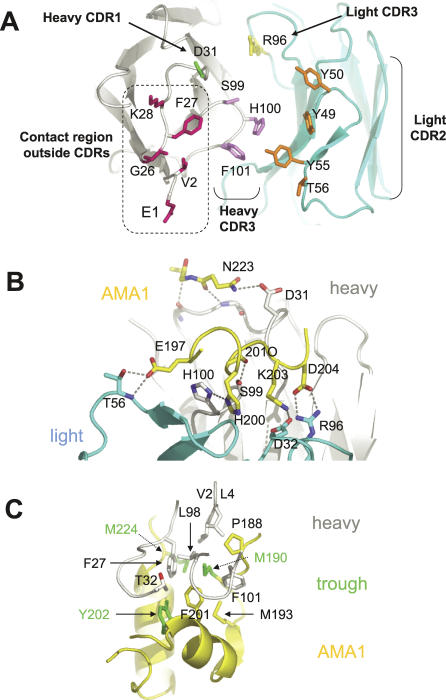
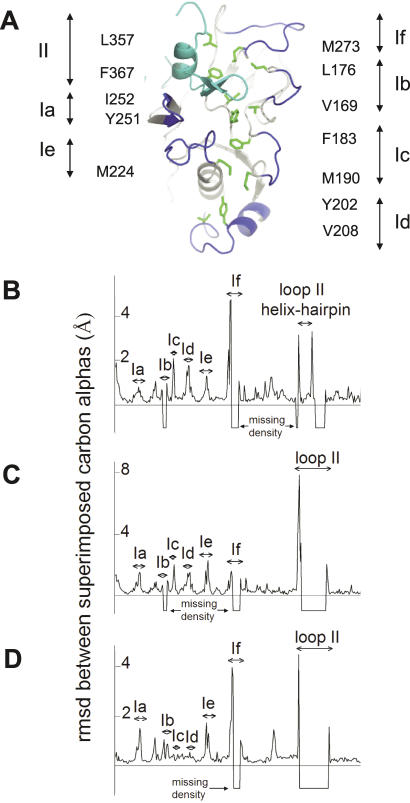
Identifying functionally critical regions of the malaria antigen AMA1 (apical membrane antigen 1) is necessary to understand the significance of the polymorphisms within this antigen for vaccine development. The crystal structure of AMA1 in complex with the Fab fragment of inhibitory monoclonal antibody 1F9 reveals that 1F9 binds to the AMA1 solvent-exposed hydrophobic trough, confirming its importance. 1F9 uses the heavy and light chain complementarity-determining regions (CDRs) to wrap around the polymorphic loops adjacent to the trough, but uses a ridge of framework residues to bind to the hydrophobic trough. The resulting 1F9-AMA1-combined buried surface of 2,470 A(2) is considerably larger than previously reported Fab-antigen interfaces. Mutations of polymorphic AMA1 residues within the 1F9 epitope disrupt 1F9 binding and dramatically reduce the binding of affinity-purified human antibodies. Moreover, 1F9 binding to AMA1 is competed by naturally acquired human antibodies, confirming that the 1F9 epitope is a frequent target of immunological attack.
确定疟疾抗原AMA1(顶膜抗原1)的功能关键区域对于理解该抗原内多态性在疫苗开发中的意义至关重要。AMA1与抑制性单克隆抗体1F9的Fab片段复合物的晶体结构表明,1F9与AMA1溶剂暴露的疏水凹槽结合,证实了其重要性。1F9利用重链和轻链互补决定区(CDR)环绕凹槽附近的多态性环,但利用框架残基的一条脊与疏水凹槽结合。由此产生的1F9-AMA1结合的掩埋表面面积为2470 Ų,远大于先前报道的Fab-抗原界面。1F9表位内多态性AMA1残基的突变会破坏1F9的结合,并显著降低亲和纯化的人抗体的结合。此外,1F9与AMA1的结合会受到天然获得的人抗体的竞争,这证实了1F9表位是免疫攻击的常见靶点。