Medland Sarah E, Loesch Danuta Z, Mdzewski Bogdan, Zhu Gu, Montgomery Grant W, Martin Nicholas G
Genetic Epidemiology Unit, Queensland Institute of Medical Research, Brisbane, Australia.
PLoS Genet. 2007 Sep;3(9):1736-44. doi: 10.1371/journal.pgen.0030165.
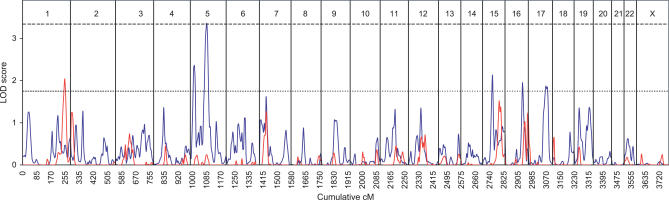
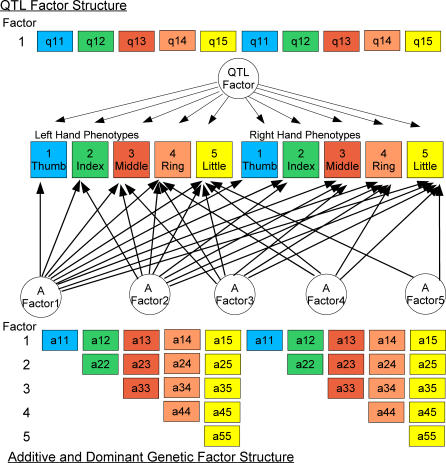
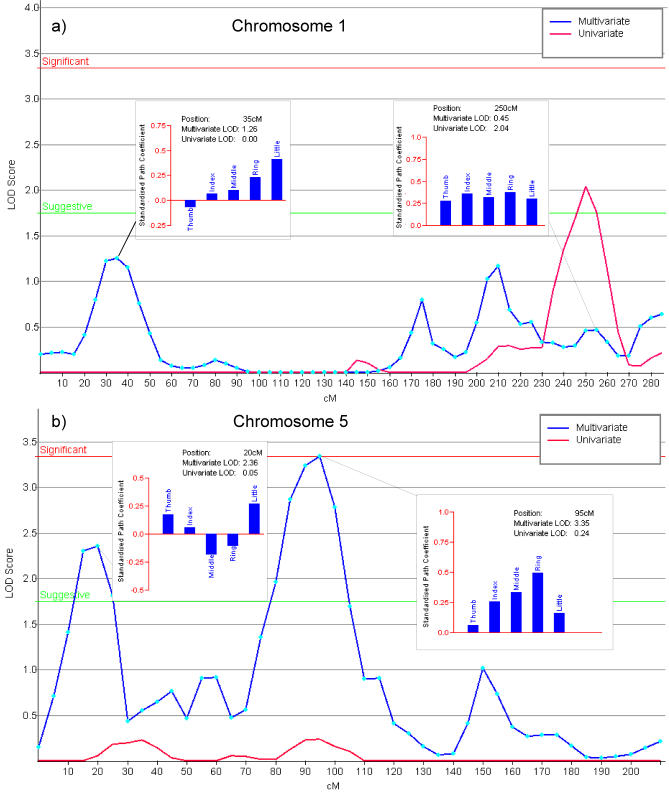
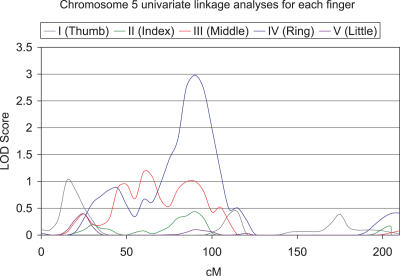
The finger ridge count (a measure of pattern size) is one of the most heritable complex traits studied in humans and has been considered a model human polygenic trait in quantitative genetic analysis. Here, we report the results of the first genome-wide linkage scan for finger ridge count in a sample of 2,114 offspring from 922 nuclear families. Both univariate linkage to the absolute ridge count (a sum of all the ridge counts on all ten fingers), and multivariate linkage analyses of the counts on individual fingers, were conducted. The multivariate analyses yielded significant linkage to 5q14.1 (Logarithm of odds [LOD] = 3.34, pointwise-empirical p-value = 0.00025) that was predominantly driven by linkage to the ring, index, and middle fingers. The strongest univariate linkage was to 1q42.2 (LOD = 2.04, point-wise p-value = 0.002, genome-wide p-value = 0.29). In summary, the combination of univariate and multivariate results was more informative than simple univariate analyses alone. Patterns of quantitative trait loci factor loadings consistent with developmental fields were observed, and the simple pleiotropic model underlying the absolute ridge count was not sufficient to characterize the interrelationships between the ridge counts of individual fingers.
指纹嵴计数(一种图案大小的测量方法)是人类研究中遗传性最强的复杂性状之一,在数量遗传学分析中被视为典型的人类多基因性状。在此,我们报告了对922个核心家庭的2114名后代样本进行指纹嵴计数全基因组连锁扫描的结果。我们既进行了与绝对嵴计数(十根手指上所有嵴计数的总和)的单变量连锁分析,也进行了对各个手指嵴计数的多变量连锁分析。多变量分析产生了与5q14.1的显著连锁(优势对数[LOD]=3.34,逐点经验p值=0.00025),这主要是由与无名指、食指和中指的连锁驱动的。最强的单变量连锁是与1q42.2(LOD=2.04,逐点p值=0.002,全基因组p值=0.29)。总之,单变量和多变量结果的结合比单纯的单变量分析提供了更多信息。观察到与发育领域一致的数量性状位点因子负荷模式,并且绝对嵴计数背后的简单多效性模型不足以描述各个手指嵴计数之间的相互关系。