Hwang Ki Tae, Han Wonshik, Bae Ji Yeon, Hwang Sung Eun, Shin Hyuk Jai, Lee Jeong Eon, Kim Sung Won, Min Hyun Jung, Noh Dong Young
Department of Surgery, Seoul National University Boramae Hospital, Seoul, Korea.
J Korean Med Sci. 2007 Sep;22 Suppl(Suppl):S24-31. doi: 10.3346/jkms.2007.22.S.S24.
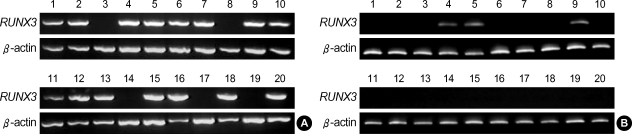
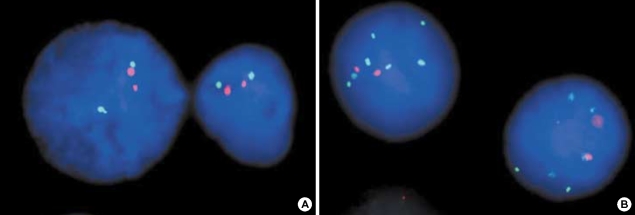
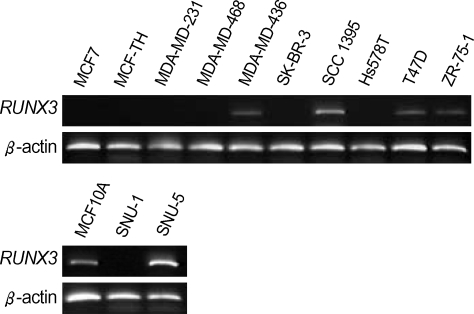
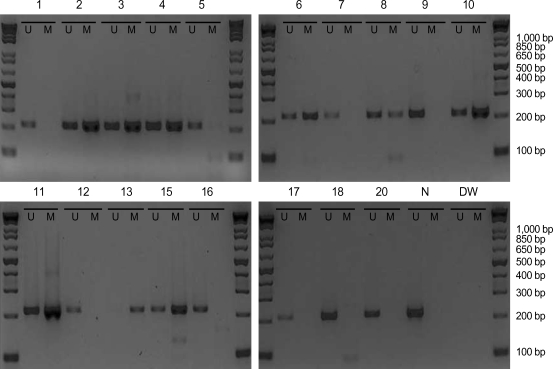
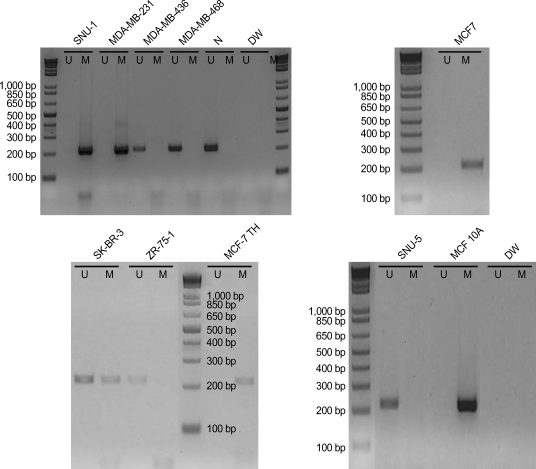
The RUNX3 gene is regarded as a tumor suppressor gene in many human solid tumors, and its inactivation is believed to be related with solid tumor carcinogenesis. As little information is available about the role of the RUNX3 gene in breast cancer, we investigated the relationship between the RUNX3 gene and breast cancer. We performed reverse transcriptase-polymerases chain reaction (RT-PCR), methylation specific PCR, and bicolor fluorescent in situ hybridization analysis in an effort to reveal related mechanisms. Forty breast tissue samples and 13 cell lines were used in this study. Eighty-five percent of breast cancer tissues showed downregulated RUNX3 gene expression, whereas it was downregulated in only 25% of normal breast tissues by RT-PCR assay. Sixty-seven percent of breast cancer cell lines showed downregulated RUNX3 expression, but the RUNX3 gene was not expressed in two normal breast cell lines. Hypermethylation was observed in 53% of breast cancer tissues and 57% of breast cancer cell lines. Hemizygous deletion was observed in 43% of breast cancer cell lines. Hypermethylation and/or hemizygous deletion was observed in 5 of 7 breast cancer cell lines, and the four of these five examined showed no RUNX3 gene expression. We suggest that various mechanisms, including methylation and hemizygous deletion, could contribute to RUNX3 gene inactivation.
RUNX3基因在许多人类实体瘤中被视为一种肿瘤抑制基因,其失活被认为与实体瘤的发生有关。由于关于RUNX3基因在乳腺癌中作用的信息较少,我们研究了RUNX3基因与乳腺癌之间的关系。我们进行了逆转录聚合酶链反应(RT-PCR)、甲基化特异性PCR和双色荧光原位杂交分析,以揭示相关机制。本研究使用了40份乳腺组织样本和13种细胞系。通过RT-PCR检测,85%的乳腺癌组织显示RUNX3基因表达下调,而在正常乳腺组织中只有25%出现下调。67%的乳腺癌细胞系显示RUNX3表达下调,但在两种正常乳腺细胞系中未检测到RUNX3基因表达。在53%的乳腺癌组织和57%的乳腺癌细胞系中观察到高甲基化。在43%的乳腺癌细胞系中观察到半合子缺失。在7种乳腺癌细胞系中的5种中观察到高甲基化和/或半合子缺失,并且这5种中的4种检测显示无RUNX3基因表达。我们认为,包括甲基化和半合子缺失在内的多种机制可能导致RUNX3基因失活。