Henken F E, Wilting S M, Overmeer R M, van Rietschoten J G I, Nygren A O H, Errami A, Schouten J P, Meijer C J L M, Snijders P J F, Steenbergen R D M
Department of Pathology, Unit of Molecular Pathology, VU University Medical Center, Amsterdam, The Netherlands.
Br J Cancer. 2007 Nov 19;97(10):1457-64. doi: 10.1038/sj.bjc.6604055. Epub 2007 Oct 30.
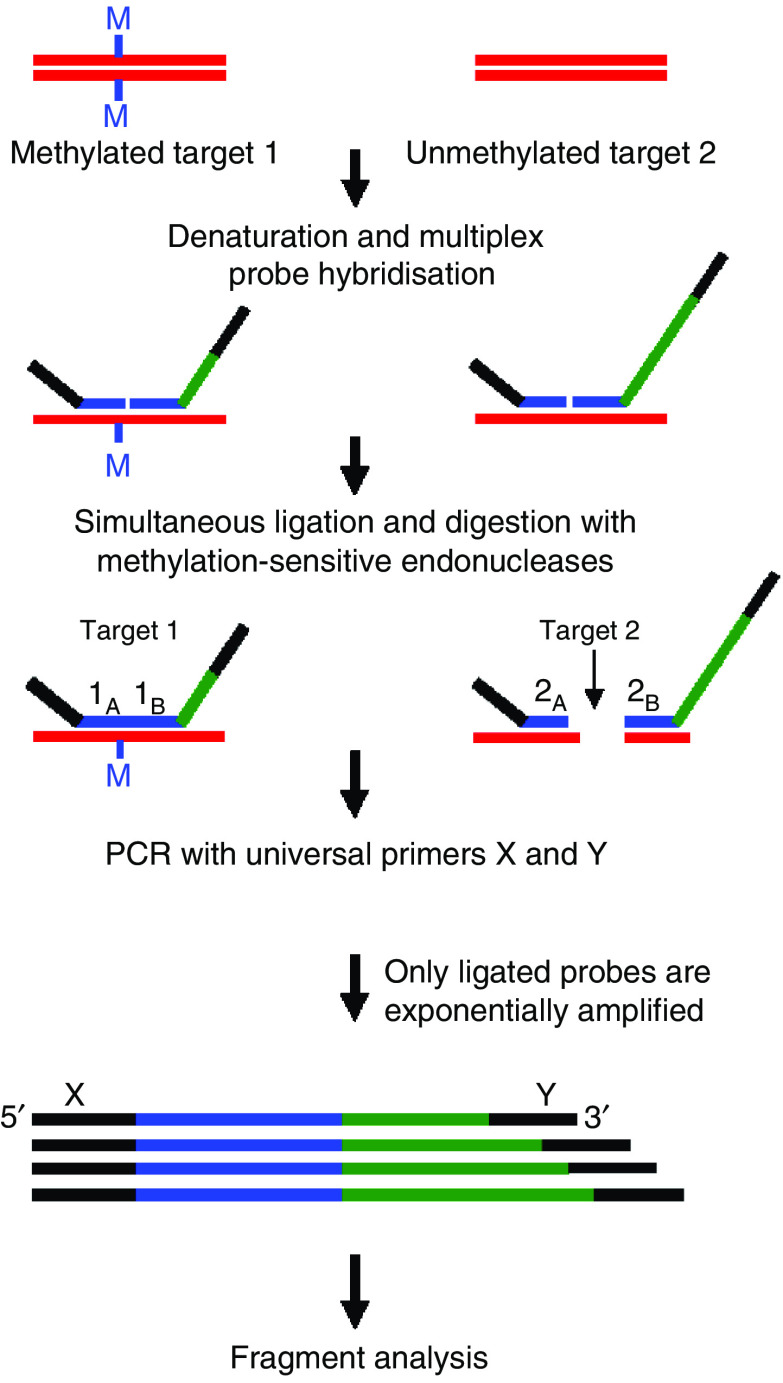
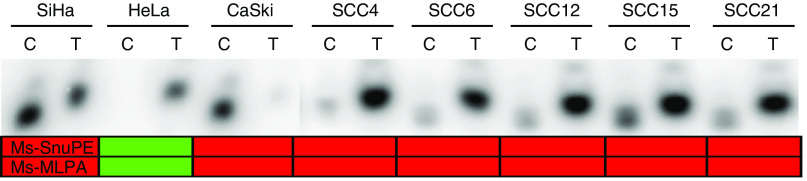
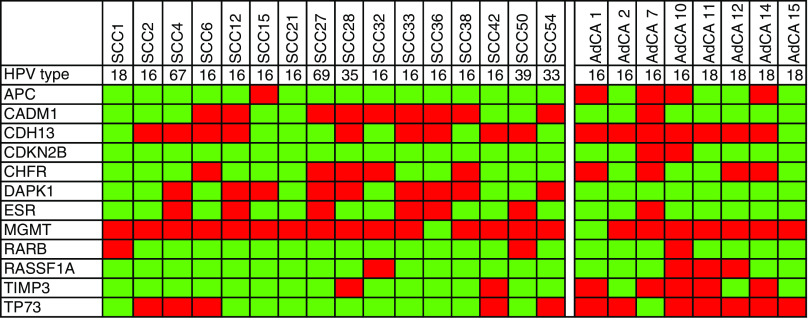
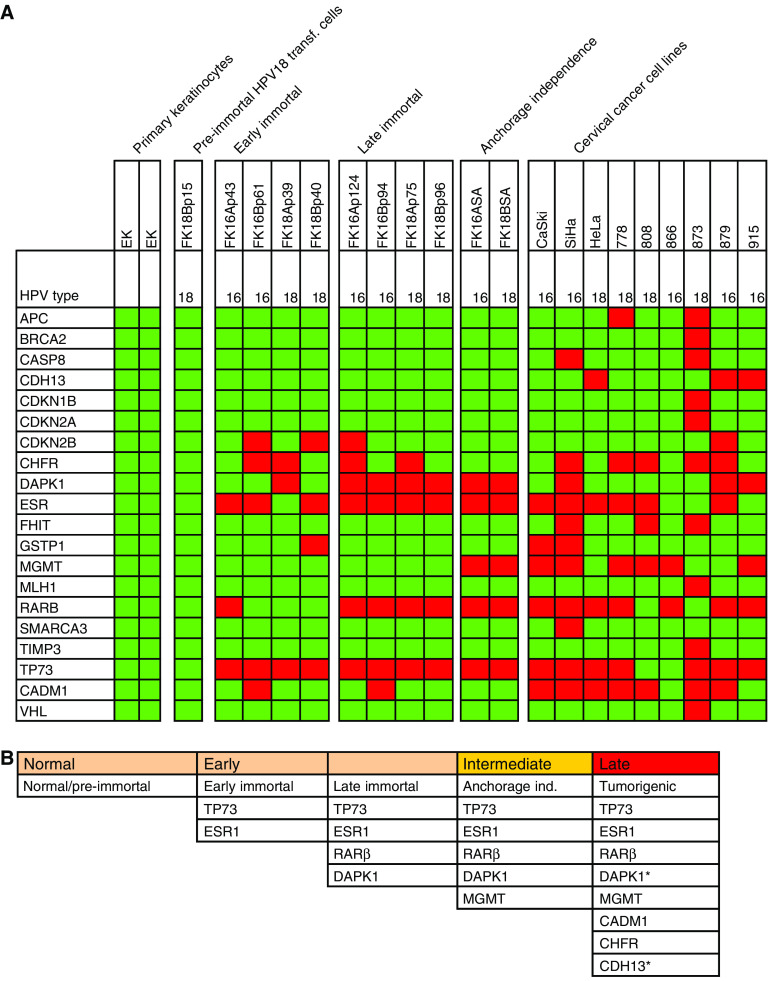
We aimed to link DNA methylation events occurring in cervical carcinomas to distinct stages of HPV-induced transformation. Methylation specific-multiplex ligation-dependent probe amplification (MS-MLPA) analysis of cervical carcinomas revealed promoter methylation of 12 out of 29 tumour suppressor genes analysed, with MGMT being most frequently methylated (92%). Subsequently, consecutive stages of HPV16/18-transfected keratinocytes (n=11), ranging from pre-immortal to anchorage-independent phenotypes, were analysed by MS-MLPA. Whereas no methylation was evident in pre-immortal cells, progression to anchorage independence was associated with an accumulation of frequent methylation events involving five genes, all of which were also methylated in cervical carcinomas. TP73 and ESR1 methylation became manifest in early immortal cells followed by RARbeta and DAPK1 methylation in late immortal passages. Complementary methylation of MGMT was related to anchorage independence. Analysis of nine cervical cancer cell lines, representing the tumorigenic phenotype, revealed in addition to these five genes frequent methylation of CADM1, CDH13 and CHFR. In conclusion, eight recurrent methylation events in cervical carcinomas could be assigned to different stages of HPV-induced transformation. Hence, our in vitro model system provides a valuable tool to further functionally address the epigenetic alterations that are common in cervical carcinomas.
我们旨在将宫颈癌中发生的DNA甲基化事件与HPV诱导的转化的不同阶段联系起来。对宫颈癌进行甲基化特异性多重连接依赖探针扩增(MS-MLPA)分析,结果显示,在分析的29个肿瘤抑制基因中,有12个基因的启动子发生甲基化,其中MGMT甲基化最为常见(92%)。随后,通过MS-MLPA对HPV16/18转染的角质形成细胞(n = 11)从永生化前到不依赖贴壁表型的连续阶段进行分析。在永生化前的细胞中未发现甲基化现象,而向不依赖贴壁状态的进展与涉及5个基因的频繁甲基化事件的积累相关,这5个基因在宫颈癌中也发生了甲基化。TP73和ESR1甲基化在早期永生化细胞中出现,随后RARβ和DAPK1甲基化出现在晚期永生化传代中。MGMT的互补甲基化与不依赖贴壁状态有关。对代表致瘤表型的9种宫颈癌细胞系进行分析,结果显示,除了这5个基因外,CADM1、CDH13和CHFR也频繁发生甲基化。总之,宫颈癌中8个反复出现的甲基化事件可归因于HPV诱导转化的不同阶段。因此,我们的体外模型系统为进一步从功能上研究宫颈癌中常见的表观遗传改变提供了一个有价值的工具。