Mathew Robin, Karantza-Wadsworth Vassiliki, White Eileen
University of Medicine and Dentistry of New Jersey, Robert Wood Johnson Medical School, Piscataway, New Jersey 08854, USA.
Nat Rev Cancer. 2007 Dec;7(12):961-7. doi: 10.1038/nrc2254.
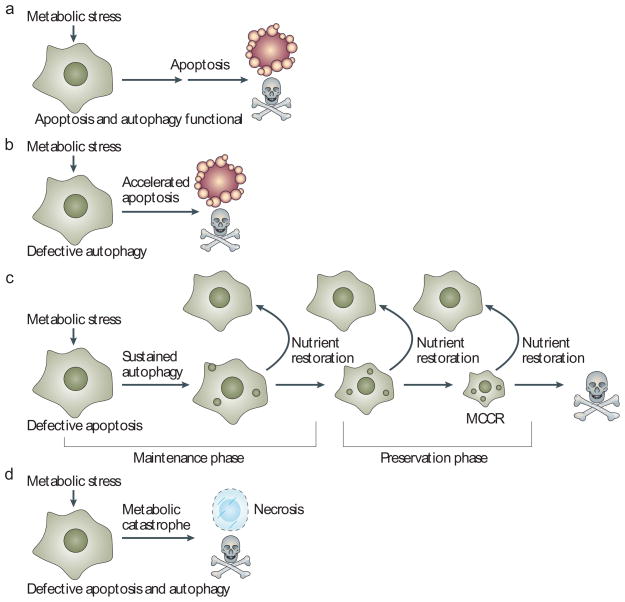
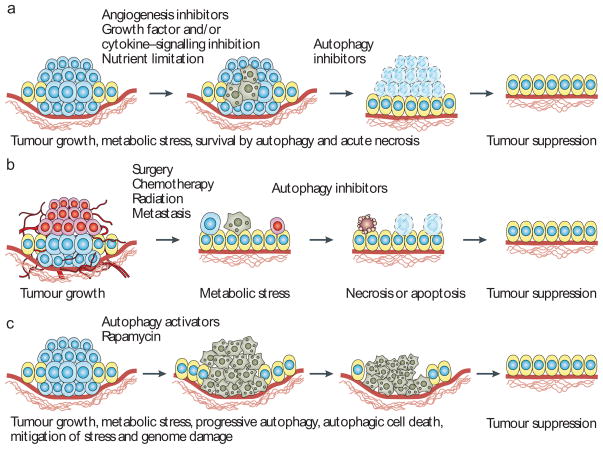
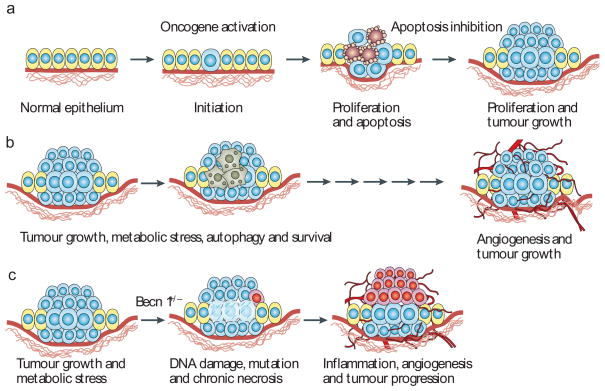
Autophagy is a cellular degradation pathway for the clearance of damaged or superfluous proteins and organelles. The recycling of these intracellular constituents also serves as an alternative energy source during periods of metabolic stress to maintain homeostasis and viability. In tumour cells with defects in apoptosis, autophagy allows prolonged survival. Paradoxically, autophagy defects are associated with increased tumorigenesis, but the mechanism behind this has not been determined. Recent evidence suggests that autophagy provides a protective function to limit tumour necrosis and inflammation, and to mitigate genome damage in tumour cells in response to metabolic stress.
自噬是一种细胞降解途径,用于清除受损或多余的蛋白质及细胞器。这些细胞内成分的循环利用在代谢应激期间也可作为替代能源,以维持体内平衡和细胞活力。在凋亡存在缺陷的肿瘤细胞中,自噬可使细胞长期存活。矛盾的是,自噬缺陷与肿瘤发生增加有关,但其背后的机制尚未明确。最近的证据表明,自噬具有保护功能,可限制肿瘤坏死和炎症,并减轻肿瘤细胞在代谢应激下的基因组损伤。