Zacchi Paola, Dreosti Elena, Visintin Michela, Moretto-Zita Matteo, Marchionni Ivan, Cannistraci Isabella, Kasap Zeynep, Betz Heinrich, Cattaneo Antonino, Cherubini Enrico
Neuroscience Programme, International School for Advanced Studies, Via Beirut 2-4, 34014 Trieste, Italy.
J Mol Neurosci. 2008 Feb;34(2):141-8. doi: 10.1007/s12031-007-9018-6. Epub 2007 Nov 16.
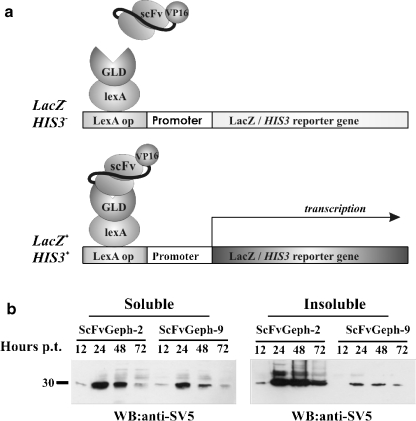
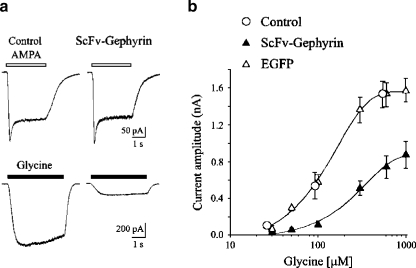
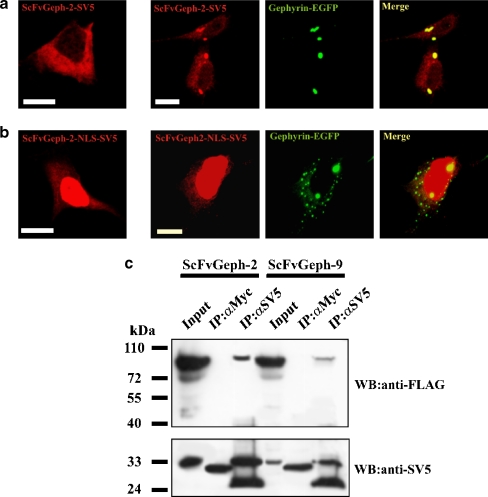
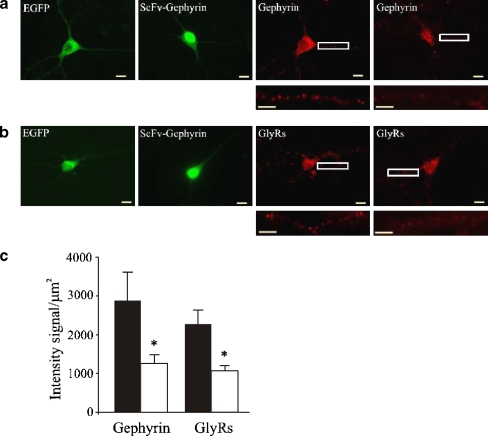
The microtubule-binding protein gephyrin is known to play a pivotal role in targeting and clustering postsynaptic inhibitory receptors. Here, the Intracellular Antibodies Capture Technology (IATC) was used to select two single-chain antibody fragments or intrabodies, which, fused to nuclear localization signals (NLS), were able to efficiently and selectively remove gephyrin from glycine receptor (GlyR) clusters. Co-transfection of NLS-tagged individual intrabodies with gephyrin-enhanced green fluorescent protein (EGFP) in HEK 293 cells revealed a partial relocalization of gephyrin aggregates onto the nucleus or in the perinuclear area. When expressed in cultured neurons, these intrabodies caused a significant reduction in the number of immunoreactive GlyR clusters, which was associated with a decrease in the peak amplitude of glycine-evoked whole cell currents as assessed with electrophysiological experiments. Hampering protein function at a posttranslational level may represent an attractive alternative for interfering with gephyrin function in a more spatially localized manner.
已知微管结合蛋白gephyrin在靶向和聚集突触后抑制性受体方面发挥关键作用。在此,细胞内抗体捕获技术(IATC)被用于筛选两个单链抗体片段或细胞内抗体,它们与核定位信号(NLS)融合后,能够高效且选择性地从甘氨酸受体(GlyR)簇中去除gephyrin。在HEK 293细胞中,将带有NLS标签的单个细胞内抗体与gephyrin增强型绿色荧光蛋白(EGFP)共转染,结果显示gephyrin聚集体部分重新定位于细胞核或核周区域。当在培养的神经元中表达时,这些细胞内抗体导致免疫反应性GlyR簇的数量显著减少,这与通过电生理实验评估的甘氨酸诱发的全细胞电流峰值幅度降低有关。在翻译后水平阻碍蛋白质功能可能是以更空间定位的方式干扰gephyrin功能的一种有吸引力的替代方法。