Alter Galit, Martin Maureen P, Teigen Nickolas, Carr William H, Suscovich Todd J, Schneidewind Arne, Streeck Hendrik, Waring Michael, Meier Angela, Brander Christian, Lifson Jeffrey D, Allen Todd M, Carrington Mary, Altfeld Marcus
Partners AIDS Research Center and Infectious Disease Unit, Massachusetts General Hospital and Division of AIDS, Harvard Medical School, Boston, MA 02129, USA.
J Exp Med. 2007 Nov 26;204(12):3027-36. doi: 10.1084/jem.20070695. Epub 2007 Nov 19.
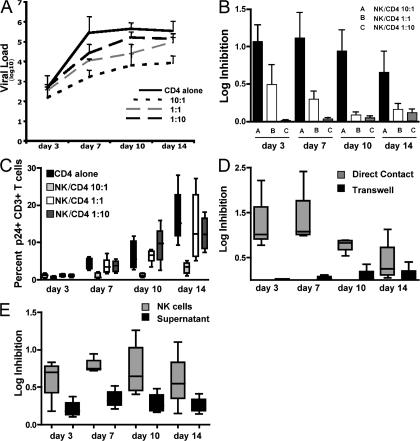
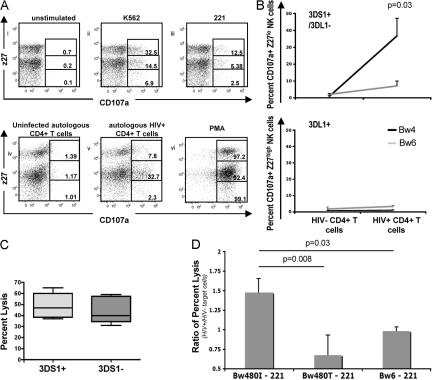
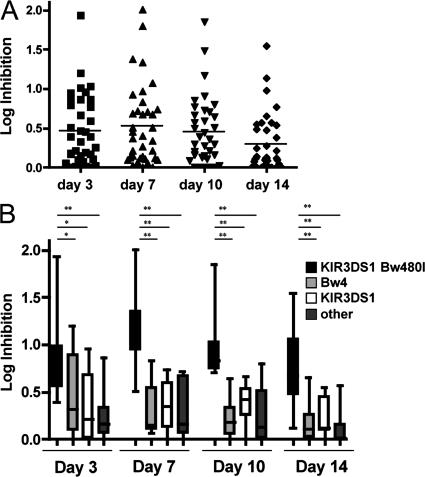
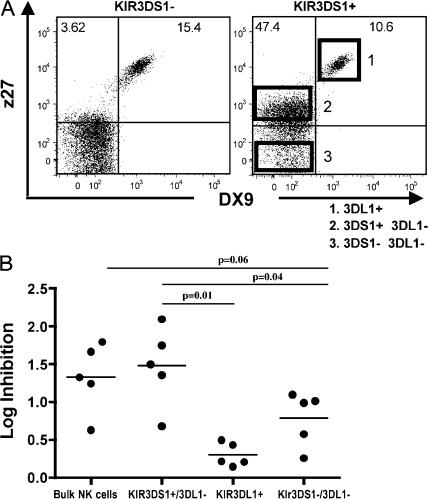
Decline of peak viremia during acute HIV-1 infection occurs before the development of vigorous adaptive immunity, and the level of decline correlates inversely with the rate of AIDS progression, implicating a potential role for the innate immune response in determining disease outcome. The combined expression of an activating natural killer (NK) cell receptor, the killer immunoglobulin-like receptor (KIR) 3DS1, and its presumed ligand, human leukocyte antigen (HLA)-B Bw4-80I, has been associated in epidemiological studies with a slow progression to AIDS. We examined the functional ability of NK cells to differentially control HIV-1 replication in vitro based on their KIR and HLA types. NK cells expressing KIR3DS1 showed strong, significant dose- and cell contact-dependent inhibition of HIV-1 replication in target cells expressing HLA-B Bw4-80I compared with NK cells that did not express KIR3DS1. Furthermore, KIR3DS1+ NK cells and NKLs were preferentially activated, and lysed HIV-1 infected target cells in an HLA-B Bw4-80I-dependent manner. These data provide the first functional evidence that variation at the KIR locus influences the effectiveness of NK cell activity in the containment of viral replication.
急性HIV-1感染期间病毒血症峰值的下降发生在强大的适应性免疫形成之前,且下降水平与艾滋病进展速率呈负相关,这表明先天免疫反应在决定疾病转归中可能发挥作用。在流行病学研究中,活化自然杀伤(NK)细胞受体杀伤免疫球蛋白样受体(KIR)3DS1及其假定配体人类白细胞抗原(HLA)-B Bw4-80I的联合表达与艾滋病缓慢进展相关。我们基于NK细胞的KIR和HLA类型,在体外检测了NK细胞对HIV-1复制进行差异控制的功能能力。与未表达KIR3DS1的NK细胞相比,表达KIR3DS1的NK细胞对表达HLA-B Bw4-80I的靶细胞中的HIV-1复制表现出强烈、显著的剂量和细胞接触依赖性抑制。此外,KIR3DS1+NK细胞和NKL细胞被优先激活,并以HLA-B Bw4-80I依赖的方式裂解HIV-1感染的靶细胞。这些数据首次提供了功能证据,表明KIR基因座的变异会影响NK细胞活性在抑制病毒复制中的有效性。