Luis Guntur E, Yong Chee-Khuen, Singh Deepak A, Sengupta S, Choon David Sk
Department of Orthopaedics Surgery, University of Malaya, Kuala Lumpur, Malaysia.
J Orthop Surg Res. 2007 Nov 27;2:22. doi: 10.1186/1749-799X-2-22.
Acromioclavicular injuries are common in sports medicine. Surgical intervention is generally advocated for chronic instability of Rockwood grade III and more severe injuries. Various methods of coracoclavicular ligament reconstruction and augmentation have been described. The objective of this study is to compare the biomechanical properties of a novel palmaris-longus tendon reconstruction with those of the native AC+CC ligaments, the modified Weaver-Dunn reconstruction, the ACJ capsuloligamentous complex repair, screw and clavicle hook plate augmentation.
There is no difference, biomechanically, amongst the various reconstruction and augmentative methods.
Controlled laboratory cadaveric study.
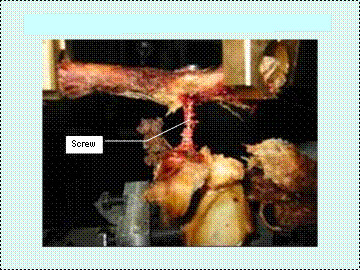
54 cadaveric native (acromioclavicular and coracoclavicular) ligaments were tested using the Instron machine. Superior loading was performed in the 6 groups: 1) in the intact states, 2) after modified Weaver-Dunn reconstruction (WD), 3) after modified Weaver-Dunn reconstruction with acromioclavicular joint capsuloligamentous repair (WD.ACJ), 4) after modified Weaver-Dunn reconstruction with clavicular hook plate augmentation (WD.CP) or 5) after modified Weaver-Dunn reconstruction with coracoclavicular screw augmentation (WD.BS) and 6) after modified Weaver-Dunn reconstruction with mersilene tape-palmaris-longus tendon graft reconstruction (WD. PLmt). Posterior-anterior (horizontal) loading was similarly performed in all groups, except groups 4 and 5. The respective failure loads, stiffnesses, displacements at failure and modes of failure were recorded. Data analysis was carried out using a one-way ANOVA, with Student's unpaired t-test for unpaired data (S-PLUS statistical package 2005).
Native ligaments were the strongest and stiffest when compared to other modes of reconstruction and augmentation except coracoclavicular screw, in both posterior-anterior and superior directions (p < 0.005).WD.ACJ provided additional posterior-anterior (P = 0. 039) but not superior (p = 0.250) stability when compared to WD alone.WD+PLmt, in loads and stiffness at failure superiorly, was similar to WD+CP (p = 0.066). WD+PLmt, in loads and stiffness at failure postero-anteriorly, was similar to WD+ACJ (p = 0.084).Superiorly, WD+CP had similar strength as WD+BS (p = 0.057), but it was less stiff (p < 0.005).
Modified Weaver-Dunn procedure must always be supplemented with acromioclavicular capsuloligamentous repair to increase posterior-anterior stability. Palmaris-Longus tendon graft provides both additional superior and posterior-anterior stability when used for acromioclavicular capsuloligamentous reconstruction. It is a good alternative to clavicle hook plate in acromioclavicular dislocation.

肩锁关节损伤在运动医学中很常见。对于Rockwood III级及更严重损伤的慢性不稳定,一般主张手术干预。已描述了多种喙锁韧带重建和增强的方法。本研究的目的是比较一种新型掌长肌腱重建与天然肩锁+喙锁韧带、改良Weaver-Dunn重建、肩锁关节囊韧带复合体修复、螺钉和锁骨钩钢板增强的生物力学特性。
各种重建和增强方法在生物力学上没有差异。
对照实验室尸体研究。
使用Instron机器对54条尸体天然(肩锁和喙锁)韧带进行测试。在6组中进行上向加载:1)完整状态下,2)改良Weaver-Dunn重建(WD)后,3)改良Weaver-Dunn重建联合肩锁关节囊韧带修复(WD.ACJ)后,4)改良Weaver-Dunn重建联合锁骨钩钢板增强(WD.CP)后或5)改良Weaver-Dunn重建联合喙锁螺钉增强(WD.BS)后,以及6)改良Weaver-Dunn重建联合涤纶带-掌长肌腱移植重建(WD.PLmt)后。除第4组和第5组外,所有组均类似地进行前后(水平)加载。记录各自的失效载荷、刚度、失效时的位移和失效模式。使用单向方差分析进行数据分析,对未配对数据使用学生未配对t检验(S-PLUS统计软件包2005)。
与其他重建和增强方式相比,除喙锁螺钉外,天然韧带在前后和上向方向均最强且最硬(p < 0.005)。与单独的WD相比,WD.ACJ提供了额外的前后稳定性(P = 0.039),但上向稳定性未增加(p = 0.250)。WD+PLmt在上向失效载荷和刚度方面与WD+CP相似(p = 0.066)。WD+PLmt在前后向失效载荷和刚度方面与WD+ACJ相似(p = 0.084)。在上向,WD+CP与WD+BS强度相似(p = 0.057),但刚度较小(p <