Shah Shweta, Solanki Kusum, Gupta Munishwar N
Department of Chemistry, Indian Institute of Technology Delhi, Hauz Khas, New Delhi, India.
Chem Cent J. 2007 Nov 29;1:30. doi: 10.1186/1752-153X-1-30.
Immobilization of biologically active proteins on nanosized surfaces is a key process in bionanofabrication. Carbon nanotubes with their high surface areas, as well as useful electronic, thermal and mechanical properties, constitute important building blocks in the fabrication of novel functional materials.
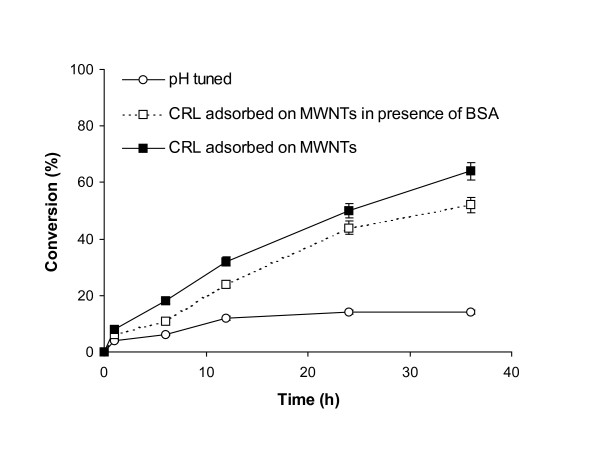
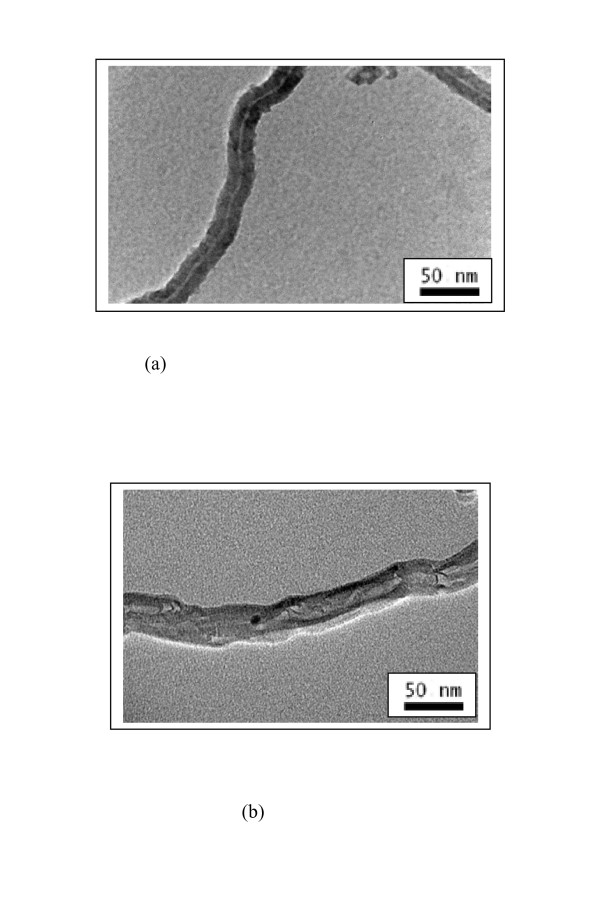
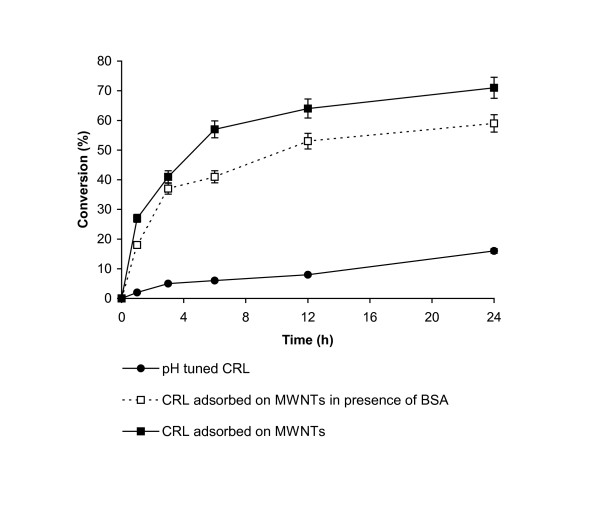
Lipases from Candida rugosa (CRL) were found to be adsorbed on the multiwalled carbon nanotubes with very high retention of their biological activity (97%). The immobilized biocatalyst showed 2.2- and 14-fold increases in the initial rates of transesterification activity in nearly anhydrous hexane and water immiscible ionic liquid [Bmim] [PF6] respectively, as compared to the lyophilized powdered enzyme. It is presumed that the interaction with the hydrophobic surface of the nanotubes resulted in conformational changes leading to the 'open lid' structure of CRL. The immobilized enzyme was found to give 64% conversion over 24 h (as opposed to 14% with free enzyme) in the formation of butylbutyrate in nearly anhydrous hexane. Similarly, with ionic liquid [Bmim] [PF6], the immobilized enzyme allowed 71% conversion as compared to 16% with the free enzyme. The immobilized lipase also showed high enantioselectivity as determined by kinetic resolution of (+/-) 1-phenylethanol in [Bmim] [PF6]. While free CRL gave only 5% conversion after 36 h, the immobilized enzyme resulted in 37% conversion with > 99% enantiomeric excess. TEM studies on the immobilized biocatalyst showed that the enzyme is attached to the multiwalled nanotubes.
Successful immobilization of enzymes on nanosized carriers could pave the way for reduced reactor volumes required for biotransformations, as well as having a use in the construction of miniaturized biosensensor devices.
将生物活性蛋白固定在纳米尺寸的表面是生物纳米制造中的关键过程。碳纳米管具有高表面积以及有用的电子、热和机械性能,是制造新型功能材料的重要组成部分。
发现皱褶假丝酵母脂肪酶(CRL)吸附在多壁碳纳米管上,其生物活性保留率非常高(97%)。与冻干的粉末状酶相比,固定化生物催化剂在几乎无水的己烷和与水不混溶的离子液体[Bmim][PF6]中的酯交换活性初始速率分别提高了2.2倍和14倍。据推测,与纳米管疏水表面的相互作用导致构象变化,从而形成CRL的“开放盖子”结构。在几乎无水的己烷中合成丁酸丁酯时,发现固定化酶在24小时内转化率为64%(而游离酶为14%)。同样,在离子液体[Bmim][PF6]中,固定化酶的转化率为71%,而游离酶为16%。通过对(±)1-苯乙醇在[Bmim][PF6]中的动力学拆分测定,固定化脂肪酶也表现出高对映选择性。虽然游离CRL在36小时后转化率仅为5%,但固定化酶的转化率为37%,对映体过量率>99%。对固定化生物催化剂的透射电子显微镜研究表明,酶附着在多壁纳米管上。
酶在纳米载体上的成功固定可为减少生物转化所需的反应器体积铺平道路,也可用于构建小型化生物传感器装置。