Ming Dengming, Wall Michael E, Sanbonmatsu Kevin Y
Computer, Computational, and Statistical Sciences Division, Los Alamos National Laboratory, Los Alamos, USA.
BMC Bioinformatics. 2007 Nov 30;8:470. doi: 10.1186/1471-2105-8-470.
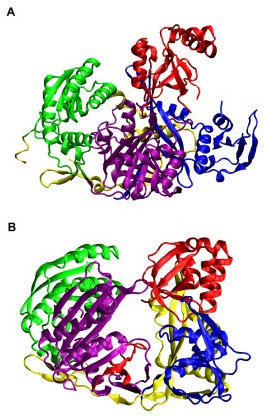
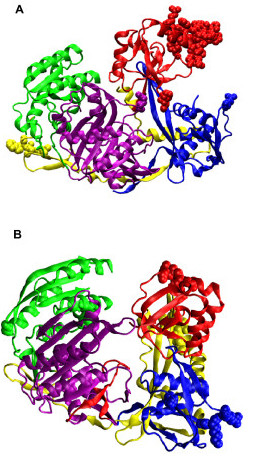
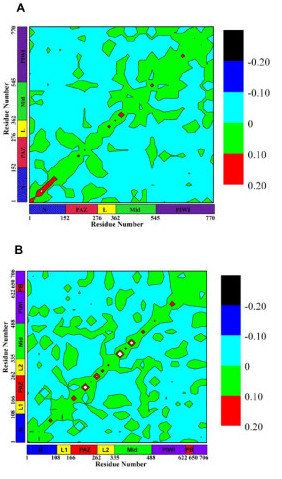
The Argonaute protein is the core component of the RNA-induced silencing complex, playing the central role of cleaving the mRNA target. Visual inspection of static crystal structures already has enabled researchers to suggest conformational changes of Argonaute that might occur during RNA interference. We have taken the next step by performing an all-atom normal mode analysis of the Pyrococcus furiosus and Aquifex aeolicus Argonaute crystal structures, allowing us to quantitatively assess the feasibility of these conformational changes. To perform the analysis, we begin with the energy-minimized X-ray structures. Normal modes are then calculated using an all-atom molecular mechanics force field.
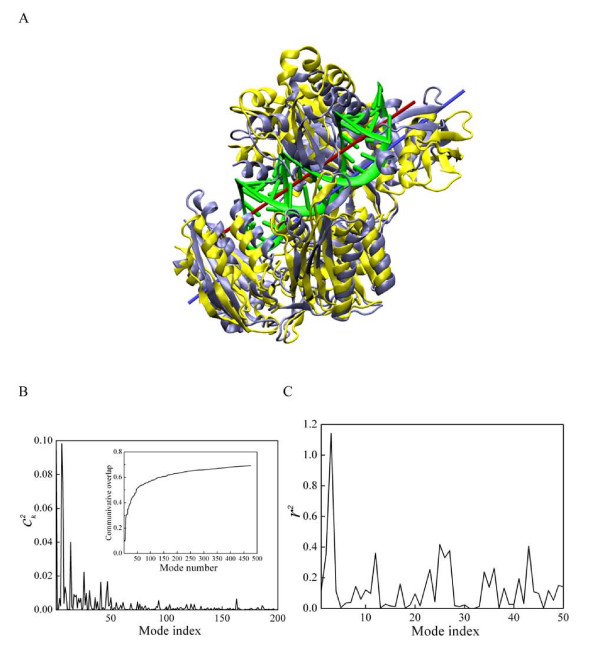
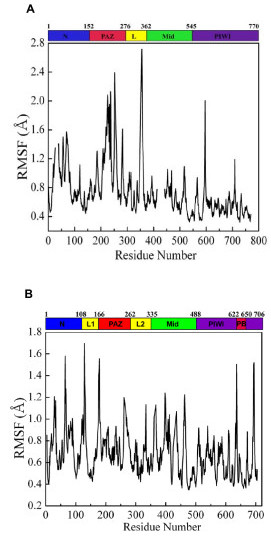
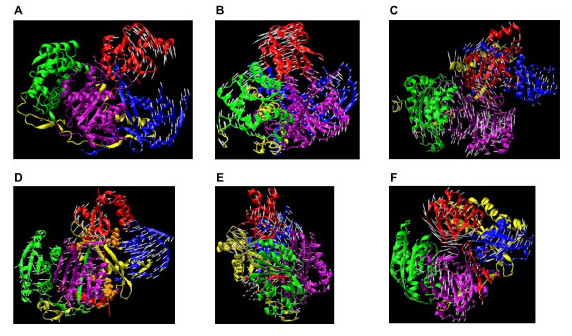
The analysis reveals low-frequency vibrations that facilitate the accommodation of RNA duplexes - an essential step in target recognition. The Pyrococcus furiosus and Aquifex aeolicus Argonaute proteins both exhibit low-frequency torsion and hinge motions; however, differences in the overall architecture of the proteins cause the detailed dynamics to be significantly different.
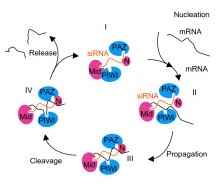
Overall, low-frequency vibrations of Argonaute are consistent with mechanisms within the current reaction cycle model for RNA interference.
AGO蛋白是RNA诱导沉默复合体的核心成分,在切割mRNA靶标过程中发挥核心作用。对静态晶体结构的可视化检查已经使研究人员能够推测AGO在RNA干扰过程中可能发生的构象变化。我们通过对嗜热栖热菌和嗜热栖热放线菌AGO晶体结构进行全原子正常模式分析,迈出了下一步,从而能够定量评估这些构象变化的可行性。为了进行分析,我们从能量最小化的X射线结构开始。然后使用全原子分子力学力场计算正常模式。
分析揭示了有助于容纳RNA双链体的低频振动——这是靶标识别的关键步骤。嗜热栖热菌和嗜热栖热放线菌AGO蛋白均表现出低频扭转和铰链运动;然而,蛋白质整体结构的差异导致详细动力学存在显著差异。
总体而言,AGO的低频振动与当前RNA干扰反应循环模型中的机制一致。