Novartis Institute for Tropical Diseases, Chromos, Singapore.
PLoS Negl Trop Dis. 2007 Nov 21;1(2):e86. doi: 10.1371/journal.pntd.0000086.
Despite the seriousness of dengue-related disease, with an estimated 50-100 million cases of dengue fever and 250,000-500,000 cases of dengue hemorrhagic fever/dengue shock syndrome each year, a clear understanding of dengue pathogenesis remains elusive. Because of the lack of a disease model in animals and the complex immune interaction in dengue infection, the study of host response and immunopathogenesis is difficult. The development of genomics technology, microarray and high throughput quantitative PCR have allowed researchers to study gene expression changes on a much broader scale. We therefore used this approach to investigate the host response in dengue virus-infected cell lines and in patients developing dengue fever.
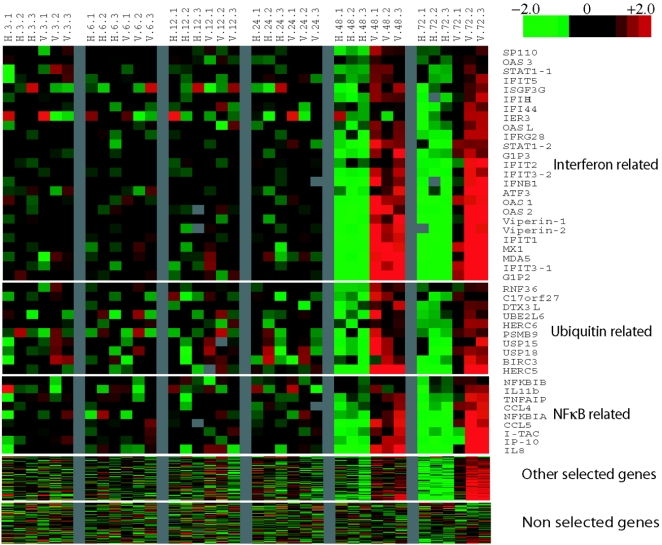
METHODOLOGY/PRINCIPAL FINDINGS: Using microarray and high throughput quantitative PCR method to monitor the host response to dengue viral replication in cell line infection models and in dengue patient blood samples, we identified differentially expressed genes along three major pathways; NF-kappaB initiated immune responses, type I interferon (IFN) and the ubiquitin proteasome pathway. Among the most highly upregulated genes were the chemokines IP-10 and I-TAC, both ligands of the CXCR3 receptor. Increased expression of IP-10 and I-TAC in the peripheral blood of ten patients at the early onset of fever was confirmed by ELISA. A highly upregulated gene in the IFN pathway, viperin, was overexpressed in A549 cells resulting in a significant reduction in viral replication. The upregulation of genes in the ubiquitin-proteasome pathway prompted the testing of proteasome inhibitors MG-132 and ALLN, both of which reduced viral replication.
CONCLUSION/SIGNIFICANCE: Unbiased gene expression analysis has identified new host genes associated with dengue infection, which we have validated in functional studies. We showed that some parts of the host response can be used as potential biomarkers for the disease while others can be used to control dengue viral replication, thus representing viable targets for drug therapy.
尽管登革热相关疾病的严重性很大,每年估计有 5000 万至 1 亿例登革热和 25 万至 50 万例登革出血热/登革休克综合征,但对登革热发病机制仍缺乏清晰的认识。由于缺乏动物疾病模型和登革热感染中的复杂免疫相互作用,宿主反应和免疫发病机制的研究较为困难。基因组学技术、微阵列和高通量定量 PCR 的发展使研究人员能够在更大范围内研究基因表达变化。因此,我们使用这种方法研究了登革病毒感染细胞系和发生登革热的患者中的宿主反应。
方法/主要发现:使用微阵列和高通量定量 PCR 方法监测细胞系感染模型和登革热患者血液样本中登革病毒复制的宿主反应,我们在三个主要途径中鉴定了差异表达的基因;NF-kappaB 启动的免疫反应、I 型干扰素 (IFN) 和泛素蛋白酶体途径。上调最明显的基因包括趋化因子 IP-10 和 I-TAC,它们都是 CXCR3 受体的配体。通过 ELISA 在十位患者发热早期的外周血中证实 IP-10 和 I-TAC 的表达增加。IFN 途径中高度上调的基因 viperin 在 A549 细胞中过表达,导致病毒复制显著减少。泛素蛋白酶体途径中基因的上调促使我们测试蛋白酶体抑制剂 MG-132 和 ALLN,它们都能降低病毒复制。
结论/意义:无偏倚基因表达分析已确定与登革热感染相关的新宿主基因,我们在功能研究中对其进行了验证。我们表明,宿主反应的某些部分可用作疾病的潜在生物标志物,而其他部分可用作控制登革病毒复制的手段,因此代表了药物治疗的可行靶点。