Pahari Susanta, Mackessy Stephen P, Kini R Manjunatha
Center for Post Graduate Studies, Sri Bhagawan Mahaveer Jain College, 18/3, 9th Main, Jayanagar 3rd Block, Bangalore, India.
BMC Mol Biol. 2007 Dec 20;8:115. doi: 10.1186/1471-2199-8-115.
Snake venoms are complex mixtures of pharmacologically active proteins and peptides which belong to a small number of superfamilies. Global cataloguing of the venom transcriptome facilitates the identification of new families of toxins as well as helps in understanding the evolution of venom proteomes.
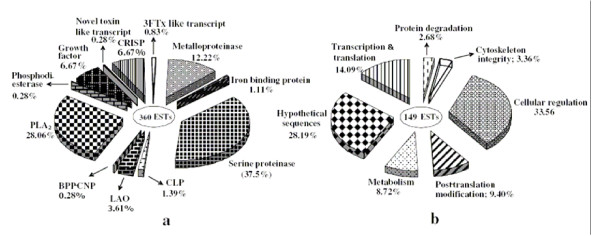
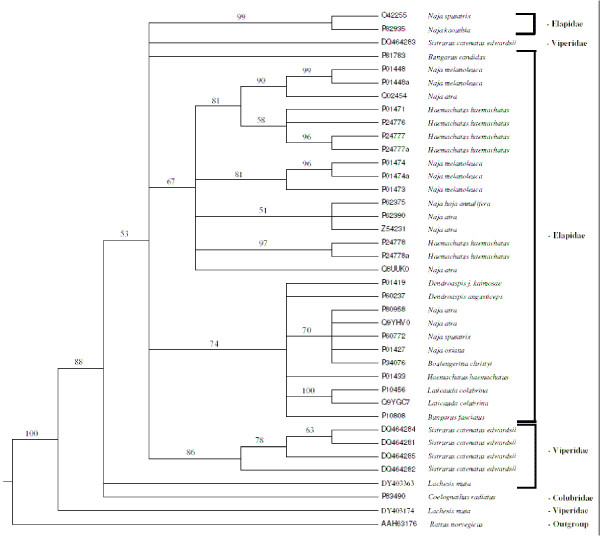
We have constructed a cDNA library of the venom gland of a threatened rattlesnake (a pitviper), Sistrurus catenatus edwardsii (Desert Massasauga), and sequenced 576 ESTs. Our results demonstrate a high abundance of serine proteinase and metalloproteinase transcripts, indicating that the disruption of hemostasis is a principle mechanism of action of the venom. In addition to the transcripts encoding common venom proteins, we detected two varieties of low abundance unique transcripts in the library; these encode for three-finger toxins and a novel toxin possibly generated from the fusion of two genes. We also observed polyadenylated ribosomal RNAs in the venom gland library, an interesting preliminary obsevation of this unusual phenomenon in a reptilian system.
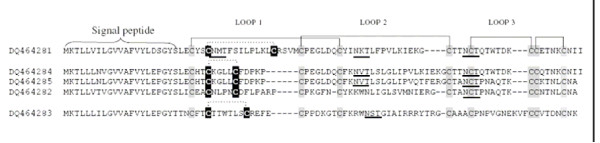
The three-finger toxins are characteristic of most elapid venoms but are rare in viperid venoms. We detected several ESTs encoding this group of toxins in this study. We also observed the presence of a transcript encoding a fused protein of two well-characterized toxins (Kunitz/BPTI and Waprins), and this is the first report of this kind of fusion in a snake toxin transcriptome. We propose that these new venom proteins may have ancillary functions for envenomation. The presence of a fused toxin indicates that in addition to gene duplication and accelerated evolution, exon shuffling or transcriptional splicing may also contribute to generating the diversity of toxins and toxin isoforms observed among snake venoms. The detection of low abundance toxins, as observed in this and other studies, indicates a greater compositional similarity of venoms (though potency will differ) among advanced snakes than has been previously recognized.
蛇毒是药理活性蛋白质和肽的复杂混合物,这些蛋白质和肽属于少数几个超家族。毒液转录组的全球编目有助于鉴定新的毒素家族,并有助于理解毒液蛋白质组的进化。
我们构建了一种濒危响尾蛇(一种蝰蛇)——爱德华兹猪鼻蛇(沙漠侏膨蝰)毒液腺的cDNA文库,并对576个EST进行了测序。我们的结果表明丝氨酸蛋白酶和金属蛋白酶转录本高度丰富,这表明止血功能的破坏是毒液的主要作用机制。除了编码常见毒液蛋白的转录本外,我们在文库中还检测到两种低丰度的独特转录本;这些转录本编码三指毒素和一种可能由两个基因融合产生的新型毒素。我们还在毒液腺文库中观察到了多聚腺苷酸化核糖体RNA,这是在爬行动物系统中对这一不寻常现象的有趣初步观察。
三指毒素是大多数眼镜蛇科毒液的特征,但在蝰蛇科毒液中很少见。在本研究中,我们检测到了几个编码这组毒素的EST。我们还观察到一个编码两种特征明确的毒素(库尼兹/抑肽酶和Waprins)融合蛋白的转录本的存在,这是蛇毒素转录组中此类融合的首次报道。我们认为这些新的毒液蛋白可能对蛇毒作用具有辅助功能。融合毒素的存在表明,除了基因复制和加速进化外,外显子改组或转录剪接也可能有助于产生蛇毒中观察到的毒素和毒素异构体的多样性。正如本研究和其他研究所观察到的,低丰度毒素的检测表明,高级蛇类毒液之间的成分相似性(尽管效力会有所不同)比之前认为的更大。