Rothenberg Ellen V, Moore Jonathan E, Yui Mary A
Division of Biology 156-29, California Institute of Technology, Pasadena, California 91125, USA.
Nat Rev Immunol. 2008 Jan;8(1):9-21. doi: 10.1038/nri2232.
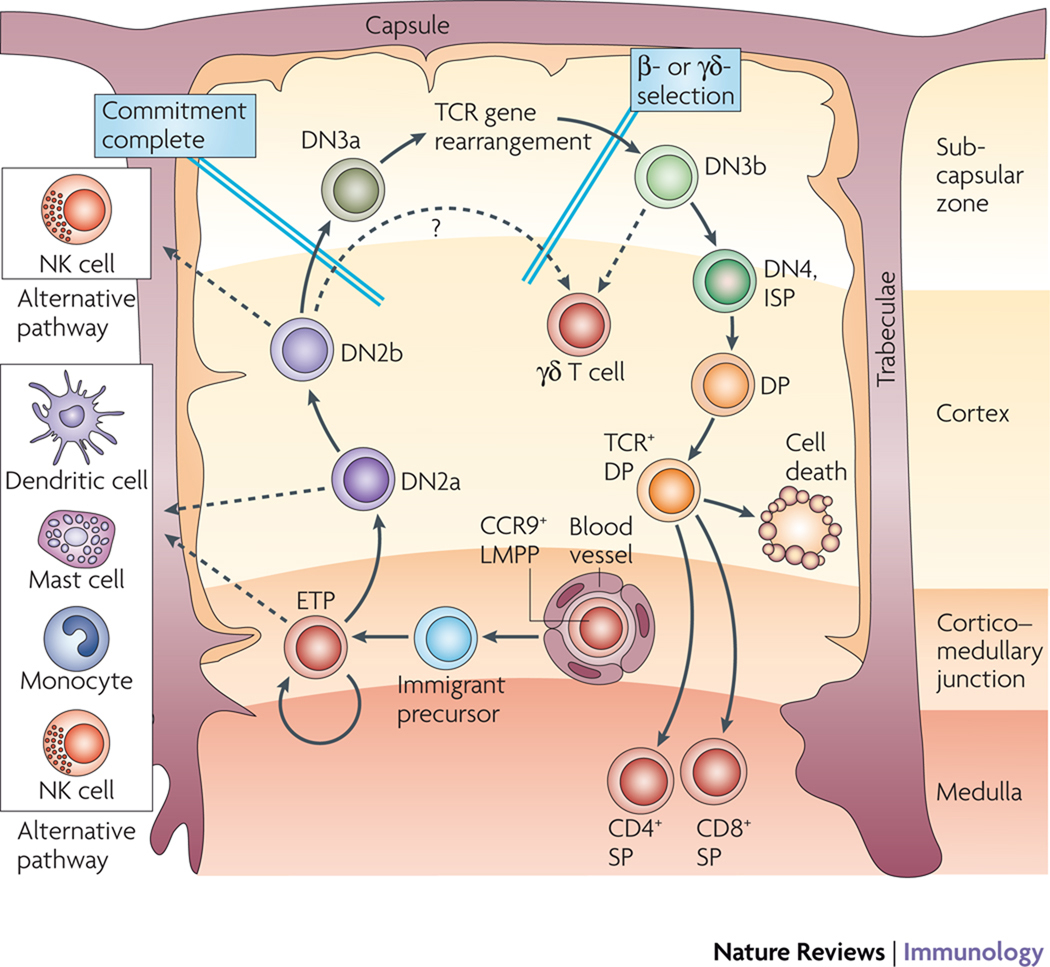
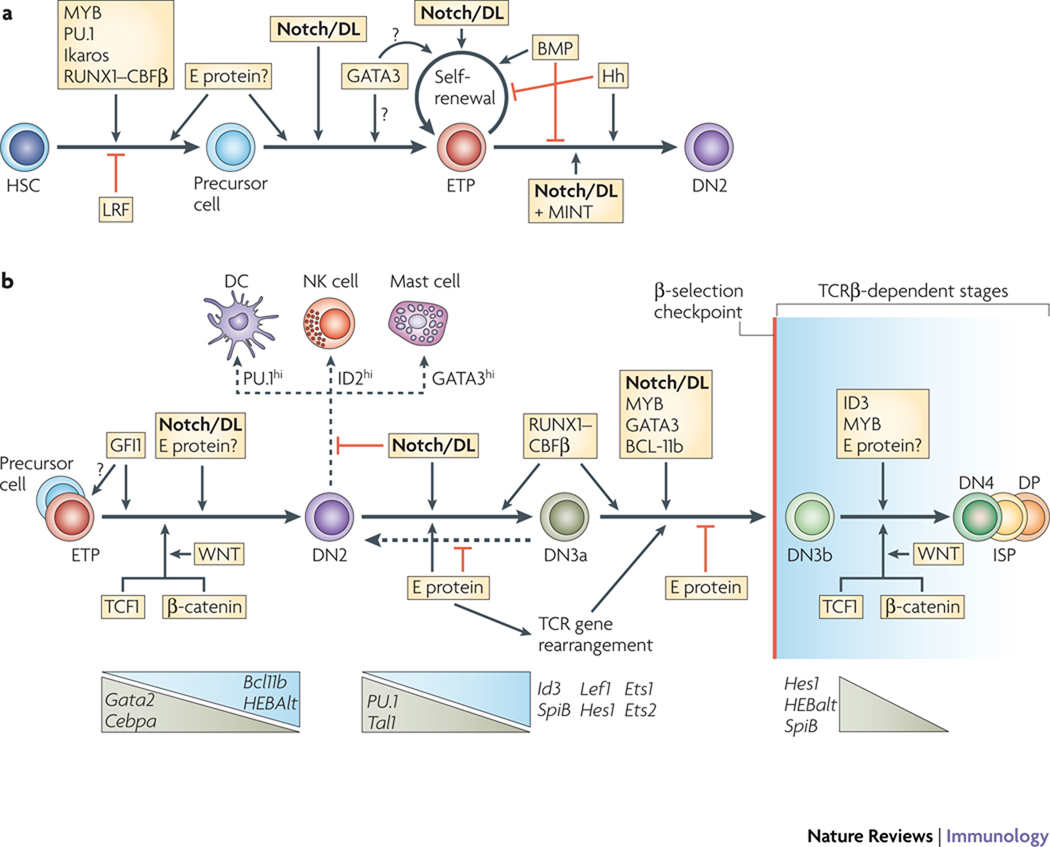
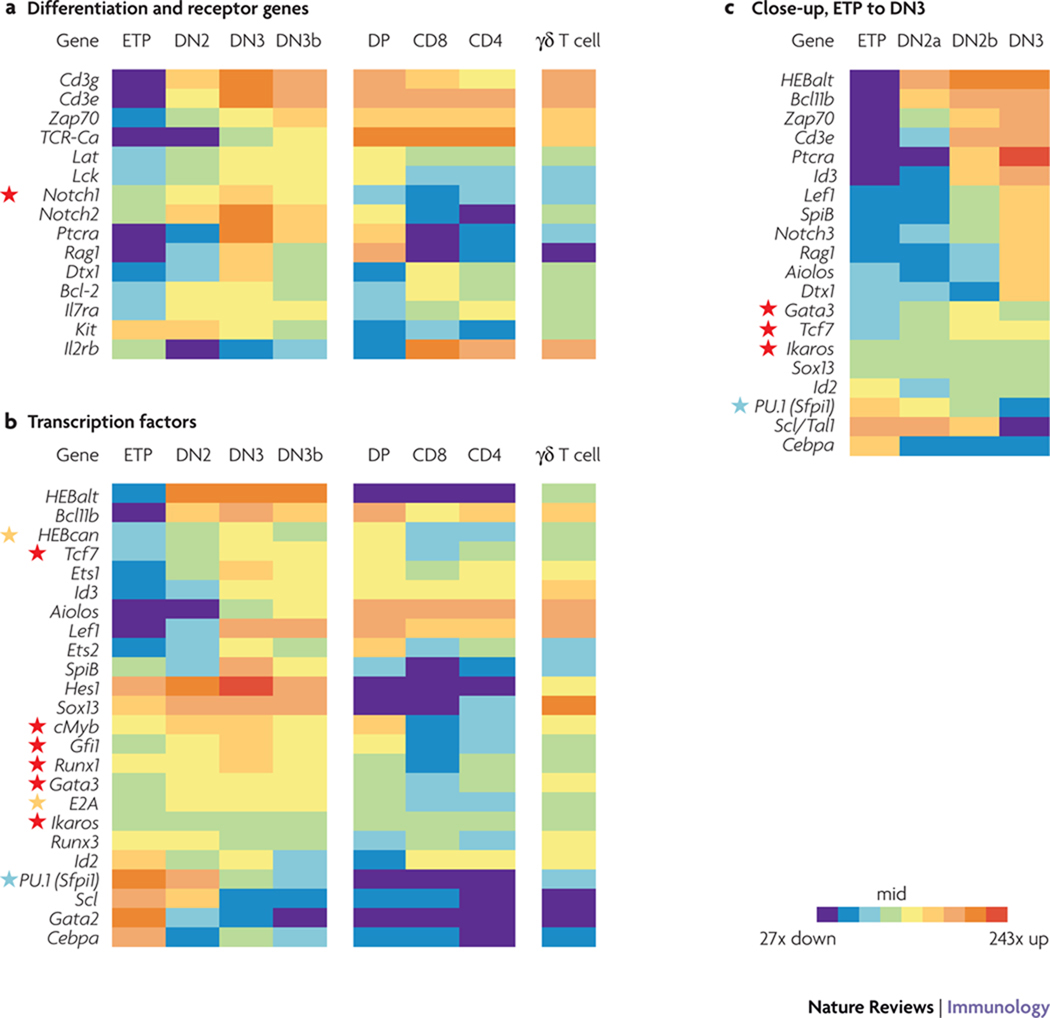
Multipotent blood progenitor cells enter the thymus and begin a protracted differentiation process in which they gradually acquire T-cell characteristics while shedding their legacy of developmental plasticity. Notch signalling and basic helix-loop-helix E-protein transcription factors collaborate repeatedly to trigger and sustain this process throughout the period leading up to T-cell lineage commitment. Nevertheless, the process is discontinuous with separately regulated steps that demand roles for additional collaborating factors. This Review discusses new evidence on the coordination of specification and commitment in the early T-cell pathway; effects of microenvironmental signals; the inheritance of stem-cell regulatory factors; and the ensemble of transcription factors that modulate the effects of Notch and E proteins, to distinguish individual stages and to polarize T-cell-lineage fate determination.
多能血液祖细胞进入胸腺并开始一个漫长的分化过程,在此过程中它们逐渐获得T细胞特征,同时摆脱其发育可塑性的遗留特性。Notch信号通路和碱性螺旋-环-螺旋E蛋白转录因子反复协作,在T细胞谱系定型之前的整个时期触发并维持这一过程。然而,该过程是不连续的,有分别受调控的步骤,这需要其他协作因子发挥作用。本综述讨论了关于早期T细胞途径中定型和谱系定型协调的新证据;微环境信号的作用;干细胞调节因子的遗传;以及调节Notch和E蛋白作用、区分各个阶段并使T细胞谱系命运决定极化的转录因子组合。