Bu Pengli, Wan Yu-Jui Yvonne
Department of Pharmacology, Toxicology and Therapeutics, University of Kansas Medical Center, 3901 Rainbow Boulevard, Kansas City, KS 66160, USA.
BMC Cancer. 2007 Dec 31;7:236. doi: 10.1186/1471-2407-7-236.
Retinoids are used to treat several types of cancer; however, their effects on liver cancer have not been fully characterized. To investigate the therapeutic potential of retinoids on hepatocellular carcinoma (HCC), the present study evaluates the apoptotic effect of a panel of natural and synthetic retinoids in three human HCC cell lines as well as explores the underlying mechanisms.
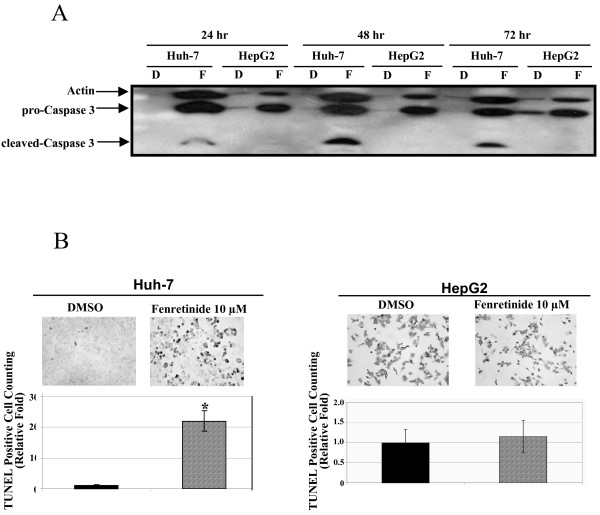
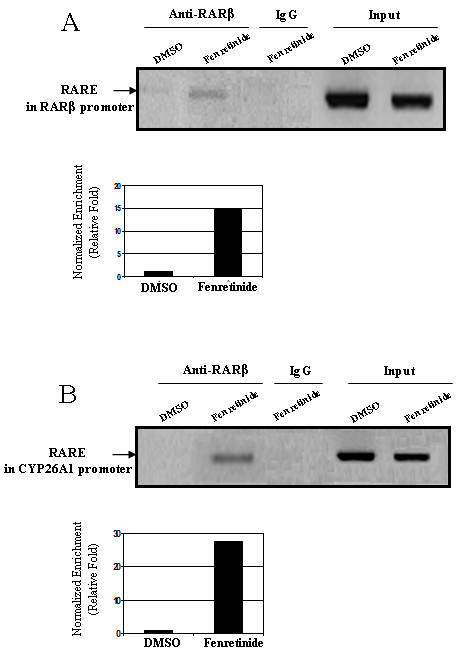
Apoptosis was determined by caspase-3 cleavage using western blot, DNA double-strand breaks using TUNEL assay, and phosphatidylserine translocation using flow cytometry analysis. Gene expression of nuclear receptors was assessed by real-time PCR. Transactivation assay and chromatin immunoprecipitation (ChIP) were conducted to evaluate the activation of RXRalpha/RARbeta pathway by fenretinide. Knockdown of RARbeta mRNA expression was achieved by siRNA transfection.
Our data revealed that fenretinide effectively induces apoptosis in Huh-7 and Hep3B cells. Gene expression analysis of nuclear receptors revealed that the basal and inducibility of retinoic acid receptor beta (RARbeta) expression positively correlate with the susceptibility of HCC cells to fenretinide treatment. Furthermore, fenretinide transactivates the RXRalpha/RARbeta-mediated pathway and directly increases the transcriptional activity of RARbeta. Knockdown of RARbeta mRNA expression significantly impairs fenretinide-induced apoptosis in Huh-7 cells.
Our findings reveal that endogenous expression of retinoids receptor RARbeta gene determines the susceptibility of HCC cells to fenretinide-induced apoptosis. Our results also demonstrate fenretinide directly activates RARbeta and induces apoptosis in Huh-7 cells in a RARbeta-dependent manner. These findings suggest a novel role of RARbeta as a tumor suppressor by mediating the signals of certain chemotherapeutic agents.
维甲酸用于治疗多种癌症;然而,其对肝癌的影响尚未完全明确。为了研究维甲酸对肝细胞癌(HCC)的治疗潜力,本研究评估了一系列天然和合成维甲酸对三种人肝癌细胞系的凋亡作用,并探讨了潜在机制。
通过蛋白质印迹法检测caspase-3裂解来确定凋亡,通过TUNEL检测法检测DNA双链断裂,通过流式细胞术分析检测磷脂酰丝氨酸易位。通过实时PCR评估核受体的基因表达。进行反式激活测定和染色质免疫沉淀(ChIP)以评估芬维A胺对RXRα/RARβ途径的激活。通过小干扰RNA转染实现RARβ mRNA表达的敲低。
我们的数据显示,芬维A胺可有效诱导Huh-7和Hep3B细胞凋亡。核受体的基因表达分析显示,维甲酸受体β(RARβ)表达的基础水平和诱导性与肝癌细胞对芬维A胺治疗的敏感性呈正相关。此外,芬维A胺可反式激活RXRα/RARβ介导的途径,并直接增加RARβ的转录活性。敲低RARβ mRNA表达可显著削弱芬维A胺诱导的Huh-7细胞凋亡。
我们的研究结果表明,维甲酸受体RARβ基因的内源性表达决定了肝癌细胞对芬维A胺诱导凋亡的敏感性。我们的数据还表明,芬维A胺直接激活RARβ,并以RARβ依赖的方式诱导Huh-7细胞凋亡。这些发现提示RARβ作为肿瘤抑制因子通过介导某些化疗药物的信号发挥新作用。