Groeneveld Iris F, Proper Karin I, van der Beek Allard J, van Duivenbooden Cor, van Mechelen Willem
Department of Public and Occupational Health, EMGO Institute, VU University Medical Centre, Van der Boechorststraat 7, 1081 BT Amsterdam, The Netherlands.
BMC Public Health. 2008 Jan 3;8:1. doi: 10.1186/1471-2458-8-1.
Of all workers in Dutch construction industry, 20% has an elevated risk of cardiovascular disease (CVD). A major risk factor for CVD risk is an unhealthy lifestyle. The aim of our study is to design a lifestyle intervention for construction workers with an elevated CVD risk, and to evaluate its (cost-) effectiveness.
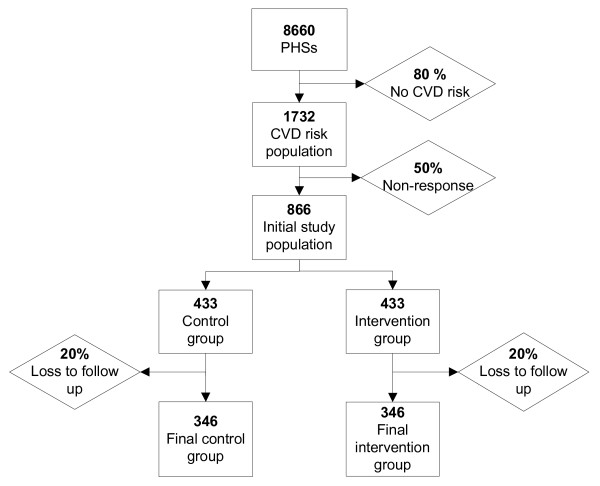
METHODS/DESIGN: In a RCT, 692 participants will be randomised to either the control or the intervention group. The control group will receive usual care. For the intervention group, a lifestyle intervention has been designed based on interviews and current literature. The intervention will last 6 months and will comprise 3 face-to-face and 4 telephone contacts, consisting of individual counselling aimed at increasing daily physical activity (PA) and improving dietary behaviour, and/or smoking cessation. Counselling will take place at the Occupational Health Service (OHS), and will be done according to motivational interviewing (MI). Additional written information about healthy lifestyle will also be provided to those in the intervention group. At baseline, after 6 and after 12 months, measurements will take place. Primary outcome variables will be the lifestyle behaviours of concern, i.e. daily PA, dietary intake, and smoking status. Secondary outcome variables will be body mass index (BMI), systolic and diastolic blood pressure, total and HDL blood cholesterol, Hba1c and cardio-respiratory fitness (CRF). Sickness absenteeism and cost-effectiveness will be assessed as well. Multilevel analysis will be performed to compare all outcome measures between the intervention group and the control group.
By improving lifestyle, CVD risk may be lowered, yielding benefits for both employee and employer. If proven effective, this lifestyle intervention will be implemented on a larger scale within the Occupational Health Services in construction industry.
Current Controlled Trials ISRCTN60545588.
在荷兰建筑业所有工人中,20%患心血管疾病(CVD)的风险较高。CVD风险的一个主要危险因素是不健康的生活方式。我们研究的目的是为CVD风险较高的建筑工人设计一种生活方式干预措施,并评估其(成本)效益。
方法/设计:在一项随机对照试验中,692名参与者将被随机分为对照组或干预组。对照组将接受常规护理。对于干预组,基于访谈和当前文献设计了一种生活方式干预措施。干预将持续6个月,包括3次面对面和4次电话联系,包括旨在增加日常身体活动(PA)、改善饮食行为和/或戒烟的个体咨询。咨询将在职业健康服务(OHS)机构进行,并将根据动机性访谈(MI)进行。还将向干预组的人员提供有关健康生活方式的额外书面信息。在基线、6个月和12个月后进行测量。主要结局变量将是所关注的生活方式行为,即每日PA、饮食摄入量和吸烟状况。次要结局变量将是体重指数(BMI)、收缩压和舒张压、总胆固醇和高密度脂蛋白胆固醇、糖化血红蛋白(Hba1c)和心肺适能(CRF)。还将评估病假缺勤情况和成本效益。将进行多水平分析以比较干预组和对照组之间的所有结局指标。
通过改善生活方式,CVD风险可能会降低,这对员工和雇主都有益。如果证明有效,这种生活方式干预措施将在建筑业的职业健康服务机构中更大规模地实施。
当前受控试验ISRCTN60545588。