Mukherjee Atish, Amato Paula, Allred D Craig, DeMayo Francesco J, Lydon John P
Department of Molecular and Cellular Biology, Baylor College of Medicine, Houston, Texas, USA.
Nucl Recept Signal. 2007 Nov 30;5:e011. doi: 10.1621/nrs.05011.
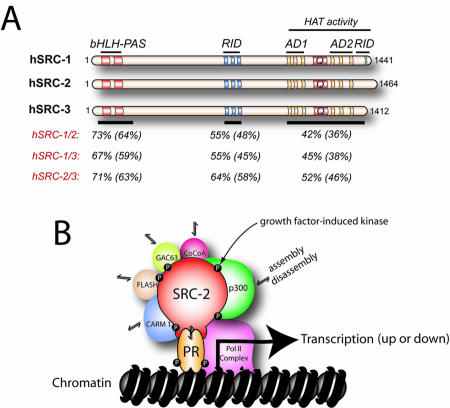
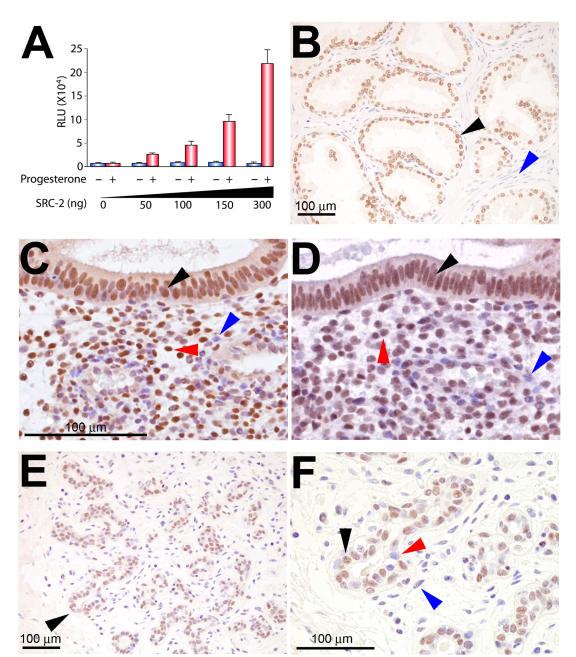
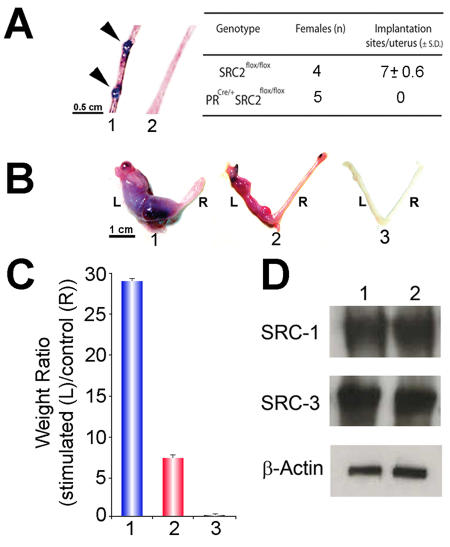
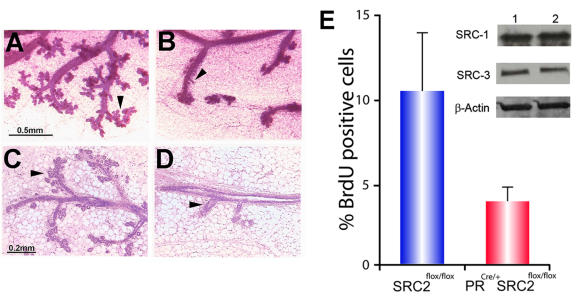
Although the importance of the progesterone receptor (PR) to female reproductive and mammary gland biology is firmly established, the coregulators selectively co-opted by PR in these systems have not been clearly delineated. A selective gene-knockout approach applied to the mouse, which abrogates gene function only in cell types that express PR, recently disclosed steroid receptor coactivator 2 (SRC-2, also known as TIF-2 or GRIP-1) to be an indispensable coregulator for uterine and mammary gland responses that require progesterone. Uterine cells positive for PR (but devoid of SRC-2) were found to be incapable of facilitating embryo implantation, a necessary first step toward the establishment of the materno-fetal interface. Importantly, such an implantation defect is not exhibited by knockouts for SRC-1 or SRC-3, underscoring the unique coregulator importance of SRC-2 in peri-implantation biology. Moreover, despite normal levels of PR, SRC-1 and SRC-3, progesterone-dependent branching morphogenesis and alveologenesis fails to occur in the murine mammary gland in the absence of SRC-2, thereby establishing a critical coregulator role for SRC-2 in signaling cascades that mediate progesterone-induced mammary epithelial proliferation. Finally, the recent detection of SRC-2 in the human endometrium and breast suggests that this coregulator may represent a new clinical target for the future management of female reproductive health and/or breast cancer.
尽管孕酮受体(PR)对女性生殖和乳腺生物学的重要性已得到充分确立,但在这些系统中被PR选择性招募的共调节因子尚未明确界定。最近,一种应用于小鼠的选择性基因敲除方法,该方法仅在表达PR的细胞类型中消除基因功能,揭示了类固醇受体共激活因子2(SRC-2,也称为TIF-2或GRIP-1)是子宫和乳腺对孕酮产生反应所必需的共调节因子。发现PR呈阳性(但缺乏SRC-2)的子宫细胞无法促进胚胎着床,而胚胎着床是建立母胎界面的必要第一步。重要的是,SRC-1或SRC-3基因敲除小鼠并未表现出这种着床缺陷,这突出了SRC-2在着床前生物学中作为独特共调节因子的重要性。此外,尽管PR、SRC-1和SRC-3水平正常,但在缺乏SRC-2的情况下,小鼠乳腺中依赖孕酮的分支形态发生和腺泡形成无法发生,从而确立了SRC-2在介导孕酮诱导的乳腺上皮增殖的信号级联反应中的关键共调节因子作用。最后,最近在人类子宫内膜和乳腺中检测到SRC-2,这表明该共调节因子可能代表未来女性生殖健康和/或乳腺癌管理的一个新的临床靶点。