Rejniak Katarzyna A, Anderson Alexander R A
Division of Mathematics, University of Dundee, Dundee, DD1 4HN, Scotland, UK.
Bull Math Biol. 2008 Apr;70(3):677-712. doi: 10.1007/s11538-007-9274-1. Epub 2008 Jan 11.
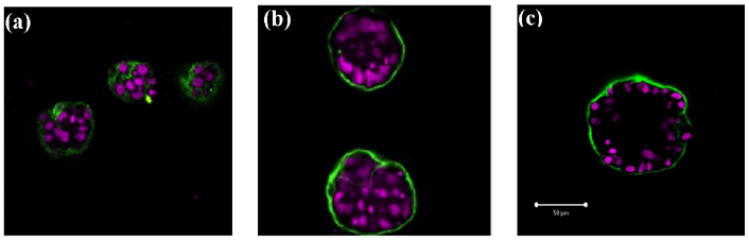
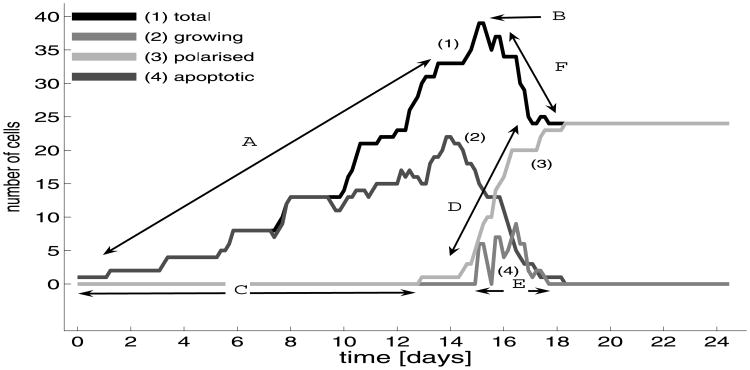
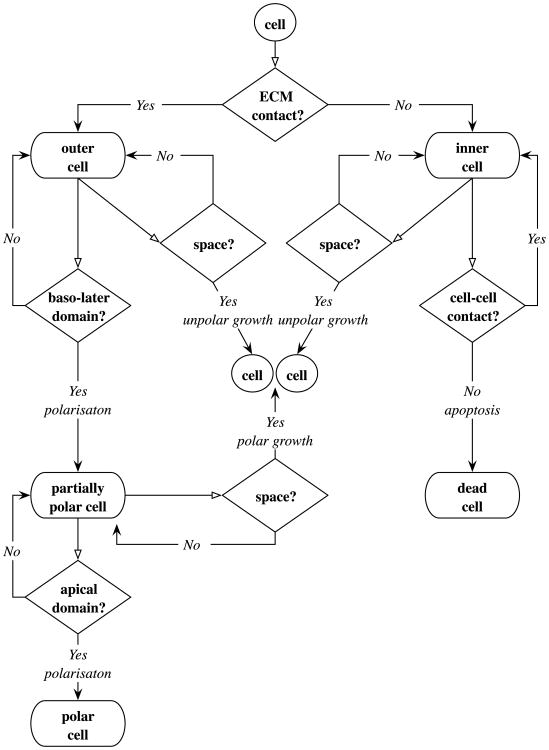
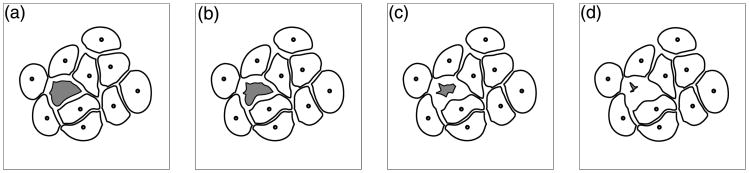
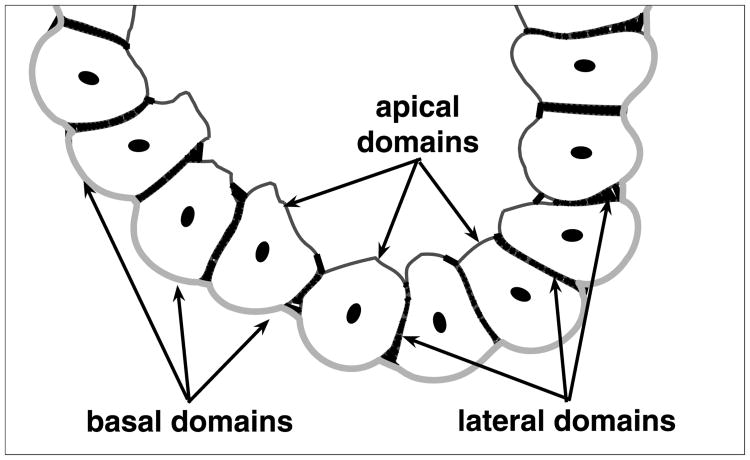
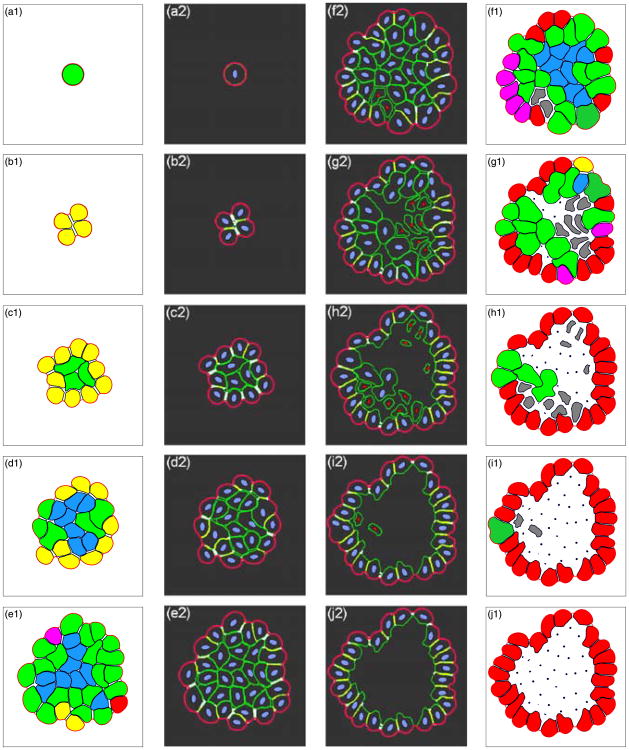
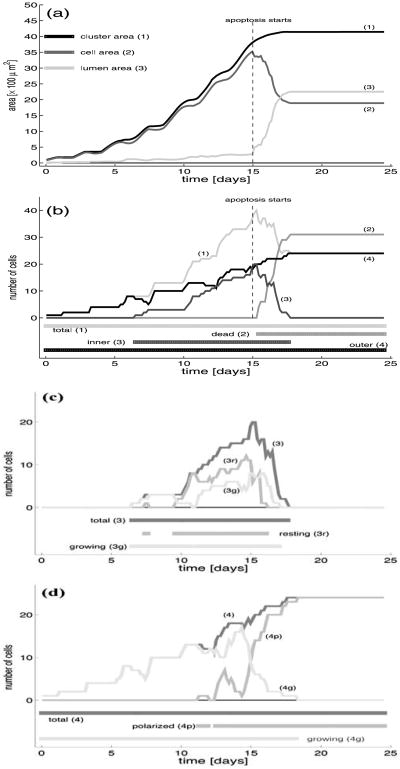
Normal hollow epithelial acini are 3-dimensional culture structures that resemble the architecture and functions of normal breast glands and lobules. This experimental model enables in vitro investigations of genotypic and molecular abnormalities associated with epithelial cancers. However, the way in which the acinar structure is formed is not yet completely understood. Gaining more information about consecutive stages of acini development-starting from a single cell that gives rise to a cluster of randomly oriented cells, followed by cell differentiation that leads to a layer of polarised cells enclosing the hollow lumen-will provide insight into the transformations of eukaryotic cells that are necessary for their successful arrangement into an epithelium. In this paper, we introduce a two-dimensional single-cell-based model representing the cross section of a typical acinus. Using this model, we investigate mechanisms that lead to the unpolarised cell growth, cell polarisation, stabilisation of the acinar structure and maintenance of the hollow lumen and discuss the sufficient conditions for each stage of acinar formation. In the follow-up paper (Rejniak and Anderson, A computational study of the development of epithelial acini. II. Necessary conditions for structure and lumen stability), we investigate what morphological changes are observable in the growing acini when some assumptions of this model are relaxed.
正常的中空上皮腺泡是三维培养结构,类似于正常乳腺腺泡和小叶的结构与功能。该实验模型能够在体外研究与上皮癌相关的基因和分子异常。然而,腺泡结构的形成方式尚未完全明确。获取更多关于腺泡发育连续阶段的信息——从单个细胞开始,形成一群随机排列的细胞,接着细胞分化形成围绕中空管腔的一层极化细胞——将有助于深入了解真核细胞成功排列成上皮组织所需的转变过程。在本文中,我们引入了一个基于二维单细胞的模型,该模型代表典型腺泡的横截面。利用这个模型,我们研究导致细胞非极化生长、细胞极化、腺泡结构稳定以及中空管腔维持的机制,并讨论腺泡形成各阶段的充分条件。在后续论文(雷尼亚克和安德森,上皮腺泡发育的计算研究。II. 结构和管腔稳定性的必要条件)中,我们研究当该模型的一些假设放宽时,生长中的腺泡会出现哪些可观察到的形态变化。