Norton Kerri-Ann, Wallace Travis, Pandey Niranjan B, Popel Aleksander S
Department of Biomedical Engineering, School of Medicine, Johns Hopkins University, Baltimore, MD, 21205, USA.
Department of Oncology and the Sidney Kimmel Comprehensive Cancer Center, School of Medicine, Johns Hopkins University, Baltimore, USA.
BMC Syst Biol. 2017 Jul 11;11(1):68. doi: 10.1186/s12918-017-0445-x.
Triple-negative breast cancer lacks estrogen, progesterone, and HER2 receptors and is thus not possible to treat with targeted therapies for these receptors. Therefore, a greater understanding of triple-negative breast cancer is necessary for the treatment of this cancer type. In previous work from our laboratory, we found that chemokine ligand-receptor CCL5-CCR5 axis is important for the metastasis of human triple-negative breast cancer cell MDA-MB-231 to the lymph nodes and lungs, in a mouse xenograft model. We collected relevant experimental data from our and other laboratories for numbers of cancer stem cells, numbers of CCR5+ cells, and cell migration rates for different breast cancer cell lines and different experimental conditions.
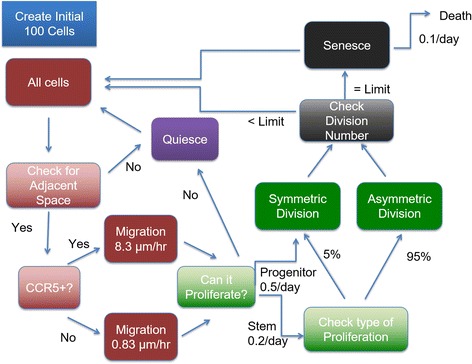
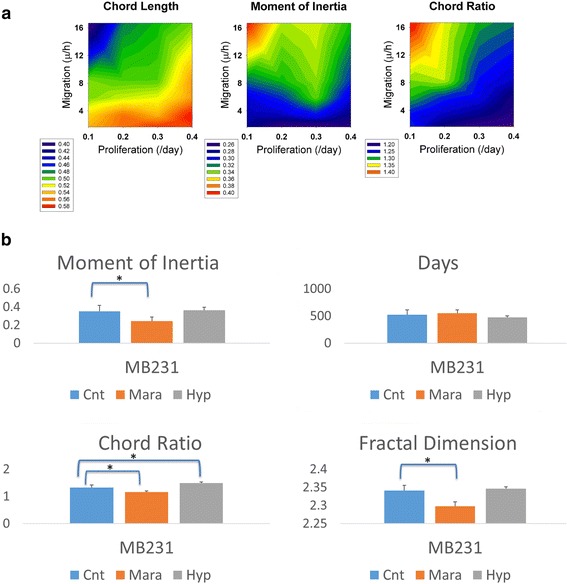
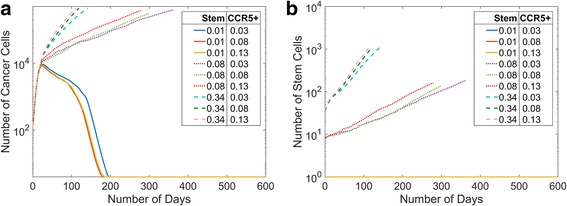
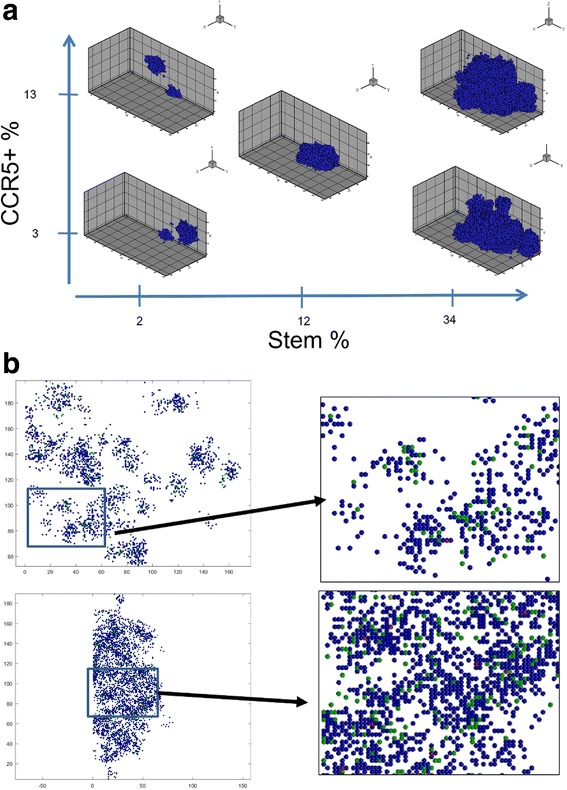
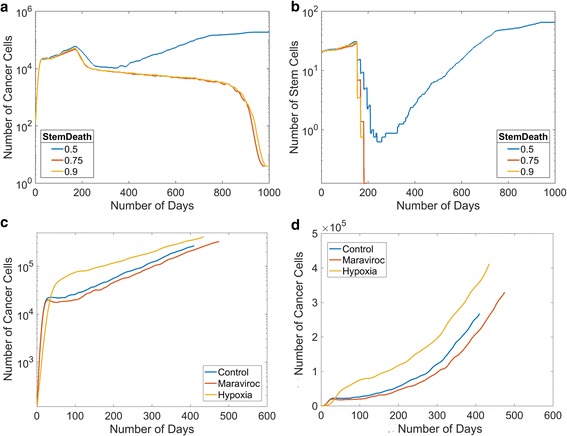
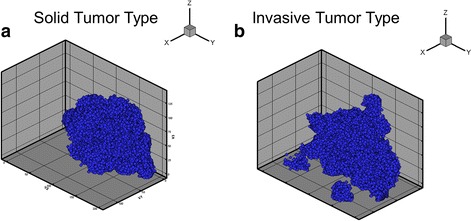
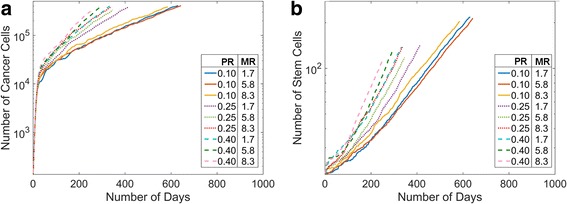
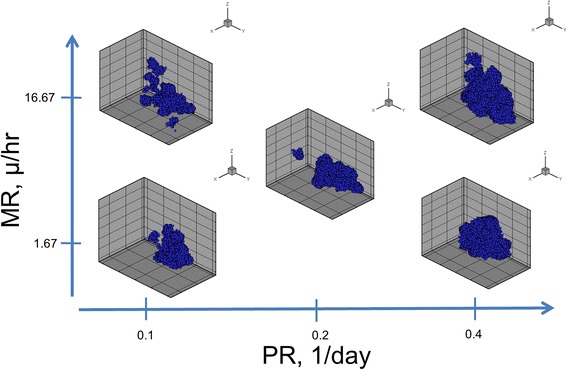
Using these experimental data we developed an in silico agent-based model of triple-negative breast cancer that considers surface receptor CCR5-high and CCR5-low cells and breast cancer stem cells, to predict the tumor growth rate and spatio-temporal distribution of cells in primary tumors. We find that high cancer stem cell percentages greatly increase tumor growth. We find that anti-stem cell treatment decreases tumor growth but may not lead to dormancy unless all stem cells get eliminated. We further find that hypoxia increases overall tumor growth and treatment with a CCR5 inhibitor maraviroc slightly decreases overall tumor growth. We also characterize 3D shapes of solid and invasive tumors using several shape metrics.
Breast cancer stem cells and CCR5+ cells affect the overall growth and morphology of breast tumors. In silico drug treatments demonstrate limited efficacy of incomplete inhibition of cancer stem cells after which tumor growth recurs, and CCR5 inhibition causes only a slight reduction in tumor growth.
三阴性乳腺癌缺乏雌激素、孕激素和HER2受体,因此无法用针对这些受体的靶向疗法进行治疗。所以,深入了解三阴性乳腺癌对于治疗这种癌症类型至关重要。在我们实验室之前的工作中,我们发现在小鼠异种移植模型中,趋化因子配体 - 受体CCL5 - CCR5轴对于人三阴性乳腺癌细胞MDA - MB - 231转移至淋巴结和肺部很重要。我们收集了来自我们实验室和其他实验室的相关实验数据,这些数据涉及不同乳腺癌细胞系以及不同实验条件下的癌症干细胞数量、CCR5 +细胞数量和细胞迁移率。
利用这些实验数据,我们开发了一种基于计算机模拟的三阴性乳腺癌模型,该模型考虑了表面受体CCR5高表达和低表达的细胞以及乳腺癌干细胞,以预测原发性肿瘤中细胞的肿瘤生长速率和时空分布。我们发现高比例的癌症干细胞会大大增加肿瘤生长。我们发现抗干细胞治疗会降低肿瘤生长,但除非所有干细胞都被消除,否则可能不会导致肿瘤休眠。我们进一步发现缺氧会增加整体肿瘤生长,而用CCR5抑制剂马拉维若进行治疗会略微降低整体肿瘤生长。我们还使用几种形状指标对实体瘤和浸润性肿瘤的三维形状进行了表征。
乳腺癌干细胞和CCR5 +细胞会影响乳腺肿瘤的整体生长和形态。计算机模拟药物治疗表明,对癌症干细胞的不完全抑制疗效有限,之后肿瘤生长会复发,并且CCR5抑制仅会使肿瘤生长略有减少。