Marchès Oliver, Covarelli Valentina, Dahan Sivan, Cougoule Céline, Bhatta Pallavi, Frankel Gad, Caron Emmanuelle
Division of Cell and Molecular Biology, Imperial College London, London SW7 2AZ, UK.
Cell Microbiol. 2008 May;10(5):1104-15. doi: 10.1111/j.1462-5822.2007.01112.x. Epub 2008 Jan 14.
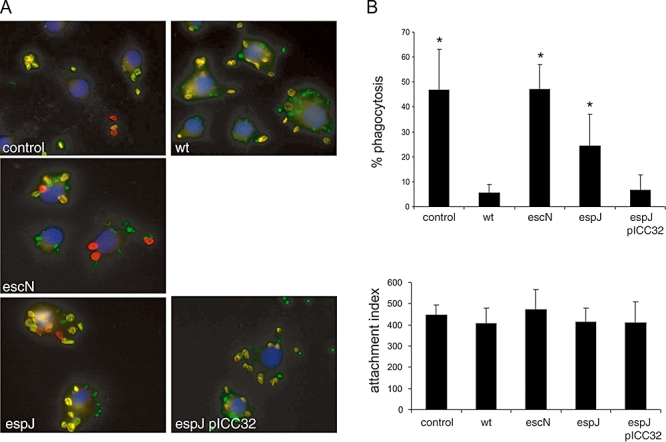
A key strategy in microbial pathogenesis is the subversion of the first line of cellular immune defences presented by professional phagocytes. Enteropathogenic and enterohaemorrhagic Escherichia coli (EPEC and EHEC respectively) remain extracellular while colonizing the gut mucosa by attaching and effacing mechanism. EPEC use the type three secretion system effector protein EspF to prevent their own uptake into macrophages. EPEC can also block in trans the internalization of IgG-opsonized particles. In this study, we show that EspJ is the type three secretion system effector protein responsible for trans-inhibition of macrophage opsono-phagocytosis by both EPEC and EHEC. While EspF plays no role in trans-inhibition of opsono-phagocytosis, espJ mutants of EPEC or EHEC are unable to block uptake of opsonized sheep red blood cells (RBC), a phenotype that is rescued upon complementation with the espJ gene. Importantly, ectopic expression of EspJ(EHEC) in phagocytes is sufficient to inhibit internalization of both IgG- and C3bi-opsonized RBC. These results suggest that EspJ targets a basic mechanism common to these two unrelated phagocytic receptors. Moreover, EspF and EspJ target independent aspects of the phagocytic function of mammalian macrophages in vitro.
微生物致病的一个关键策略是破坏专业吞噬细胞呈现的第一道细胞免疫防线。肠致病性大肠杆菌和肠出血性大肠杆菌(分别为EPEC和EHEC)通过附着和消除机制在肠道黏膜定植时仍保持在细胞外。EPEC利用三型分泌系统效应蛋白EspF来阻止自身被巨噬细胞摄取。EPEC还能在反式作用中阻断IgG调理颗粒的内化。在本研究中,我们表明EspJ是负责EPEC和EHEC对巨噬细胞调理吞噬作用进行反式抑制的三型分泌系统效应蛋白。虽然EspF在调理吞噬作用的反式抑制中不起作用,但EPEC或EHEC的espJ突变体无法阻断调理的绵羊红细胞(RBC)的摄取,这一表型在用espJ基因互补后得以挽救。重要的是,在吞噬细胞中异位表达EspJ(EHEC)足以抑制IgG和C3bi调理的RBC的内化。这些结果表明,EspJ靶向这两种不相关吞噬受体共有的基本机制。此外,EspF和EspJ在体外靶向哺乳动物巨噬细胞吞噬功能的不同方面。