Young Joanna C, Clements Abigail, Lang Alexander E, Garnett James A, Munera Diana, Arbeloa Ana, Pearson Jaclyn, Hartland Elizabeth L, Matthews Stephen J, Mousnier Aurelie, Barry David J, Way Michael, Schlosser Andreas, Aktories Klaus, Frankel Gad
MRC Centre for Molecular Bacteriology and Infection, Imperial College, SW7 2AZ London, UK.
Institute of Experimental and Clinical Pharmacology and Toxicology, University of Freiburg, D-79104 Freiburg, Germany.
Nat Commun. 2014 Dec 19;5:5887. doi: 10.1038/ncomms6887.
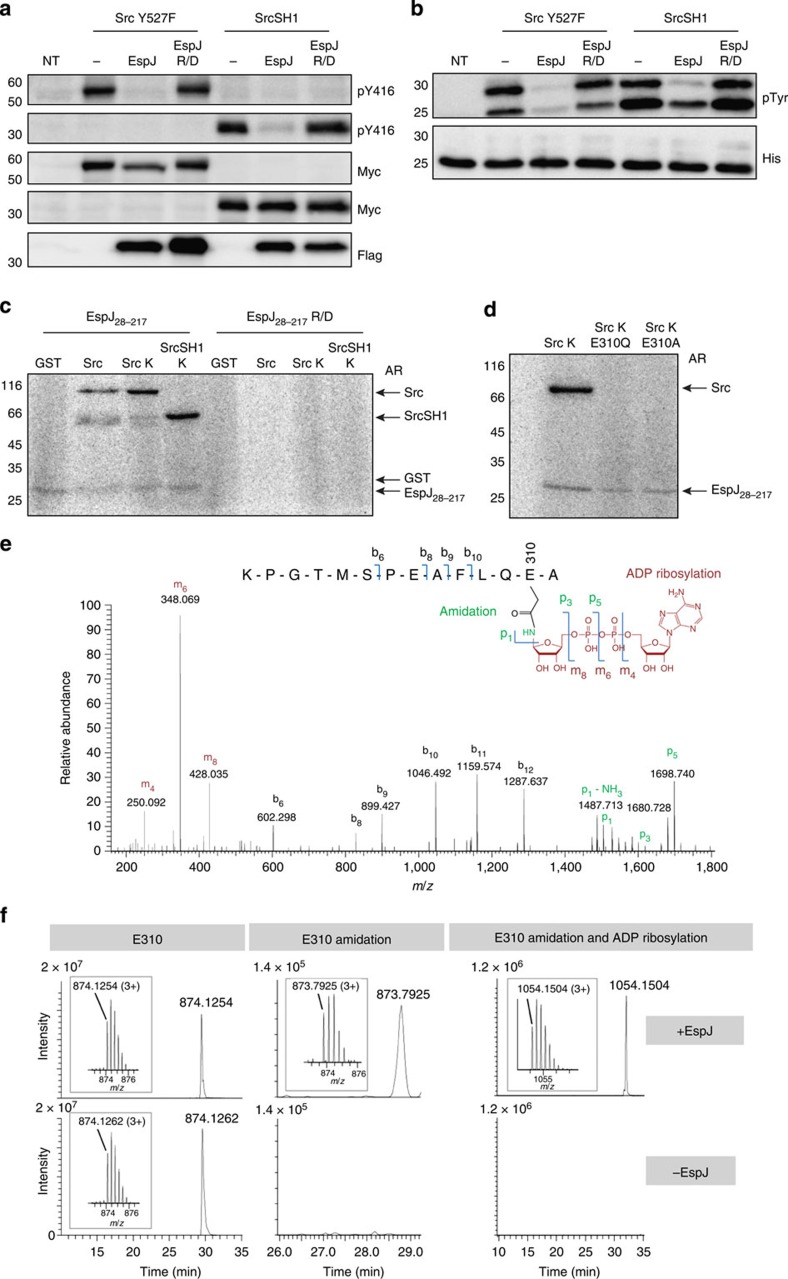
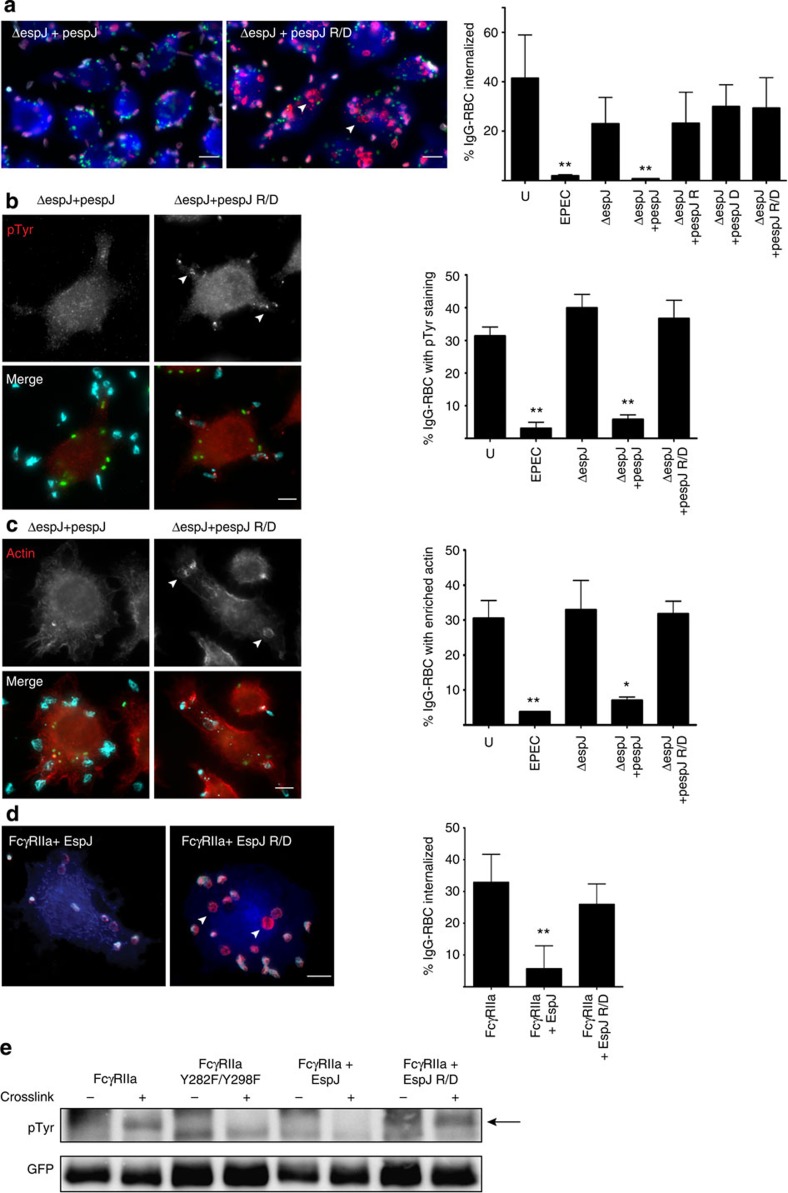
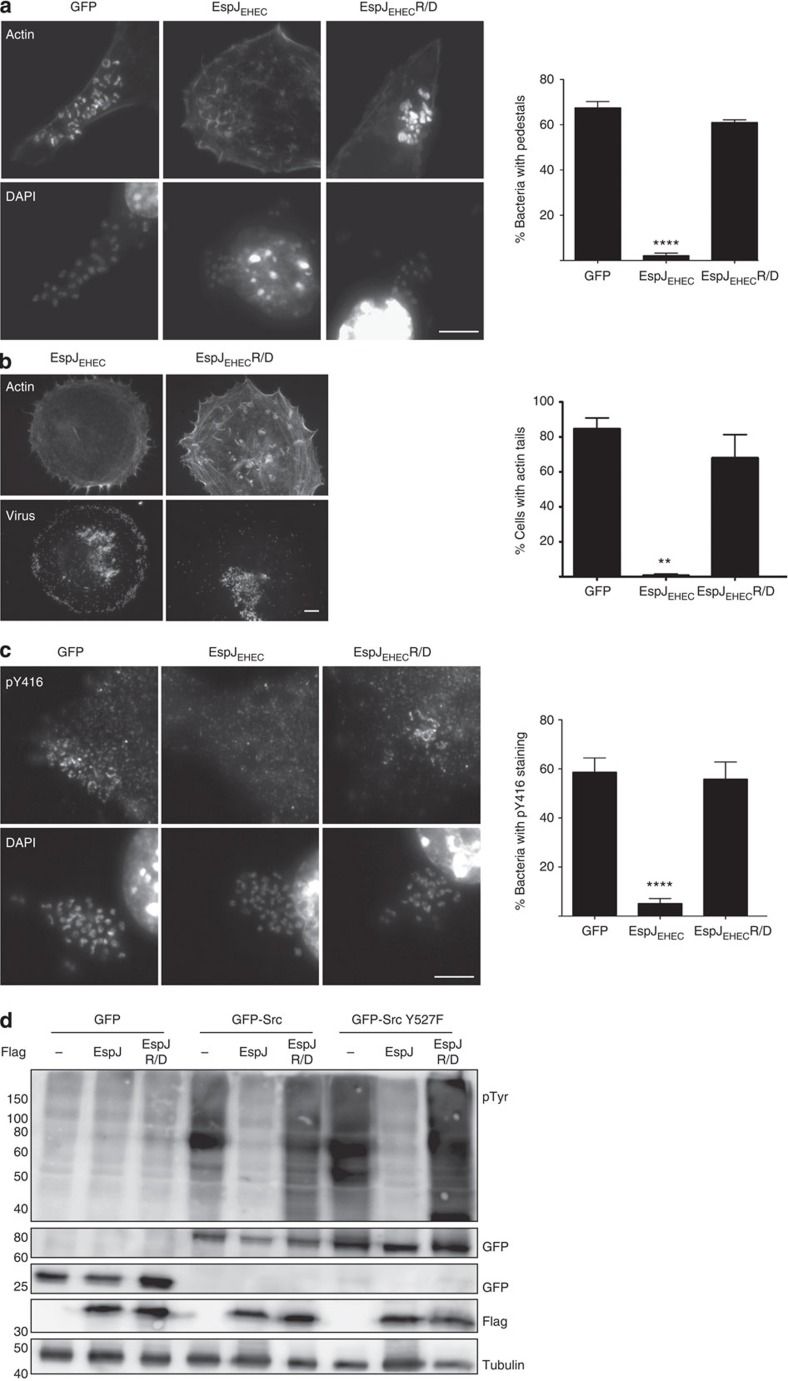
The hallmark of enteropathogenic Escherichia coli (EPEC) infection is the formation of actin-rich pedestal-like structures, which are generated following phosphorylation of the bacterial effector Tir by cellular Src and Abl family tyrosine kinases. This leads to recruitment of the Nck-WIP-N-WASP complex that triggers Arp2/3-dependent actin polymerization in the host cell. The same phosphorylation-mediated signalling network is also assembled downstream of the Vaccinia virus protein A36 and the phagocytic Fc-gamma receptor FcγRIIa. Here we report that the EPEC type-III secretion system effector EspJ inhibits autophosphorylation of Src and phosphorylation of the Src substrates Tir and FcγRIIa. Consistent with this, EspJ inhibits actin polymerization downstream of EPEC, Vaccinia virus and opsonized red blood cells. We identify EspJ as a unique adenosine diphosphate (ADP) ribosyltransferase that directly inhibits Src kinase by simultaneous amidation and ADP ribosylation of the conserved kinase-domain residue, Src E310, resulting in glutamine-ADP ribose.
肠致病性大肠杆菌(EPEC)感染的标志是形成富含肌动蛋白的基座样结构,这些结构是在细胞Src和Abl家族酪氨酸激酶对细菌效应蛋白Tir进行磷酸化后产生的。这导致Nck-WIP-N-WASP复合物的募集,该复合物触发宿主细胞中Arp2/3依赖性肌动蛋白聚合。相同的磷酸化介导的信号网络也在痘苗病毒蛋白A36和吞噬性Fc-γ受体FcγRIIa的下游组装。在这里,我们报告EPEC III型分泌系统效应蛋白EspJ抑制Src的自磷酸化以及Src底物Tir和FcγRIIa的磷酸化。与此一致的是,EspJ抑制EPEC、痘苗病毒和调理的红细胞下游的肌动蛋白聚合。我们确定EspJ是一种独特的二磷酸腺苷(ADP)核糖基转移酶,它通过对保守的激酶结构域残基Src E310同时进行酰胺化和ADP核糖基化来直接抑制Src激酶,从而产生谷氨酰胺-ADP核糖。