Sung Jinsil, Siegel Judith, Tornetta Paul, Bhandari Mohit
Department of Surgery, McMaster University, 293 Wellington Street N, Suite 110, Hamilton, Ontario, L8L 8E7, Canada.
BMC Musculoskelet Disord. 2008 Jan 29;9:14. doi: 10.1186/1471-2474-9-14.
Evidence-based medicine posits that health care research is founded upon clinically important differences in patient centered outcomes. Statistically significant differences between two treatments may not necessarily reflect a clinically important difference. We aimed to quantify the sample sizes and magnitude of treatment effects in a review of orthopaedic randomized trials with statistically significant findings.
We conducted a comprehensive search (PubMed, Cochrane) for all randomized controlled trials between 1/1/95 to 12/31/04. Eligible studies include those that focused upon orthopaedic trauma. Baseline characteristics and treatment effects were abstracted by two reviewers. Briefly, for continuous outcome measures (ie functional scores), we calculated effect sizes (mean difference/standard deviation). Dichotomous variables (ie infection, nonunion) were summarized as absolute risk differences and relative risk reductions (RRR). Effect sizes >0.80 and RRRs>50% were defined as large effects. Using regression analysis we examined the association between the total number of outcome events and treatment effect (dichotomous outcomes).
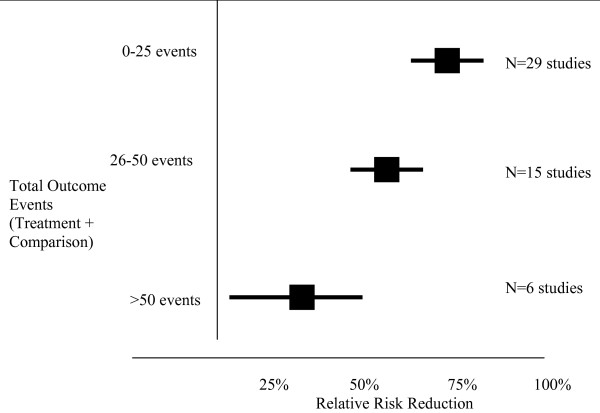
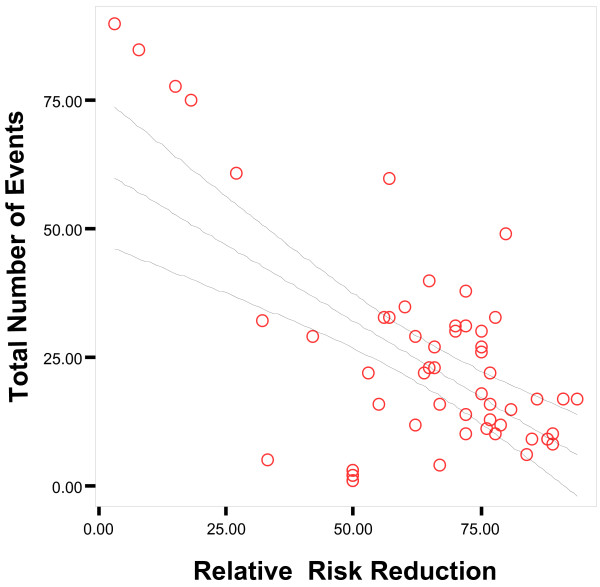
Our search yielded 433 randomized controlled trials (RCTs), of which 76 RCTs with statistically significant findings on 184 outcomes (122 continuous/62 dichotomous outcomes) met study eligibility criteria. The mean effect size across studies with continuous outcome variables was 1.7 (95% confidence interval: 1.43-1.97). For dichotomous outcomes, the mean risk difference was 30% (95%confidence interval:24%-36%) and the mean relative risk reduction was 61% (95% confidence interval: 55%-66%; range: 0%-97%). Fewer numbers of total outcome events in studies was strongly correlated with increasing magnitude of the treatment effect (Pearson's R = -0.70, p < 0.01). When adjusted for sample size, the number of outcome events revealed an independent association with the size of the treatment effect (Odds ratio = 50, 95% confidence interval: 3.0-1000, p = 0.006).
Our review suggests that statistically significant results in orthopaedic trials have the following implications-1) On average large risk reductions are reported 2) Large treatment effects (>50% relative risk reduction) are correlated with few number of total outcome events. Readers should interpret the results of such small trials with these issues in mind.
循证医学认为,医疗保健研究基于以患者为中心的结局方面具有临床重要意义的差异。两种治疗方法之间具有统计学显著性差异并不一定反映临床重要差异。我们旨在通过对具有统计学显著性结果的骨科随机试验进行综述,来量化样本量和治疗效果的大小。
我们对1995年1月1日至2004年12月31日期间的所有随机对照试验进行了全面检索(PubMed、Cochrane)。符合条件的研究包括那些专注于骨科创伤的研究。两名评审员提取了基线特征和治疗效果。简而言之,对于连续性结局指标(即功能评分),我们计算了效应量(平均差值/标准差)。二分变量(即感染、骨不连)总结为绝对风险差值和相对风险降低率(RRR)。效应量>0.80和RRR>50%被定义为大效应。我们使用回归分析研究了结局事件总数与治疗效果(二分结局)之间的关联。
我们的检索产生了433项随机对照试验(RCT),其中76项RCT在184个结局(122个连续性结局/62个二分结局)上具有统计学显著性结果,符合研究纳入标准。具有连续性结局变量的研究的平均效应量为1.7(95%置信区间:1.43 - 1.97)。对于二分结局,平均风险差值为30%(95%置信区间:24% - 36%),平均相对风险降低率为61%(95%置信区间:55% - 66%;范围:0% - 97%)。研究中结局事件总数较少与治疗效果大小增加密切相关(Pearson相关系数R = -0.70,p < 0.01)。在调整样本量后,结局事件数量显示出与治疗效果大小的独立关联(优势比 = 50,95%置信区间:3.0 - 1000,p = 0.006)。
我们的综述表明,骨科试验中具有统计学显著性的结果具有以下意义——1)平均而言,报告的风险降低幅度较大;2)大的治疗效果(相对风险降低>5%)与结局事件总数较少相关。读者在解读此类小型试验的结果时应牢记这些问题。